The department of land reform and rural development plans to shift its focus from merely transferring land to ensuring that newly redistributed farms become viable commercial operations.
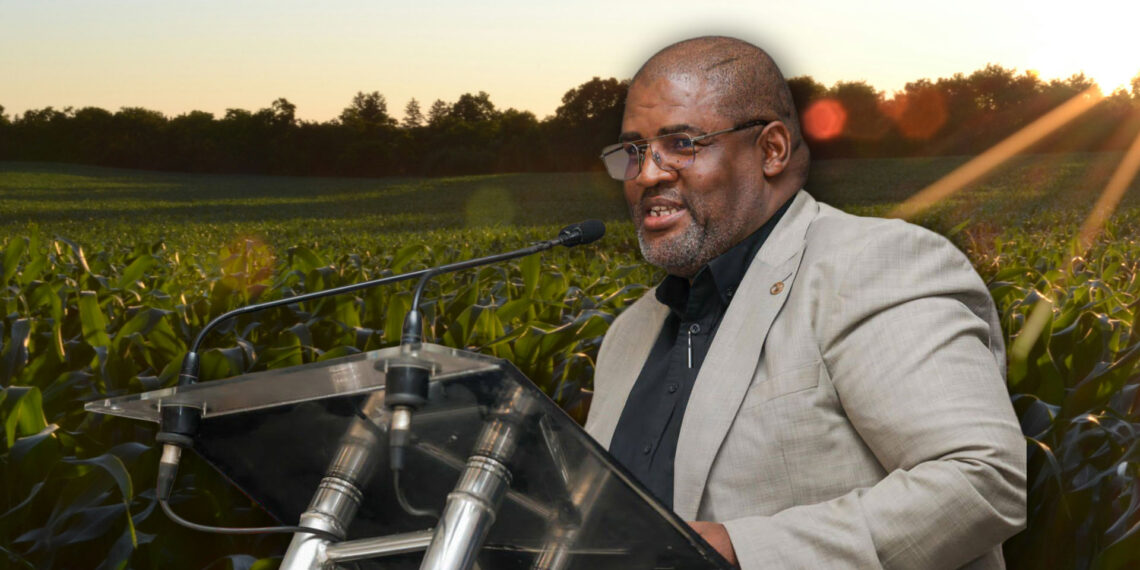
Delivering the budget address in the national assembly, minister Mzwanele Nyhontso laid out the state’s 2026/27 financial strategy to back up future land handovers with direct infrastructure and production support.
Supported by his deputy, Stanley Mathabatha, Nyhontso stated that land reform cannot successfully defeat rural underdevelopment through title deeds alone. The department intends to deploy targeted capital injections and sweeping policy overhauls to ensure that state spending translates into sustainable rural prosperity.
Reflecting on the core philosophy behind the department’s strategy, Nyhontso noted, “In this address, we focus not only on the financial resource part of our work, but also on what we are doing in the sphere of developing the necessary policy and legislative frameworks.”
Related stories
- Agriculture gets billions: 10 key budget takeaways
- VAT deadlock forces budget speech delay
- Hard-hit farmers expected more from Godongwana
- Development finance key to growing future commercial farmers
How the budget is split and spent
At the core of the department’s operational plans is a multi-billion-rand financial layout. This is how the funding is scheduled to be split and spent this financial year:
- R3.839 billion: Granted to the Commission on Restitution of Land Rights to process 307 old-order land claims and finalise 284 outstanding cases.
- R630 million: Allocated for the acquisition and allocation of an estimated 57 751 hectares of land for redistribution and tenure purposes.
- R388 million: Injected into infrastructure and production support, earmarked to back 60 selected farms through the land development support programme.
- R27.6 billion: The historical sum paid out as financial compensation to qualifying beneficiaries over the lifespan of the programme.
- R27 billion: The total historical land acquisition cost recorded by the state for the restoration of approximately 3.9 million hectares of land to beneficiaries since the inception of the restitution programme in 1995.
- R5.5 billion: Allocated historically in the form of development grants to support settled communities.
Demographic targets
During the previous reporting period under review, the department reported that it acquired approximately 53 000 hectares of land and allocated more than 35 000 hectares to qualifying individuals and communities. In line with the Cabinet-approved Beneficiary Selection and Land Allocation Policy, the department’s data shows a targeted focus on historically disadvantaged groups, with roughly 20 000 hectares allocated to women and 13 000 hectares to youth beneficiaries.
Nyhontso explained, “While this is a positive development, we recognise the need to improve further in this regard; and the department will thus continue to prioritise equitable access to land for women, youth, persons with disabilities, and other qualifying beneficiaries.”
To achieve this, the state has reviewed and amended its existing Beneficiary Selection and Allocation Policy to eliminate the strict financial and educational prerequisites that historically blocked small-scale farmers. According to the department, the new framework is designed to prioritise individuals who demonstrate clear farming potential, even if they currently operate under severe infrastructure deficits and land shortages in communal areas.
To address transparency concerns in the sector, a comprehensive national land audit is being launched under the guidance of a retired judge to establish definitive data regarding who owns what land in South Africa by race, gender, nationality, and corporate entity.
Tenure security and communal land
Beyond commercial operations, the budget vote addressed the critical issue of tenure security for farmworkers and farm dwellers. In collaboration with the Special Master on Labour Tenants, the department reported that approximately 7 000 hectares of land were acquired and transferred to more than 700 farm dwellers and labour tenants.
While 61 labour tenant matters were successfully finalised through mediation, 313 disputes, where voluntary negotiations with landowners failed, have been referred to court for a legal resolution. Additionally, the department stated that approximately 206 000 hectares of land were transferred from the state to affected communities through the implementation of the Transformation of Certain Rural Areas Act.
The department said it is also stepping up oversight to protect communal farming projects from internal failure. To address ongoing governance instability, poor financial management, and escalating tensions between traditional leaders and communal property associations (CPAs), the department had trained 821 CPA executive members in essential management and legal administration skills during the reporting period.
Looking ahead, the department is counting on legislative updates to provide rural areas with better investment certainty. Public consultations are set to begin by June this year for both the Equitable Access to Land Bill and the Communal Land Tenure and Administration Bill, aiming to establish a system where rural communities and traditional leaders are expected to manage communal land in a mutually supportive manner.
Concluding his address, Nyhontso underscored the department’s commitment to strict fiscal accountability, stating, “Although more financial resources will always be required, the department will continue implementing its mandate within the available resources, approved policy frameworks, applicable legislation, and the oversight authority of parliament.”
READ NEXT: Beating the rot below ground: How to protect your root crops