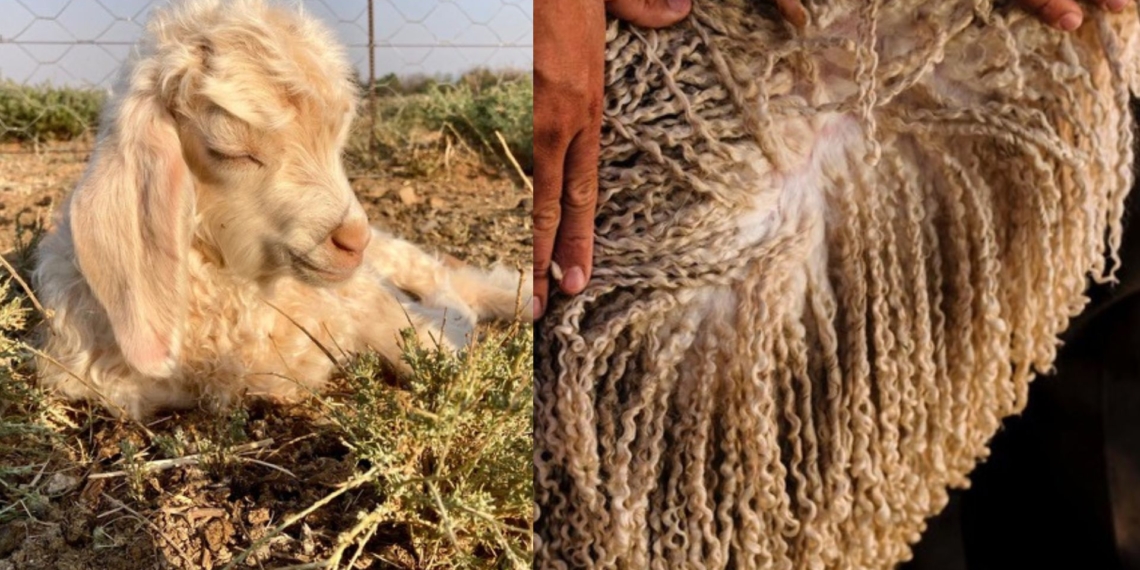
While Angora goats aren’t originally from Mzansi, they have made the Karoo a global leader in mohair. The market thrives as the goat grows.
Young hair is used to create luxury sweaters and suits, while the thicker hair from older goats is used for durable carpets and upholstery.
Mastering Angora farming could be a smart way to secure direct market access. By dealing straight with manufacturers, farmers have turned this “diamond fibre” into a world-class business.
Mastering the diamond fibre
Masixole Maswana, a production scientist at Tutimomo Agricultural Enterprise, explains that Angora goats differ from other breeds because they are single-coated, meaning all their hair follicles produce the same type of fibre.

He says these goats perform best in dry, low-humidity regions like the Karoo. To protect the hair quality, he notes that farmers must provide adequate shelter and a strict health plan to manage worms.
Maswana adds that high-protein nutrition is essential to ensure the fibre meets the strength and texture standards that drive profit. “South Africa has made substantial investments over the years to enhance these valuable characteristics.”
Weight and age are key, explains Maswana, as younger, well-nourished animals produce a higher quantity of quality hair. However, the production of high-quality mohair requires effective breeding programmes, which can be difficult for some.
“Small-scale farmers often struggle to implement well-managed breeding programmes due to communal grazing lands, where various types of goats graze together,” he says.
This puts pressure on farmers to monitor their goats to prevent crossbreeding. “Therefore, small-scale farmers must establish extremely strict breeding protocols.”
Maswana further notes that Angora goats need well-structured shelters to protect hair quality from high temperatures, which can be expensive. Without these, the quality of the mohair is adversely affected.

Related stories
- Why Kalahari Red goats are winning over SA farmers
- One goat sparked Sibonelo’s farming future in Vaalkop
- Turning goat milk into gold: Farmers tap agro-processing power
- Building a goat milk brand: The rise of Asante Saanen
How Mzansi’s mohair moves across the globe
Jonker Venter, mohair manager at OVK, tells Food For Mzansi that because mohair grows at roughly 2cm per month, goats are shorn twice a year. The process begins when raw fibre is sent to OVK, acting as a broker and central node to prepare the mohair for sale through a transparent auction system.
“Once purchased, the mohair is exported to international hubs, notably Italy, the UK, and China. Here, it undergoes scouring (cleaning), combing (creating ‘tops’), and spinning into yarn,” Venter explains.
This yarn is then integrated into luxury textiles for global fashion houses and interior design. Venter says, “OVK serves as the critical intermediary and market facilitator between the primary producer and the global textile industry.”
Their role includes providing market access, quality assurance, and farmer support. “OVK ensures that the mohair entering the market meets international standards through rigorous sampling and cataloguing while keeping RMS (Responsible Mohair Standard) practices in mind,” he adds.

The company weighs every bale and tests samples for micron and clean yield, publishing these details in an auction catalogue.
“International buyers bid on these lots. Once the hammer falls, OVK manages the financial transaction, ensuring the farmer receives payment in a secure and timely manner.”
Venter explains that quality is determined by length, fineness, style, and character. While genetics dictate lustre, nutrition and health ensure strength. Age is also a factor, as hair becomes coarser as goats age.
Venter warns that proper on-farm classing is vital, as a single coarse fleece can “contaminate” a fine lot and lower the price. He also notes that farmers face constant pressure from predators, such as jackals and caracals, alongside high input costs and market volatility.
Global trade realities
Khethiwe Mnguni, an agricultural economist at the National Agricultural Marketing Council (NAMC), explains that the global mohair industry is recovering in 2026 following a severe decline in 2020.
She says strong demand has increased prices and output, especially in the fine-micron class. As the world’s largest producer, South Africa remains a net exporter, with significant markets in Italy, China, the UK, and Tunisia.
“At least 50% of the world’s mohair is produced by at least 1 000 farmers in South Africa, including 300 smallholder farms,” Mnguni says.
She tells Food For Mzansi that these smallholders are supported by initiatives through the Mohair Empowerment Trust. Geographically, the Eastern Cape accounts for 72% of output, followed by the Western Cape at 15%.
“Through auctions held in Gqeberha in the winter and summer of each year, farmers sell their mohair to middlemen like brokers and cooperatives like the House of Fibre, OVK, BKB, and Blue Crane Wool & Mohair,” Mnguni adds.
She notes that the Stucken Group, House of Fibre, and SAMIL control over 50% of the local processing and trading industry.

Challenges for new farmers
Thabile Nkunjana, a senior agricultural economist at the NAMC, explains that the industry’s primary challenges involve accreditation, particularly for new smallholder farmers.
“The Responsible Mohair Standard (RMS) certification is required for farmers,” he says. This requires a third-party assessment of social responsibility, land management, and animal welfare.
“Although these appear straightforward in writing, they are not in reality, but the industry does offer the assistance farmers need to go past this point,” Nkunjana says.
He notes that support for smallholders is vital not only for empowerment but in sustaining the industry’s viability and boosting production of one of the world’s most sought-after fibres.


READ NEXT: Hardy goats and hard work are Njabulo’s recipe for success