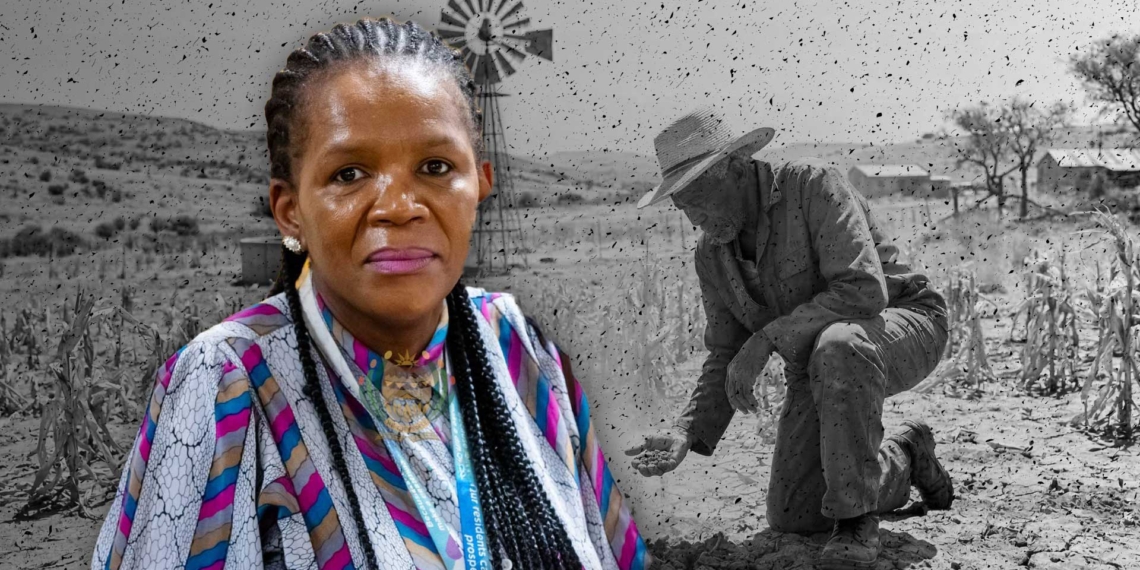
The Western Cape is at a crossroads. While agricultural export figures soar, dam levels are dropping to critical lows. Nobulumko Nkondlo, a member of the Western Cape provincial legislature, says without better planning and infrastructure, climate shocks will continue to undermine the sector’s success.
While the Western Cape continues to celebrate record agricultural export milestones, the province, alongside the Eastern and Northern Cape, has simultaneously been declared a national disaster area due to drought.
The same province that anchors South Africa’s agricultural export economy finds itself struggling to shield farmers and rural communities from increasingly severe climate shocks.
South Africa’s agricultural sector has reached unprecedented export highs, recording an impressive US$15.1 billion in agricultural exports. These figures signal resilience, global competitiveness and the sector’s growing contribution to national economic growth. According to Statistics South Africa, agricultural employment increased from 753 059 in 2018 to 770 181 in 2023.
The Western Cape alone accounts for 25.5% of total agricultural employment, underscoring the province’s central role in the country’s agricultural economy. Yet beneath these impressive statistics lies a troubling contradiction.
Dropping dam levels a concern
As a member of the Western Cape provincial parliament serving on the Portfolio Committee on Agriculture, the declaration of the drought as a national disaster must be viewed both as a necessary intervention and as a signal of deeper structural challenges. Between 2015 and 2018, the Western Cape endured the “Day Zero” water crisis, a moment that exposed the fragility of water governance and infrastructure planning.
That crisis was widely described as a wake-up call. Yet today’s drought raises serious questions about whether sufficient lessons were institutionalised and whether long-term climate resilience planning has kept pace with the growing risks.
Recent municipal data illustrate the severity of the current situation. As of mid-February 2026, the Idas Valley Dam in Stellenbosch was reported at just 30% capacity. In Beaufort West, the Gamka Dam stood at a mere 14%, placing the municipal water system under severe strain. Knysna’s Akkerkloof Dam had dropped to 19%, while the Dassieshoek and Koos Kok Dams in Langeberg were recorded at 29% and 30% respectively.
These figures are not merely statistics; they represent mounting pressure on farmers, farmworkers and small-scale agricultural operators whose livelihoods depend on reliable water access.
Related stories
- Western Cape fires destroy farmland and livelihoods
- Rapid response halts foot-and-mouth spread in Western Cape
- Western Cape on high alert after FMD reports
- Clock ticks for Tongaat Hulett as April liquidation deadline looms
My engagement with farmers across several regions of the province, including areas in the Garden Route and Central Karoo, revealed a growing concern among emerging farmers and those operating within the informal agricultural sector. Many report limited access to drought relief support and inadequate municipal interventions, such as water tankers for livestock.
The result has been livestock losses, depleted grazing land and increasing financial strain for small-scale farmers who often lack the financial buffers available to larger commercial operations.
Environmental and governance systems fall short
My concern is that the consequences of drought are rarely distributed equally. Emerging farmers, farmworkers and informal operators often bear the greatest risk, frequently without access to insurance or capital reserves. In a province celebrated for agricultural success, it is often these actors who absorb the greatest shocks when environmental and governance systems fall short.
Concerns have also been raised regarding water infrastructure maintenance and governance. In Beaufort West, for example, municipal water losses reportedly remain as high as 77%, despite the installation of approximately 2 000 water meters.
Losses of this scale point to systemic weaknesses in water management where leaks, ageing infrastructure and administrative inefficiencies compound the impact of natural water scarcity. While climate change is intensifying drought conditions, governance failures can significantly worsen their consequences.
The cost of reactive planning has been demonstrated before. During the Day Zero crisis, approximately 200 water collection points were established across Cape Town to guarantee the legally mandated minimum of 25 litres per person per day.
The estimated cost of operating the emergency system for three months was R200 million, while revenue losses reached roughly R1.4 billion as water was distributed free of charge. These figures illustrate that crisis management is often significantly more expensive than proactive infrastructure investment and long-term planning.
The pattern that emerges is clear: record agricultural exports coexist with fragile water systems, and global competitiveness sits alongside local vulnerability. If the Western Cape is to sustain its agricultural leadership, a decisive shift in planning is required. Climate resilience cannot be treated as a secondary consideration.
What needs to be done
Farming methods will increasingly need to adapt to intensifying climate variability. This includes greater investment in groundwater development, advanced irrigation technologies, expanded water storage capacity and regenerative agricultural practices.
Equally important is the maintenance and modernisation of municipal water systems to reduce losses and improve accountability. Reliable water infrastructure is not only a municipal service issue but also a critical component of agricultural sustainability and rural economic stability.
In the rollout of drought relief measures, it is also important that support mechanisms are accessible to emerging and smallholder farmers who often struggle to navigate complex application processes. Ensuring that drought relief is distributed transparently and equitably will be essential in preventing climate shocks from deepening existing inequalities within the agricultural sector.
The Western Cape now stands at a critical crossroads. Climate volatility is no longer a temporary disruption but a structural risk to the province’s agricultural economy.
Surface dams alone can no longer anchor long-term water planning. Reduced water levels translate directly into irrigation restrictions, lower yields, job insecurity for farmworkers and ultimately higher food prices.
In regions such as the Central Karoo, Garden Route and Cape Winelands, prolonged dry spells are also placing increasing pressure on groundwater resources.
For this reason, there have been repeated calls within the provincial legislature for the appointment of an independent environmental commissioner to strengthen oversight, coordination and long-term climate planning. The province now finds itself in a declared drought disaster, a stark reminder that environmental governance cannot remain fragmented or reactive.
Strengthening institutional oversight and climate planning capacity will be essential if the province is to build a more resilient agricultural system.
Ultimately, the true test of agricultural success is not measured by export figures alone. It lies in whether the system is resilient enough to withstand climate shocks while protecting the livelihoods of farmworkers, emerging farmers and rural communities who sustain the sector.
- Nobulumko Nkondlo is a member of the Western Cape provincial legislature serving in the Portfolio Committee of Agriculture, Economic Development and Tourism. The views and opinions expressed in this article are those of the author and do not necessarily reflect the views or positions of Food For Mzansi.
READ NEXT: Cape heatwave havoc: Farmers battle extreme temperatures