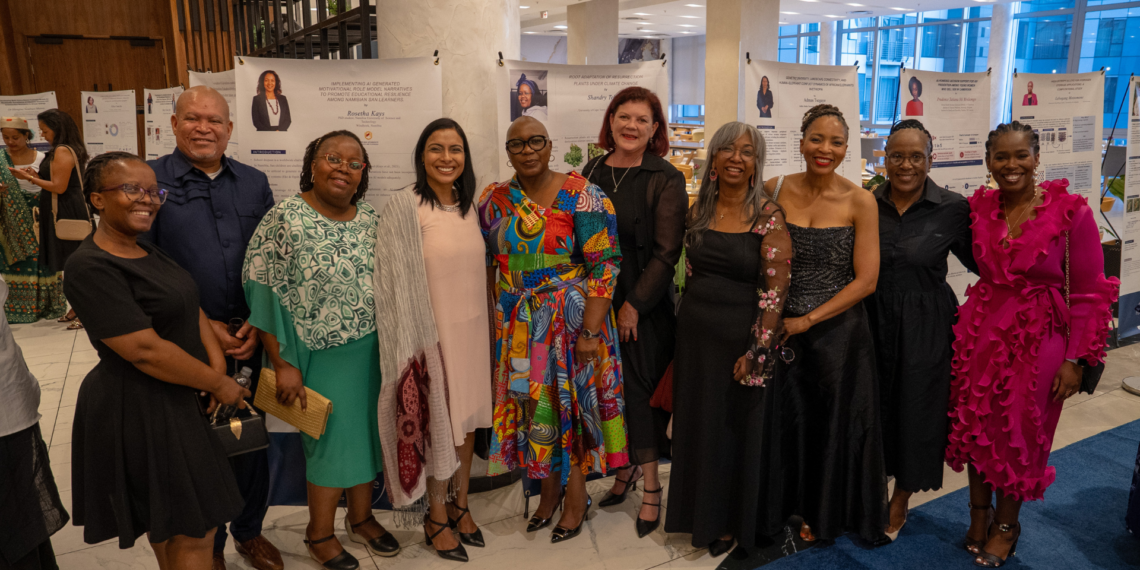
Thirty-eight women researchers from across Sub-Saharan Africa were recognised at the 2026 L’Oréal-Unesco For Women in Science Awards ceremony, held at @Sandton Hotel recently.
The 30 doctoral and eight postdoctoral researchers represent countries across Sub-Saharan Africa, including South Africa, Nigeria, Botswana, Tanzania, Guinea and Cameroon, with research spanning water, agriculture, health, technology and energy.
According to L’Oréal-Unesco, the researchers were selected from more than 1 000 applications. This year’s awardees reflect the breadth of scientific talent shaping the future, from life and environmental sciences to engineering, technology, and beyond. Their research tackles a range of scientific questions with practical implications for the regions.
Honouring the best women researchers
“Projects recognised this year include low-cost water filters made from clay and cassava peel, batteries and supercapacitors developed from agricultural waste, and artificial intelligence tools to support disease diagnosis in humans and crops. Other researchers are investigating medicinal plants for potential use against drug-resistant bacteria, monitoring tuberculosis through wastewater and studying genetic variants associated with type 2 diabetes in African populations.
“Eight South African women scientists were among this year’s awardees, with three advancing research focused on water and sanitation infrastructure, resource recovery, agricultural resilience. Their work highlights the role of scientific research in addressing critical environmental challenges and supporting more sustainable development,” L’Oréal-Unesco said in a statement.
Related stories
- Under siege: Women in farming demand action amid rising violence
- Soul to Soil: Women urged to claim every corner of agriculture
- Women trailblazers honoured for driving change in SA farming
- Silent burden: Women farmers open up about mental health
Nonjabulo Mbhele from the University of Cape Town is examining how municipal water and sanitation infrastructure is managed throughout its lifecycle, from planning and construction to operation, maintenance and renewal.
“Her research focuses on developing performance measures that can help identify weaknesses in infrastructure systems and support more reliable water and sanitation services,” L’Oréal-Unesco said.
In a different application of wastewater research, Nikita Singh is exploring how wastewater treatment can go beyond cleaning water to recover valuable resources from the process. Her research investigates a 240-litre airlift raceway system combining duckweed and microalgae, examining how the organisms interact within the reactor and their potential to support wastewater treatment and resource recovery for future biofuel production.
The research explores opportunities to make more effective use of water and biological materials while supporting more sustainable production systems.
Finding sustainable solutions
Singh wants wastewater treatment to do two jobs: clean water and recover something valuable from the process. Her research explores whether what is usually treated as waste could instead become a resource for more sustainable production. She is investigating a 240-litre airlift raceway system that brings together duckweed and microalgae.
Moving from water management to agricultural resilience, Shandry Tebele from the University of Cape Town is investigating how resurrection plants survive extreme water loss, focusing on the relationship between their roots and the microorganisms living around them.
“Her research examines how these interactions contribute to drought tolerance, with the aim of generating insights that could help improve crops’ ability to withstand water scarcity and environmental stress.
“Together, their research explores opportunities to improve water management, recover resources and strengthen agricultural resilience, contributing to broader efforts to address environmental challenges and support more sustainable development,” L’Oréal-Unesco said.
Shaping the future of science
In Sub-Saharan Africa, women make up 33.6% of researchers, based on 2022 data. The figures differ across countries: 47.6% in South Africa (2022), 30.6% in Nigeria (2019), 26.1% in Ghana (2015), and 9.8% in Guinea (2013).
The challenges also extend into the workplace. An Ipsos study conducted for Foundation L’Oréal, involving researchers across 117 countries, found that 81% of women scientists had personally experienced sexism during their careers, while 49% had experienced sexual harassment.
Award recipients receive a grant of €10 000 if they are PhD candidates or €15 000 if they are postdoctoral researchers, along with training in leadership, science communication, and career development.
Michelle Gololo, corporate affairs and engagement lead at L’Oréal Sub-Saharan Africa, said, “Visibility is part of the answer. When African women’s research is seen, funded and cited, it changes who gets to lead and who believes they can.
“Our responsibility is to sustain that visibility beyond this ceremony, so these 38 women and the young women who follow them can shape the future of science.”
READ NEXT: Six hard-earned lessons from black-owned wine brands