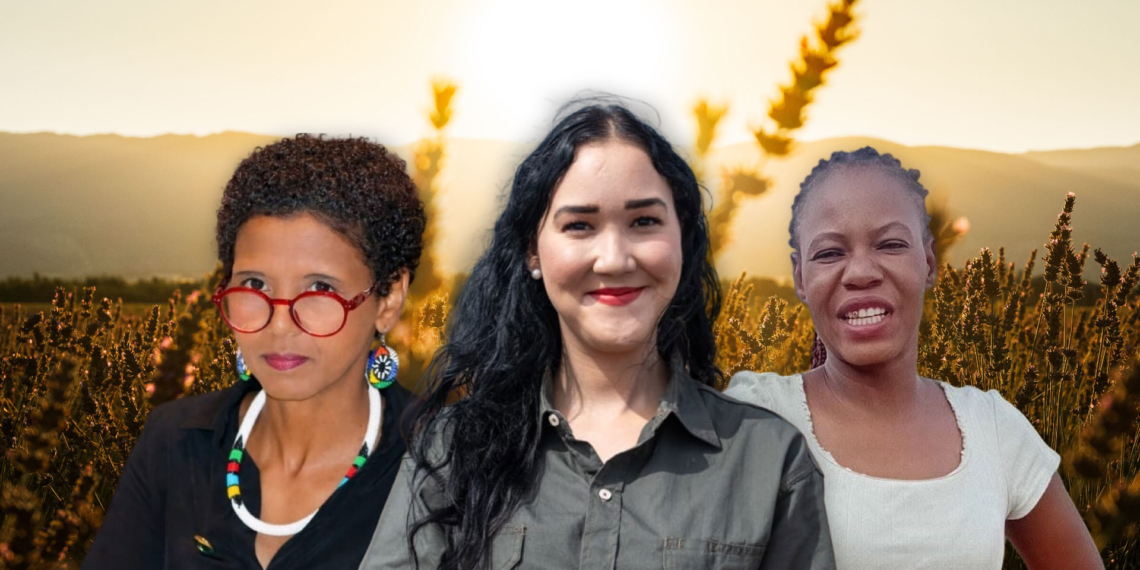
As the country commemorates Women’s Day, female farmers and activists have stated that their working conditions at times take a toll on them, which affects their well-being and mental health.
Food For Mzansi caught up with Elize Gerda Beukes, the founder of G&E Beukes Boerdery, just 15 km outside Keimoes in the Northern Cape. She said working in a male-dominated space in her province has really challenged her; however, she remains resilient.
“At auctions, I’ve noticed buyers direct questions to men standing nearby instead of me, even when I’m the one who owns the livestock. Early on, that constant need to prove myself took a real toll. I’d leave some of those interactions feeling smaller, more anxious, doubting decisions I actually knew were sound.
“Over time, though, I have learned to manage that mentally rather than let it wear me down. I remind myself that competence isn’t something I need anyone else to confirm; my results speak for themselves,” she said.
Navigating the pressure to succeed
Beukes said financial strain adds another layer: accessing credit or support can be slower for women. She added that safety is also something she thinks about constantly, such as checking fences alone, driving to remote camps, and being aware of stock theft.
She noted that low-level vigilance is its own quiet mental load that many men in this industry simply don’t carry the same way.
Related stories
- EC women-led co-op turns communal land into retail success
- Women farmers call for inclusive growth and development
- Backing women farmers can boost Africa’s agrifood systems
- New agriculture chair targets FMD, governance, oversight
Rebaone Alecia Paul, a livestock and crop farmer in Ganyesa, North West, said it is tiring for women having to constantly prove their ability to lead, and it can be emotionally exhausting and reduce confidence.
“Many women farmers work in remote areas where access to mental health services, farmer networks, and support groups is limited. This can increase loneliness and make it difficult to share challenges.
“Women who lead farms or agricultural businesses may experience pressure to succeed while also meeting expectations as caregivers, mothers, wives, or community members,” she explained.
Paul emphasised that supporting women farmers’ mental health requires recognising that their challenges are not only agricultural but also social and emotional.
“Providing access to resources, mentorship, farmer networks, and mental health support can help women farmers thrive while strengthening South Africa’s agricultural sector,” she said.
Challenges take a toll on mental health
An independent consultant working in the agricultural industry, Emerentia Patientia, said any woman worker overall carries multiple roles and this can be very stressful.
“If we think of a female farmer: she needs to run the business – and not just run it, but run it profitably. Apart from all the hard work of running a farm successfully, she still has to care for her family.
“Criminal activities can be very scary for a woman and may cause anxiety and stress. If she does not have a partner to support her, it can take its toll on her; the pressure becomes heavier and increases the financial stress,” Patientia explained.
According to Patientia, in today’s life there are also still a lot of stereotypical challenges to deal with where women are being perceived as less capable than men, especially when it comes to farming roles that are normally associated with men.
“As a result, women most of the time have to do the work with fewer resources and support systems. That leads to higher levels of anxiety and exhaustion.
“Females still experience less access to land ownership, funding, training, and decision-making. That creates constant uncertainty. One would think after all the years things would be better – it’s improved, but huge challenges still remain,” she added.
Start with self-care
Beukes shared what has helped her through the challenges: “What has genuinely protected my mental health through all of this is community. Women farmers around me have started checking in on each other more intentionally, sharing what’s worked, warning each other about risks, and just asking, ‘How are you holding up?’
“I have also had to learn practical self-care: setting small boundaries around rest, talking to someone when things feel too heavy, and not treating exhaustion as something to just push through silently,” she said.
READ NEXT: Table grape industry faces ‘new normal’ in climate crisis