Saturday, September 5, 2026
SUBSCRIBE
22 GLOBAL MEDIA AWARDS
Food For Mzansi
  • News
  • Changemakers
  • Lifestyle
  • Farmer’s Inside Track
  • Food for Thought
No Result
View All Result
  • News
  • Changemakers
  • Lifestyle
  • Farmer’s Inside Track
  • Food for Thought
No Result
View All Result
Food For Mzansi
No Result
View All Result
in Farmer's Inside Track, Weird & Wonderful

‘Help! There’s a snake on my farm’

by Dona Van Eeden
22nd February 2021
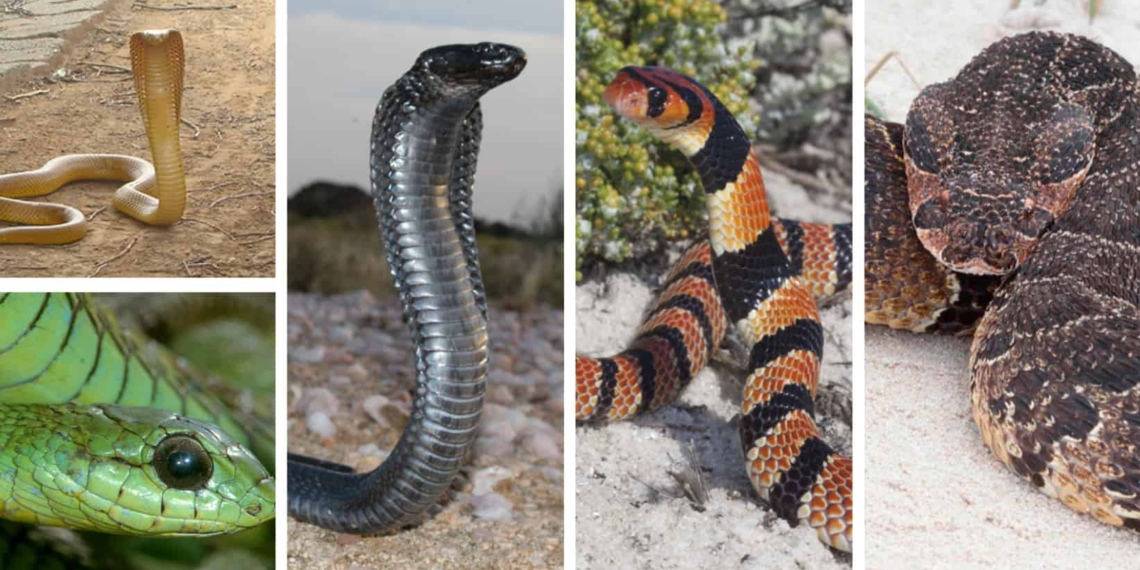
Most snakes pose no threat to humans. For instance, only five of the 55 snake species found in the Northern Cape are considered dangerous. They are (from left)  Cape Cobra (top), Boomslang (bottom), Black Spitting Cobra, Cape Coral Snake and Puff Adder. Photo's: African Snake Bite Institution

Most snakes pose no threat to humans. For instance, only five of the 55 snake species found in the Northern Cape are considered dangerous. They are (from left) Cape Cobra (top), Boomslang (bottom), Black Spitting Cobra, Cape Coral Snake and Puff Adder. Photo's: African Snake Bite Institution

Share on FacebookShare on TwitterShare on WhatsApp
farmers podcast

Last week we shared the astounding story of Durban snake catcher Nick Evans, Mzansi’s own Steve Irwin, as the adjudicator in a python vs. goat battle. (No jokes, go check it out.)

Evans pointed out that it’s not helpful when our go-to reaction is to kill all snakes on our land. Snakes, after all, play valuable roles in their ecosystems, keeping pests under control. In many cases they won’t cause any harm to humans.  

Evans started the KwaZulu-Natal Amphibian & Reptile Conservation in 2015 and joined Food For Mzansi to answer all your snake-related questions. He gives tips on how farmers should be handling snakes on their farms. 

Dona van Eeden: So, Nick, as a snake catcher, what would you say is the main reason people resort to killing snakes they encounter on their farms? 
Snake rescuer Nick Evans says pythons are not venomous, but they have rows of sharp teeth, which can certainly inflict a painful bite. A bit he clearly isn't scared of... Photo: Supplied/KwaZulu-Natal Amphibian & Reptile Conservation
Snake rescuer Nick Evans says pythons are not venomous, but they have rows of sharp teeth, which can certainly inflict a painful bite. A bite he clearly isn’t scared of… Photo: Supplied/KwaZulu-Natal Amphibian & Reptile Conservation

Nick Evans: People kill snakes because they don’t understand them, and because of that they are scared them. The more you learn about snakes the less you fear them. Obviously some people have true phobias, but there will be less fear when you understand them. 

One of the best ways to change that is to be educated, and to educate yourself about snakes. If you see snake presentation events or snake parks near you, go there. Learn about them. There are also many resources on Google. 

Are there more sustainable ways of keeping snakes off your property? 

Unfortunately, you can’t really ensure in any way that snakes won’t come onto your property. It’s very difficult on farms especially, since that is snake habitat. There will always be snakes, you can’t keep them away. 

There are specific plants and chemicals people plant and use to keep them away, but those are all myths. 

So, if there are no ways to keep snakes off your farm, what should farmers do when they encounter these animals? 

If it’s a harmless snake you can leave it alone or sweep it away with a broom. For venomous snakes, it would be best not to approach them and to call a snake catcher. There is a website, African Snake Bite Institute, that has a list of snake removers across the country that you can contact.  

There is also an app, the ASI app, that is free and gives you a nationwide list of snake removers so that you can call someone to safely and sustainably remove the snake. 

Look, this snake is perfectly sized for social distancing during a pandemic! Nick Evans (right) caught this four-metre python on a farm in Camperdown, KwaZulu-Natal. He was assisted by Tyrone Marcus. Photo: Supplied/KwaZulu-Natal Amphibian & Reptile Conservation
Why shouldn’t farmers just kill the snake when they encounter it? 

Killing snakes is dangerous. A snake doesn’t come to your house to attack you, they are just there for shelter or food. Rats and lizards attract them, they don’t have the intention of killing you when you encounter them. But once you want to kill a snake and attack it, it will fight for its life and spit or bite, which is dangerous. 

Some people even use a gun to try and shoot snakes, and one guy tried to shoot a mamba and ended up shooting himself in the foot in Limpopo. You don’t want to be firing off a shotgun in your home just for a snake that might not even pose a threat. 

I don’t think I would know the difference between venomous and non-venomous snakes. So, where can I get info on that to educate myself? 

If you can learn to identify different snakes, that would be the best. Search for a list of venomous snakes that occur in your area and learn how to identify them first. There are also sometimes workshops on snake identification and snake handling that you can attend. 

Another option is joining the snake identification group on Facebook, Snakes of SA, and you can post a photo of the snake you see to get help from someone in the group to identify it. 

We’re big fans of People’s Weather on DStv channel 180. If you’re channel hopping, be sure to check out “Snake Season”, a riveting series of live snake rescues featuring Nick Evans. Photo: KwaZulu-Natal Amphibian & Reptile Conservation

Dona Van Eeden

Dona van Eeden is a budding writer and journalist, starting her career as an intern at Food for Mzansi. Furnished with a deep love and understanding of environmental systems and sustainable development, she aims to make the world a better place however she can. In her free time you can find her with her nose in a book or wandering on a mountain, looking at the world through her camera's viewfinder.

Tags: Nick EvansSnake seasonsustainable farming methods
News

Aucamp outlines strategy for biosecurity, trade, and infrastructure

by Tiisetso Manoko
2nd September 2026

In an exclusive interview with Food For Mzansi, agriculture minister Willie Aucamp outlines his vision to accelerate the AAMP, tackle...

Read moreDetails
Tobias Doyer, CEO of Grain SA. Photo: Supplied/Grain SA Facebook

Rising costs, climate risk push Swartland wheat farmers to the brink

2nd September 2026
Sick spuds: No need to panic as SA’s potatoes are banned in Zim

Potato turning point ahead as onions double in price year-on-year

1st September 2026
Early calf care: Key growth targets every cattle farmer must track

Early calf care: Key growth targets every cattle farmer must track

1st September 2026

How to align your farming cycles with long-term financial success

1st September 2026

This week’s agri events: 31 August – 03 September

Early calf care: Key growth targets every cattle farmer must track

Mamelodi farmers learn how to test soil with just a bottle and spade

Water rights alone won’t fix inequality in SA commercial farming

Government hikes sugar import price, but industry warns of gap

Join Food For Mzansi's WhatsApp channel for the latest updates!

JOIN NOW!
Next Post
African agriculture: Agriculture is one sector that’s no stranger to adverse external factors presenting risk that threatens business continuity. However, Covid-19 has had a severe knock-out effect on many up-and-coming farmers. Photo: Supplied/Getty Images 

Beyond hope: A farmer battles Covid-19 odds

THE NEW FACE OF SOUTH AFRICAN AGRICULTURE

With 21 global awards in the first six years of its existence, Food For Mzansi is much more than an agriculture publication. It is a movement, unashamedly saluting the unsung heroes of South African agriculture. We believe in the power of agriculture to promote nation building and social cohesion by telling stories that are often overlooked by broader society.

Honoured roots: A father’s legacy, a daughter’s farming dream

Gauteng farmers urged to harness massive urban market

Foot-and-mouth crisis hits SA dairy industry with R1-billion loss

Tough times, hardy cattle: Why Mzansi farmers are choosing Nguni

Dragon fruit thrives in KZN valley despite tough national season

Government hikes sugar import price, but industry warns of gap

  • Awards & Global Impact
  • Our Story
  • Contact Us
  • Cookie Policy
  • Privacy Policy
  • Copyright

Contact us
Office: +27 21 879 1824
News: info@foodformzansi.co.za
Advertising: sales@foodformzansi.co.za

Contact us
Office: +27 21 879 1824
News: info@foodformzansi.co.za
Advertising: sales@foodformzansi.co.za

  • Awards & Global Impact
  • Our Story
  • Contact Us
  • Cookie Policy
  • Privacy Policy
  • Copyright

Chat Options

I'm Lerato, your AI assistant!
No Result
View All Result
  • News
  • Changemakers
  • Lifestyle
  • Farmer’s Inside Track
  • Food for Thought

Copyright © 2024 Food for Mzansi

This website uses cookies. By continuing to use this website you are giving consent to cookies being used. Visit our Privacy and Cookie Policy.