Wednesday, May 6, 2026
SUBSCRIBE
21 GLOBAL MEDIA AWARDS
Food For Mzansi
  • News
  • Changemakers
  • Lifestyle
  • Farmer’s Inside Track
  • Food for Thought
No Result
View All Result
  • News
  • Changemakers
  • Lifestyle
  • Farmer’s Inside Track
  • Food for Thought
No Result
View All Result
Food For Mzansi
No Result
View All Result
in News

MSc graduate turns mushroom waste into poultry gold

North-West University graduate Dineo Majoang has found a sustainable solution for poultry farming. Her MSc research discovered that a 2% inclusion of oyster mushroom by-product in feed significantly enhances egg, meat, and bone quality while combating toxic aflatoxins

by Lisakanya Venna
22nd November 2025
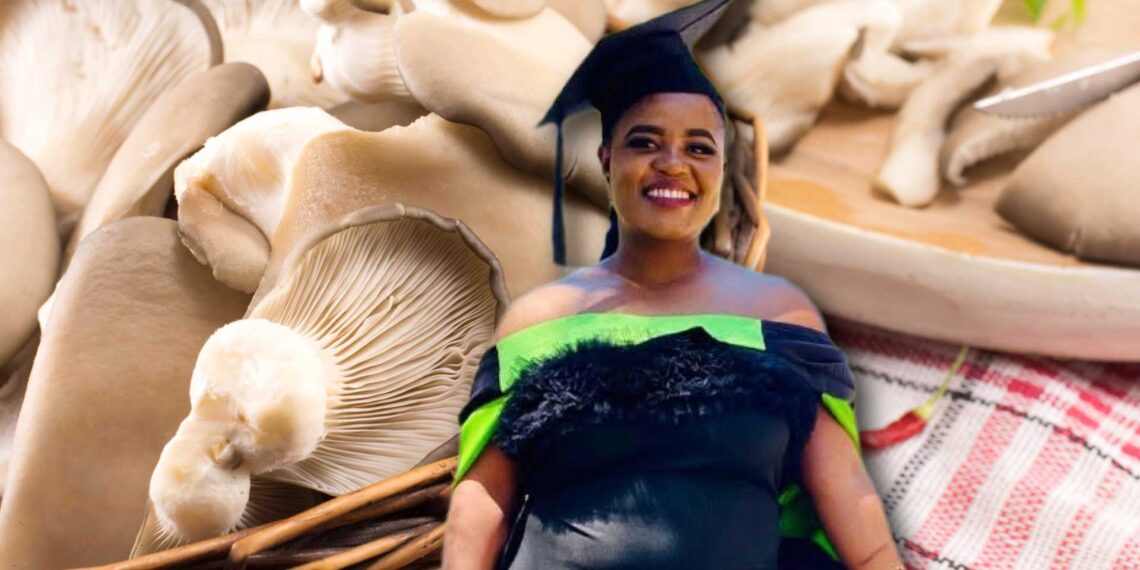
From rural roots to groundbreaking research, Dineo Majoang’s journey exemplifies innovation in animal science and sustainable farming. Photo: Supplied / Food For Mzansi

From rural roots to groundbreaking research, Dineo Majoang’s journey exemplifies innovation in animal science and sustainable farming. Photo: Supplied / Food For Mzansi

Share on FacebookShare on TwitterShare on WhatsApp

Dineo Majoang’s journey from a childhood spent watching her grandparents farm in the Free State to completing an MSc in animal science at North-West University is a story rooted in both tradition and innovation. Her dissertation explored the potential use of a by-product from oyster mushroom cultivation as a poultry feed additive to mitigate the adverse effects of aflatoxins.

Majoang’s research revealed that while high levels of organic mushroom substrate in feed worsened some physiological effects, a modest 2% inclusion actually enhanced egg, meat, and bone quality.

This finding opens the door to affordable, environmentally friendly poultry feed alternatives that could help rural farmers improve productivity and reduce costs.

Food For Mzansi caught up with Majoang as she reflected on her journey, combining early lessons from her grandparents with scientific research to create affordable, sustainable poultry feed solutions aimed at helping rural farmers reduce costs and improve productivity.

📢 Stand Up, Be Seen, Be Counted

We want to provide you with the most valuable, relevant information possible. Please take a few minutes to complete this short, confidential survey about your farming practices and challenges. Your feedback helps us tailor our coverage to better support the future of agriculture across Mzansi.

What is your main commodity farmed?
CAPTCHA image

This helps us prevent spam, thank you.

FARMER POLL

📢 Which bank is powering your farming journey?

Tell us which bank you use so we can better advocate for the specialised financial tools and accessible capital needed to help South African farmers overcome growth barriers and thrive!

All submissions are kept strictly confidential. 

Lisakanya Venna: What inspired you to explore the use of mushroom by-products in poultry feed, and how exactly does it help reduce aflatoxins?

Dineo Majoang: There are millions of people, particularly in rural areas, who are malnourished, and eggs, as a cheaper source of protein relatively expensive red meat can cater for that. In southern Africa, the production and health of layers and the quality of their products are threatened by the proliferation of mycotoxigenic fungal metabolites, particularly aflatoxin, in major dietary ingredients such as maize and oilseed cakes. 

Hence, there was a need for new solutions to combat aflatoxicosis in birds. My study looked at how adding oyster mushroom spent substrate (OMSS) to poultry feed could help reduce the toxic effects of aflatoxin.

At the same time, the cultivation of oyster mushrooms (Pleurotus ostreatus) has increased tremendously throughout the world because of their ability to grow at a wide range of temperatures and utilise various agro-based residues.


Related stories
  • Mastering poultry feed: Tips to maximise efficiency
  • Poultry farmers: A guide to selling to abattoirs
  • Young Limpopo scientist unlocks peperboom’s healing power
  • Indigenous crops: The climate-smart superfoods we need

⁠Can you explain the science behind how mushroom by-products mitigate aflatoxin contamination in poultry?

Oyster mushrooms have special enzymes that can break down tough plant materials as well as harmful toxins like aflatoxins. These enzymes work by changing the chemical structure of the aflatoxins, making them less harmful.

They do this by opening up the toxic molecules and turning them into safer compounds that are easier to remove or neutralise. This natural process helps reduce dangerous toxins in food and animal feed.

Oyster mushrooms fuel Daniels’s dream for community growth

What potential impact could this innovation have on the poultry industry in South Africa and beyond?

This innovation could have several positive impacts on the poultry industry in South Africa and beyond. Improved layer health and productivity can result from reducing aflatoxicosis using spent mushroom substrate, leading to better egg production, improved egg and meat quality, and lower mortality rates. 

It also enhances food safety by lowering aflatoxin residues in eggs and poultry products, which reduces health risks for consumers.

Economically, reducing losses caused by aflatoxicosis can increase profitability for poultry farmers and the industry as a whole. Additionally, spent mushroom substrate is a sustainable, readily available, and eco-friendly alternative to synthetic feed additives.

How does this research contribute to sustainable agriculture and food waste reduction?

The use of OMSS in poultry feed promotes sustainable agriculture by repurposing a waste product from mushroom cultivation into a valuable feed additive. This reduces waste disposal issues and environmental impact, while also cutting feed costs by partially replacing traditional ingredients.

OMSS supports a circular economy approach by turning waste into a useful resource and helps reduce mycotoxin contamination in feed, promoting a safer, healthier food system.

Additionally, OMSS contributes to food waste reduction by creating value-added poultry products, such as eggs and meat, which can fetch premium prices and encourage sustainable farming. It repurposes agricultural by-products from mushroom cultivation, including compost and various organic residues, and minimises environmental harm by diverting waste from landfills or other disposal methods.

READ NEXT: Joburg Market empowers small-scale farmers with market training

Sign-up for the latest agricultural news delivered straight to your inbox every day with Mzansi Today!

Lisakanya Venna

Lisakanya Venna is a junior journalist and content coordinator with varied multimedia experience. As a CPUT journalism alumni, she finds fulfilment in sharing impactful stories and serving as a reliable source of information.

Tags: Animal feedCommercialising farmerInform memushroomspoultry industry
News

Heading to Nampo? Join these free farm talks!

by Staff Reporter
4th May 2026

Food For Mzansi’s popular lunchtime conversations return to Nampo Harvest Day at stand H10b with a full programme of free,...

Read moreDetails
How irrigation automation benefits farms of all sizes

How irrigation automation benefits farms of all sizes

4th May 2026
Simemo Nkosi grows family farm into diversified enterprise

Simemo Nkosi grows family farm into diversified enterprise

4th May 2026
How Middle East tensions are reshaping SA agriculture in 2026

How Middle East tensions are reshaping SA agriculture in 2026

4th May 2026
Cheers to 366 years of South African winemaking excellence!

This week’s agri events: 04 – 08 May

4th May 2026

Mpondoland’s soil-to-pharmacy vision takes root

How Middle East tensions are reshaping SA agriculture in 2026

Citrus sector enters uncertain season as trade shifts reshape markets

Land restitution leads, but reform still lacks

Heading to Nampo? Join these free farm talks!

Join Food For Mzansi's WhatsApp channel for the latest updates!

JOIN NOW!
Next Post

How to read the label on a pesticide product

THE NEW FACE OF SOUTH AFRICAN AGRICULTURE

With 21 global awards in the first six years of its existence, Food For Mzansi is much more than an agriculture publication. It is a movement, unashamedly saluting the unsung heroes of South African agriculture. We believe in the power of agriculture to promote nation building and social cohesion by telling stories that are often overlooked by broader society.

Citrus sector enters uncertain season as trade shifts reshape markets

Start small, grow big: Tap into Mzansi’s mushroom market

SA and Brazil unite to tackle foot-and-mouth disease crisis

Goss’s Wilt: What to look for and what to do

Massive fuel price hikes hit SA despite extended levy relief

Mpondoland’s soil-to-pharmacy vision takes root

  • Awards & Global Impact
  • Our Story
  • Contact Us
  • Cookie Policy
  • Privacy Policy
  • Copyright

Contact us
Office: +27 21 879 1824
News: info@foodformzansi.co.za
Advertising: sales@foodformzansi.co.za

Contact us
Office: +27 21 879 1824
News: info@foodformzansi.co.za
Advertising: sales@foodformzansi.co.za

  • Awards & Global Impact
  • Our Story
  • Contact Us
  • Cookie Policy
  • Privacy Policy
  • Copyright
No Result
View All Result
  • News
  • Changemakers
  • Lifestyle
  • Farmer’s Inside Track
  • Food for Thought

Copyright © 2024 Food for Mzansi

This website uses cookies. By continuing to use this website you are giving consent to cookies being used. Visit our Privacy and Cookie Policy.