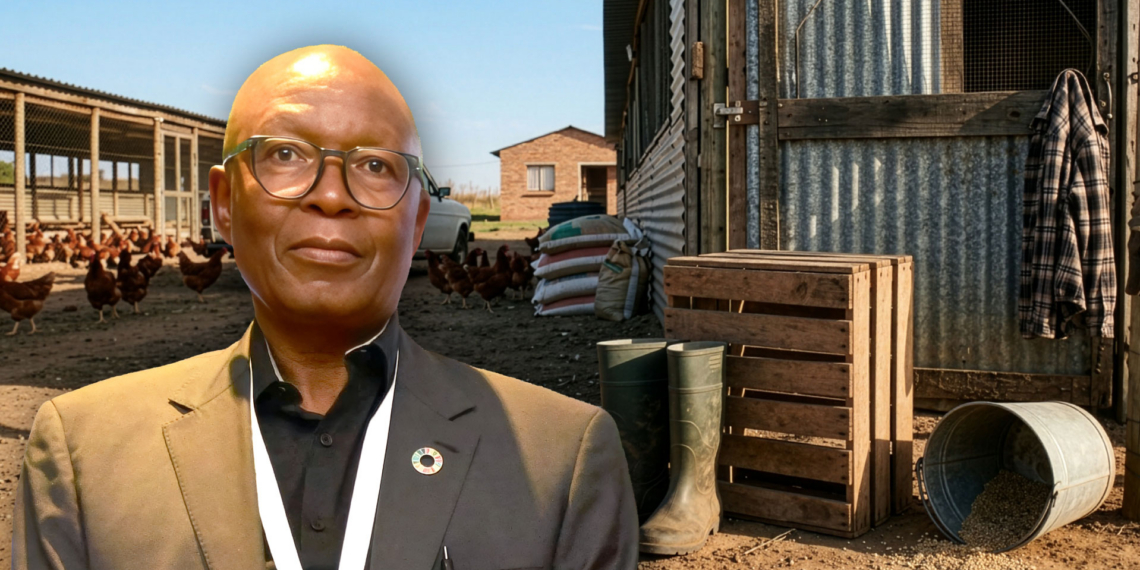
To truly transform Southern Africa’s poultry value chain, the industry must look beyond basic micro-projects. Sacau CEO Ishmael Sunga makes a compelling case for empowering young entrepreneurs to lead medium-scale enterprises.
Southern Africa’s poultry sector stands at a strategic crossroads. It can continue to expand at the margins by adding more micro and small producers into an already crowded survivalist space, while the most profitable parts of the value chain remain concentrated in the hands of a few large integrated firms. Or it can make a bolder choice: deliberately build the missing middle.
The missing middle is a new generation of professionalised, medium-scale enterprises led by young women and men who can turn local demand into ownership, production into decent jobs, and poultry into a serious engine of inclusive industrialisation.
The poultry value chain does not only need more producers; it needs a stronger enterprise class between small production and large integrated companies. This is the “missing middle”: the underdeveloped space where medium-scale, commercially disciplined businesses should be operating, growing, supplying formal markets and creating decent jobs.
If this space remains empty, the sector will remain structurally divided between informal survivalist activity and large firms that dominate feed, production, processing, distribution and market access.
The missing middle is not simply a funding problem. It is a structural gap in ownership, infrastructure, management capacity, market access, commercial opportunity, biosecurity readiness, bargaining power and supply-chain influence.
Many promising poultry value-chain operators are too advanced for micro-enterprise support, but not yet strong enough to win large commercial contracts, access affordable finance, comply consistently with formal standards or negotiate effectively with major buyers. Without deliberate support, they remain trapped below scale, and the industry continues to reproduce exclusion.
Related stories
- Bold policy can turn poultry feed cost crisis into youth agribusiness
- Poultry value chains: Driving rural economic growth in SA
- Why SA’s poultry industry needs a new integration model now
- How to bridge the ‘missing middle’ in agri-finance
1. The advocacy proposition: Build the missing middle deliberately
Poultry is one of the most practical places to build this missing middle because demand is strong, production cycles are relatively short, and opportunities exist across the entire value chain.
Medium-scale enterprises led by young women and men can operate in broiler and egg production, feed distribution, hatcheries, day-old chick supply, veterinary services, housing construction, slaughtering, cold storage, transport, packaging, aggregation, branding and market distribution. The opportunity is therefore not limited to farming; it extends to every link that makes the poultry economy work.
Building this layer is not charity; it is an economic necessity. Medium-scale poultry enterprises can create more jobs than fragmented micro-projects, remain more locally rooted than large corporations, and respond more flexibly to regional, peri-urban, township and institutional markets. They can turn young people from programme participants into employers, asset owners, service providers, aggregators and suppliers to formal markets.
Just as importantly, they can act as a pull factor for micro and small-scale operators by creating structured demand, aggregation channels, service networks and market discipline.
2. Why young women and men must lead this agenda
Young women and men should be at the centre of this strategy because they represent the next generation of enterprise leadership. They are more likely to adopt digital tools and AI, maintain records, use mobile payments, market products online, organise through platforms or clusters, and experiment with new business models.
Women entrepreneurs, already active in food trading and community supply networks, are especially well positioned to build reliable customer relationships, manage distribution and strengthen household and community food security.
This new generation can also drive the professionalisation of the poultry value chain. Many young women and men bring higher-level aptitudes needed to navigate the complexity of modern value-chain systems: digital literacy, systems thinking, adaptability, data interpretation, networking, innovation and problem-solving across production, finance, logistics and markets.
With access to modern tools, technical knowledge and global exposure, they can raise standards, improve productivity, strengthen biosecurity, use evidence to make better business decisions, and build enterprises with regional and global ambition.
If young entrepreneurs are left at a survivalist level, they will remain dependent on grants, exposed to market shocks and unable to reshape the structure of the industry. But if they are deliberately supported to become medium-scale operators, they can form the bridge between informal production, smallholder participation and large agribusiness systems.
This is where enterprise development becomes transformative: it builds businesses that can employ, invest, supply, comply, compete and grow.
3. Professionalisation is the foundation of bankability
Professionalisation must be treated as the backbone of developing the missing middle. Small and emerging poultry enterprises cannot compete, scale or supply formal markets if they remain trapped in informal practices, weak record-keeping, inconsistent production standards and limited compliance with food safety, animal health and buyer requirements. Professionalisation is therefore not a soft add-on; it is the discipline that turns promising operators into bankable, investable and contract-ready businesses.
This requires strong business governance, production planning, financial controls, traceability, biosecurity protocols, quality assurance, contract management, customer service and digital systems for records, payments, logistics and market intelligence.
It also calls for recognised training, attachments, mentorship, coaching and certification pathways that de-risk young women and men and give them the credibility to access finance, meet procurement standards, negotiate with buyers and move confidently into higher-value parts of the poultry value chain.
In practical terms, professionalisation means building enterprises that can produce to specification, price accurately, honour contracts, manage disease risk, maintain reliable records, meet delivery schedules and continuously improve performance. Without this foundation, finance becomes risky, markets remain inaccessible, and enterprise support produces dependency rather than competitiveness.
4. What must be built around the missing middle
To occupy the missing middle, young entrepreneurs need more than motivation and training. They need an enabling enterprise-development platform that combines policy support, blended finance, shared infrastructure, technical assistance, professionalisation systems and guaranteed or structured market access.
The following priorities should guide development-sector programming, public policy and private investment:
- Establish youth- and women-led medium-scale poultry enterprise clusters linked to hatcheries, abattoirs, cold rooms, feed depots and logistics hubs. • Provide staged finance that grows with the business, moving entrepreneurs from start-up and expansion support to working capital, asset finance and commercial credit.
- Negotiate off-take agreements with retailers, public institutions, wholesalers, processors and food-service companies so that enterprises can grow against real demand.
- Build strong management systems in production efficiency, animal health, financial control, compliance, labour management, quality assurance and contract delivery.
- Open opportunities across the full value chain so that young entrepreneurs can own businesses in services, logistics, processing, inputs and marketing, not only primary production.
5. Stakeholder-specific actions
- Policy makers and regulators: Recognise medium-scale poultry enterprise development as an industrialisation and employment priority; reduce barriers to formalisation; strengthen biosecurity and food-safety systems; and align youth, agriculture, SME and industrial policy instruments.
- Development-sector actors: Move from short-term project support to integrated enterprise-building platforms that combine incubation, coaching, certification, infrastructure access, market linkage and performance-based graduation.
- Development finance institutions and commercial financiers: Create blended finance windows, credit guarantees, working-capital facilities and asset-finance products linked to verified business performance, off-take agreements and professionalisation milestones.
- Industry players, retailers and processors: Use supplier-development programmes, off-take contracts, technical assistance and local sourcing commitments to integrate youth- and women-led medium-scale enterprises into formal value chains.
- Producer organisations and training institutions: Build pipelines of capable young entrepreneurs through mentorship, peer learning, attachments, certification, business coaching and practical exposure to commercially viable poultry models.
6. A call to action: Make the missing middle a measure of transformation
The missing middle should be treated as a deliberate development frontier for the poultry industry. Government, industry, development finance institutions, retailers, producer organisations, training institutions and development partners should work together to create a new generation of medium-scale enterprises led by young women and men.
Doing away with the missing middle should become a critical indicator of successful industry transformation: proof that the sector is no longer trapped between survivalist activity and concentrated large-scale ownership, but is building a broader, more inclusive and competitive enterprise base.
The choice is clear
Either the missing middle remains empty, and the industry continues to reproduce exclusion, or it is intentionally filled with capable, ambitious and well-supported medium-scale enterprises.
These enterprises can meet commercial standards while creating local jobs, broadening ownership, strengthening food security and giving young women and men a real stake in the future of a modern poultry economy that is data-driven, science-based, ICT-enabled and globally ambitious.
Future-proofing poultry in Southern Africa therefore means future-proofing enterprise ownership – and that begins by building the missing middle.
- The views and opinions expressed in this article are those of the author and do not necessarily reflect the views or positions of Food For Mzansi.
READ NEXT: Langa urban garden feeds crèche, community to drive food justice