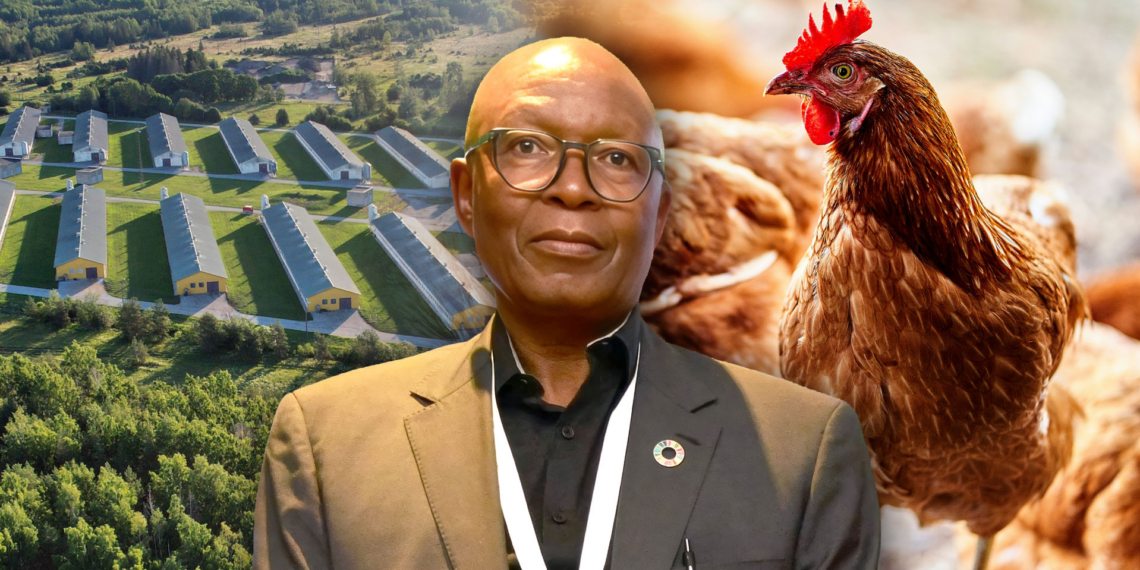
Meaningful transformation in southern Africa’s poultry industry will require more than general support for emerging farmers, writes Sacau CEO Ishmael Sunga. It calls for structured bilateral engagement with large poultry producers and supplier brands to identify the fiscal, monetary and political-risk inducements that would make SME inclusion commercially rational.
Southern Africa should ask large suppliers what inducements would make real SME inclusion commercially rational, then design the safeguards to make it work.
Southern Africa talks a great deal about transforming agriculture. Few sectors illustrate both the promise and the difficulty of that ambition as sharply as poultry. Chicken is not a luxury product; it is the region’s most widely accessible animal protein, a major contributor to food security, jobs and agro-industrial activity. Yet the small and medium producers who should be part of this growth story remain trapped on the margins of formal value chains.
The usual answer is to call for more support for emerging farmers. That is necessary, but it is no longer sufficient. The harder question is this: what would it take for large poultry producers and supplier brands to deliberately open parts of their systems to credible small and medium enterprises – not as charity, not as public relations, but as commercially rational partners in a transformed poultry economy?
That is the conversation southern Africa now needs. National and regional poultry development efforts have rightly emphasised expanding local production, driving demand, supporting trade, strengthening regulation and deepening transformation. These are not minor ambitions. But the next frontier is harder: turning transformation from a policy aspiration into an operating model inside the value chain.
Why do small-scale producers fail?
The poultry value chain is demanding. It requires reliable feed, day-old chicks, veterinary discipline, biosecurity, electricity, working capital, processing access, cold chains, quality assurance and predictable routes to market. Many SMEs do not fail because they lack ambition; they fail because they are asked to compete in a system whose infrastructure, standards and market channels are already controlled by established players.
This is precisely why large suppliers matter. They already have brands, logistics, technical systems, processing capacity and market relationships. If those capabilities can be used to anchor contract growing, input supply, shared infrastructure, technical mentorship and preferential procurement, emerging producers could move from the periphery into real commercial participation.
But government and development partners should resist the temptation to design the incentive package in a boardroom and then sell it to industry. The smarter approach is to ask producers directly: what fiscal and monetary inducements would make meaningful participation credible, sufficient and administratively workable?
Related stories
- Transformation: ‘Integrate black farmers across entire value chain’
- SA poultry industry calls for urgent bird flu vaccine rollout
- Govt and industry unite for phase 2 of Poultry Master Plan
- Poultry farming: Tips to manage unpredictable weather patterns
Structured inducements: What will shift big industry behaviour?
That question should be put through structured bilateral inquiries with large producers and supplier brands. It should ask what would actually shift behaviour: tax allowances for verified enterprise development investment; accelerated depreciation for shared infrastructure used by SMEs; VAT or duty relief on approved production and biosecurity technologies; concessional finance; interest-rate subsidies; partial credit guarantees; first-loss facilities; working-capital windows; matching grants; or production-cycle finance linked to off-take agreements.
The point is not to give big companies a blank cheque. Quite the opposite. The inducements should be earned, verified and time-bound. They should be tied to measurable supplier commitments: the number of SMEs supported, volumes procured, infrastructure made available, technical services provided, jobs created, biosecurity standards met and production outcomes achieved.
Political de-risking as a real business asset
There is another inducement that deserves more honest attention: political de-risking. Large poultry companies operate in a politically sensitive sector. They face public pressure around prices, imports, jobs, transformation, food security and market concentration. By visibly supporting credible SME integration, they can build reputational capital, strengthen their social licence, improve trust with government and communities, and position themselves as partners in national development rather than targets of suspicion.
That political de-risking capital is not soft or sentimental. It has real business value. It can reduce adversarial policy pressure, improve the quality of engagement with government, and create a more stable environment for investment. In a sector exposed to disease outbreaks, trade disputes, import pressure, consumer affordability concerns and transformation expectations, stability is not a luxury – it is an asset.
Of course, inducements carry risks. Poorly designed fiscal benefits can leak. Subsidies can distort markets. Administrative complexity can kill good intentions. Larger suppliers can capture benefits without genuinely changing outcomes for SMEs. These risks are real, but they are not arguments for doing nothing. They are arguments for better design.
Safeguards and practical pilot compacts
The safeguards are not mysterious. Incentives should be linked to audited expenditure and independently verified SME benefits. They should include sunset clauses, co-investment requirements, transparent reporting, clear eligibility rules and simple administrative processes. Support should decline over time as commercial relationships mature. Contracts between large suppliers and SMEs should be transparent, fair and supported by grievance mechanisms.
What is needed now is not another grand plan. It is a disciplined consultation process that starts with the right question: what would make large suppliers participate meaningfully, and what safeguards would make that participation serve the public interest?
The bilateral inquiries should be direct and practical. Would suppliers support contract-growing models? What infrastructure could be shared? What risks would they not carry without public or development finance support? What inducements would change the internal business case? What conditions would prevent abuse? What would make SMEs bankable? What would constitute a fair return for public support?
If the answers show sufficient appetite, southern Africa can then move to a carefully designed pilot. If they do not, policymakers will at least have learned something important: which inducements are unrealistic, which risks are overstated, and where the real bottlenecks lie.
The poultry sector does not need transformation rhetoric that collapses at the farm gate. It needs practical compacts that align commercial incentives with national development goals. Large suppliers should be challenged to say what it would take. Government and financiers should be ready to listen – and equally ready to insist on accountability.
The prize is worth pursuing: a poultry industry that grows local production, protects jobs, widens ownership, supports emerging producers and strengthens food security. But that will not happen by wishful thinking. It will happen when the people who control the systems are brought into a serious negotiation about what they can contribute, what they need in return, and how the public interest will be protected.
That conversation should begin now.
- The views and opinions expressed in this article are those of the author and do not necessarily reflect the views or positions of Food For Mzansi.
READ NEXT: 15 000 jobs shed: Why the SA agri sector is feeling the pinch