Sunday, October 11, 2026
SUBSCRIBE
22 GLOBAL MEDIA AWARDS
Food For Mzansi
  • News
  • Changemakers
  • Lifestyle
  • Farmer’s Inside Track
  • Food for Thought
No Result
View All Result
  • News
  • Changemakers
  • Lifestyle
  • Farmer’s Inside Track
  • Food for Thought
No Result
View All Result
Food For Mzansi
No Result
View All Result
in AgriCareers

Eastern Cape scientist is breeding a better future for farmers

Raised in Ngqushwa, Eastern Cape, Masixole Maswana turned early farming lessons into a career in animal genetics. Now pursuing a PhD, he helps farmers improve livestock productivity, reduce costs, and build sustainable systems

by Vateka Halile
2nd April 2026
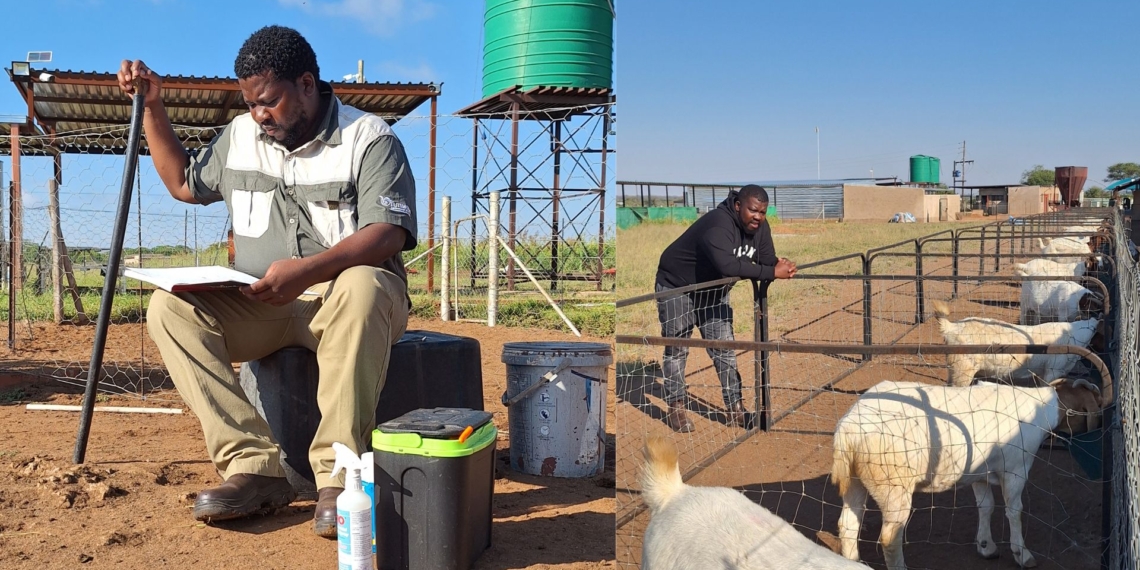
For Masixole Maswana, studying animal science was a natural step, growing up in a family devoted to farming and animal health. Photos: Supplied/Food For Mzansi

For Masixole Maswana, studying animal science was a natural step, growing up in a family devoted to farming and animal health. Photos: Supplied/Food For Mzansi

Share on FacebookShare on TwitterShare on WhatsApp

Masixole Maswana from Ngqushwa in the Eastern Cape grew up under the guidance of his grandfather, a farmer and wool producer. While other children played, his days were filled with early mornings, practical skills in the garden, and the strict values his grandfather lived by. Those lessons shaped the man he would grow into. 

Yet, Maswana once imagined a very different future, picturing himself in a white coat, helping bring life into the world as a gynaecologist. 

Instead, he studied animal science, a path that had been preparing him all along.

Farming lessons that last a lifetime

Maswana’s parents migrated from Entloko in Ngqushwa to an urban area, now known as kuGompo, formerly East London, in the early 1990s. During his childhood, every school holiday was spent in his grandfather’s agricultural businesses in eNgqushwa (Peddie).

“He enforced strict rules,” Maswana says. “Before I could play with other children, I had to irrigate vegetable gardens, feed the chickens, and herd his sheep. Sometimes we would harvest grain from his fields or drive his tractor to clean animal dipping tanks in over fifteen villages, returning home late with no time to play.” 

He developed a strong aversion to agriculture, associating it with hard labour. As a teenager, his grandfather asked, “What do you choose: endless money or large cultivated fields?” Maswana chose money, drawn to city life. 

However, his grandfather’s response was, “Money will never enter your mouth; how can you choose it over cultivated fields?” That stayed with him. 

Maswana passed matric and hoped to study medicine but was not accepted. Instead, he was admitted to the University of Fort Hare to study human resource management, inspired by a character from the soapie Generations and dreams of becoming a CEO. 

Masixole Maswana is now a production scientist at Tutimomo Agricultural Enterprise in Limpopo. Photo: Supplied/Food For Mzansi

His parents expressed concern, warning that the HR field was saturated and many struggled to find jobs. His mother contacted a childhood friend in senior agricultural management, who suggested another path.

Motivated by his love for animals and fascination with the National Geographic channel, Maswana switched to animal production science in 2007 and also earned his master’s in animal production science (breeding and genetics) at the University of Limpopo. 


Related stories
  • Hardship forged Sihle’s passion for animal health
  • Babalwa’s mission: Saving the Eastern Cape’s medicinal plants
  • From an apricot tree, a career in agronomy blooms
  • Betty Nkoana’s gardens bring hope to struggling families

Becoming an expert in animal genetics

Maswana tells Food For Mzansi that animal production scientists are responsible for investigating challenges faced by farmers and developing scientifically validated solutions. 

“They document trends related to animals and their environments, which can help countries design effective agricultural policies, programmes, and production techniques.”

He adds that scientists must innovate new technologies to improve farming practices and find better methods for production amid a changing climate. They also explore ways to enhance animal feed, genetics, health, and overall productivity.

His expertise lies in animal genetics, where he identifies genes that allow animals to thrive in today’s environmental conditions. “Farmers rely on my insights to select breeding targets and determine which animals are suitable for reproduction in the current era.” 

Maswana notes that modern animals have become overly reliant on Western medicine, and part of his role is to counteract this trend. “My goal is to reduce production costs for farmers while increasing their profits.”

Masixole Maswana’s expertise in breeding and genetics helps farmers raise healthier, more productive animals. Photos: Supplied/Food For Mzansi

He adds that his work also aims to support more black farmers in participating in the mainstream economy, develop modern breeding programmes, educate farmers, and reduce methane emissions from animal waste. 

With the global population growing each year, he stresses the importance of the next generation entering the field, understanding its challenges, and working together to find effective solutions.

Turning heritage into impact

Looking back, Maswana says his grandfather’s question was fundamental, yet also complex.

He explains, “It touched on food security, an unstable economy, the ability to grow your own food, and the understanding that with this skill, you would always be secure. No matter the circumstances, survival would be assured.”

Now, as he works towards his doctorate of philosophy in agriculture and animal health at the University of South Africa, Maswana adds that one of his goals is to lead the provincial livestock industry, promoting more profitable black-owned businesses that fully participate in the animal products value chain. He hopes to achieve this in the Eastern Cape.

From handling livestock to connecting with farmers, Masixole Maswana’s work lives in the day to day of farming. Photos: Supplied/Food For Mzansi

READ NEXT: Boss moves put soil scientist Palesa on a path to success

Sign-up for the latest agricultural news delivered straight to your inbox every day with Mzansi Today!

Vateka Halile

Vateka Halile grew up in rural areas of Cofimvaba in the Eastern Cape. She was raised in a traditional family setting and found writing to be a source of comfort and escape. Vateka participated in an online citizen journalism course through Food For Mzansi, and her passion for health and medicine-related stories was born. Her dedication to community work and love for social justice and solidarity spaces is evident in her quality time with the community when she isn't working.

Tags: Animal healthAnimal SciencesEastern CapeGoat farmingInspire meLivestock farming
AgriCareers

Phelisa Ndayi brings soil science and smart tech to Mzansi farmers

by Vateka Halile
8th October 2026

Phelisa Ndayi went from being set back four grades after moving from the Eastern Cape to Johannesburg to becoming an...

Read moreDetails

Agri Skills Transfer: Where agriculture meets opportunity

8th October 2026
Unlocking the economic and nutritional power of the fifth quarter

Unlocking the economic and nutritional power of the fifth quarter

8th October 2026
Prepare your livestock for a drier 2026/27 breeding season

Prepare your livestock for a drier 2026/27 breeding season

8th October 2026
NW government boosts Taung lucerne farmers with new packhouse

NW government boosts Taung lucerne farmers with new packhouse

8th October 2026

Phelisa Ndayi brings soil science and smart tech to Mzansi farmers

Crucial management habits every livestock farmer must practice

Four major risks SA farmers can’t afford to ignore

SADC Plant Nutrition Symposium tackles long-term soil health and farm viability

Scrap sugar tax to save farmers and jobs, SA Canegrowers plead

Join Food For Mzansi's WhatsApp channel for the latest updates!

JOIN NOW!
Next Post
Easter fish frenzy: Mzansi market going strong despite challenges

Easter fish frenzy: Mzansi market going strong despite challenges

THE NEW FACE OF SOUTH AFRICAN AGRICULTURE

With 21 global awards in the first six years of its existence, Food For Mzansi is much more than an agriculture publication. It is a movement, unashamedly saluting the unsung heroes of South African agriculture. We believe in the power of agriculture to promote nation building and social cohesion by telling stories that are often overlooked by broader society.

From five fish to a commercial farm: Meet the AWSA !Xhariep winners

Booberries campaign brings breast health to Checkers shelves

Crucial management habits every livestock farmer must practice

Energy shock, weather risks drive operational costs for SA farmers

Hope restored as Land Bank secures R500m to end funding freeze

Young Lady Grey farmer diversifies from broilers to shisanyama

  • Awards & Global Impact
  • Our Story
  • Contact Us
  • Cookie Policy
  • Privacy Policy
  • Copyright

Contact us
Office: +27 21 879 1824
News: info@foodformzansi.co.za
Advertising: sales@foodformzansi.co.za

Contact us
Office: +27 21 879 1824
News: info@foodformzansi.co.za
Advertising: sales@foodformzansi.co.za

  • Awards & Global Impact
  • Our Story
  • Contact Us
  • Cookie Policy
  • Privacy Policy
  • Copyright

Chat Options

I'm Lerato, your AI assistant!
No Result
View All Result
  • News
  • Changemakers
  • Lifestyle
  • Farmer’s Inside Track
  • Food for Thought

Copyright © 2024 Food for Mzansi