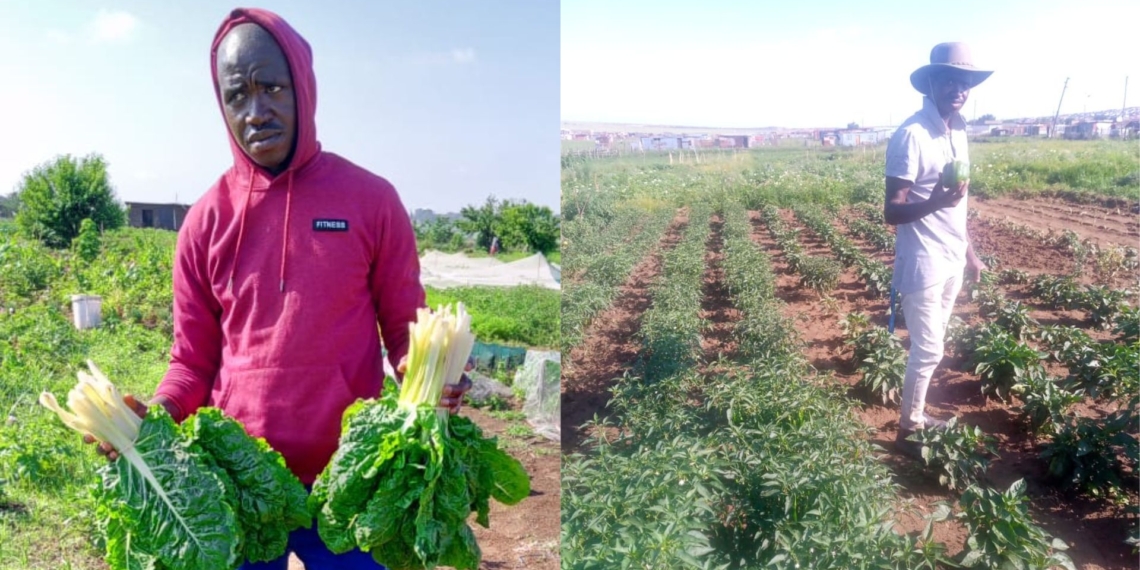
Twenty-eight years ago, a group of elderly residents in Ermelo, Mpumalanga, planted a simple garden to provide fresh, accessible vegetables. Over time, it has grown into the Sabelani Vegetable Agricultural Primary Co-operative, a space where youth are learning skills and carrying forward the spirit of care.
That is how it changed Bongani Nkosi’s life. When he lost his parents at a very young age, he was left with the void only a mother’s love could fill. But even in that emptiness, the care of his community reached him in small, meaningful ways.
Today, that same community is growing food under the Msukaligwa Municipality.
Planting hope in the community
Nkosi’s parents died when he was just two years old. He grew up with family on his mother’s side, cared for by his older sister Promise Nkosi.
Life carried on until his sister passed away in 2009. “By then, I was old enough to stand on my own, but even standing wasn’t easy,” he says.
He credits much of what he knows to the love and care his community showed him and other boys his age, guiding them towards work and helping steer them away from the streets.
Nkosi explains that the community garden has existed for 28 years, though it was only officially registered in 2018. “Its mission is to help people escape adversity and poverty and to provide safe produce to the nearest community.”

The garden also inspires young people to embrace agriculture and farming, especially as unemployment rises, adds Nkosi.
Related stories
- From spinning beats to raising chicks, Maseko rises to the top
- Cape dumping site transformed into veggie garden
- Amaranth ambitions: Naidoo builds empire on KZN hilltop
Gardens that give back
The co-operative is run differently. Various groups plant a mix of crops under one umbrella. The Msukaligwa Municipality provided the 2.1-hectare land, and each member works their own plot.
Currently, they grow green peppers, chillies, cabbage, spinach, tomatoes, lettuce, potatoes, sweet potatoes, and onions. “Most of our vegetables go to the nearest community and small enterprises.”
Although he has experience in work supervision, construction regulation, first aid, incident investigation, stacking and storage, and working at heights, Nkosi says farming is where he truly feels at home.
Ploughing through challenges
One of their challenges is crop theft due to the old fencing they currently have.
“We haven’t been able to get funding to repair it, and at night people sometimes come and steal our produce,” Nkosi says.
He adds that unattended livestock is another big challenge. “Animals often get inside and damage our crops, which becomes a huge loss for us.”
The weather also takes a toll. “Heavy downpours and hailstorms damage our crops because we don’t have shade nets to protect them. Sometimes hailstones destroy almost everything.”
Despite these challenges, Nkosi says the co-operative is manageable with 24 members, because each person works on their own small portion of the land.
Sometimes they receive training through the department of agriculture in Ermelo. The training includes skills on how to use chemical fertilisers, but Nkosi says they also make their own homemade manure.

“Reducing the use of chemical fertiliser is great because it minimises harm. We make compost tea from our manure, which results in an organic harvest,” he explains.
Most of their produce is sold to hawkers in Ermelo town, and some of the communities that support them include Emadamini and Khayelitsha.
Support goes a long way
Over the years, their municipality, under the Gert Sibande District, has supported the co-operative with a 5 000-litre water tank, wheelbarrows, shovels, watering cans, irrigation pipes, and other essential tools.
“We also receive practical assistance from our agriculture office,” Nkosi says. “They provide fertiliser, seeds, and vital training on farming, with a particular focus on food safety and quality.”
Looking ahead, Nkosi has big plans for the co-operative. He hopes to secure his own space where he can expand beyond just growing vegetables. “In my own space, I might try growing grains and raising livestock as well.”

He also wants to learn more about advanced planting methods beyond traditional ground planting.
“I’m fascinated by how other farmers experiment with different crops on their farms, as well as methods like hydroponics, vertical planting, and growing under nets.”
In Mpumalanga, unemployment is very high. Nkosi says for a young person with farming skills, he hopes hire several people in the near future and help address the unemployment challenge.
READ NEXT: Mpumalanga duo rise and shine with mixed farming operation