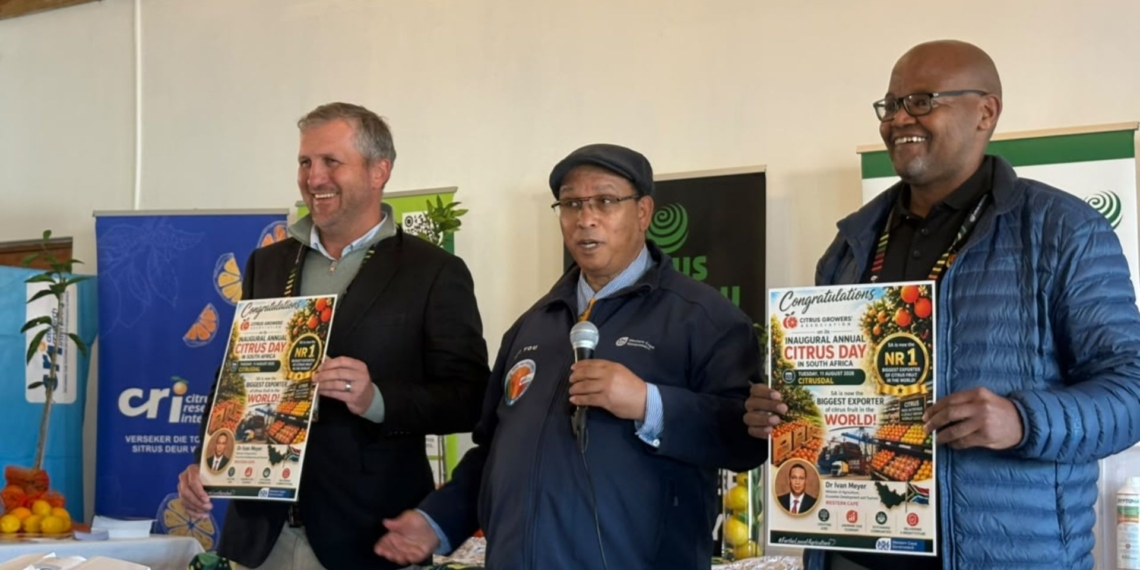
The Citrus Growers’ Association’s inaugural Citrus Day in Citrusdal, Western Cape, recently focused on the state of the industry, opportunities, infrastructure development, climate resilience and community development.
For a town like Citrusdal, citrus is not only about what leaves the orchards. It keeps local businesses running, supports workers and sustains families who depend on the industry.
That was one of the key messages from Citrus Growers’ Association (CGA) chairperson Gerrit van der Merwe at the event, where he spoke about the responsibility that comes with being at the centre of a citrus-dependent rural economy.
“If something goes wrong with the citrus exports, it’s not just the farmers. It’s the workers, the local businesses, the spa owner, the butcher, the spaza shop. Everybody is dependent on what we do with the citrus exports,” Van der Merwe said.
Strengthening rural economies
He also called for a stronger sense of shared responsibility between government and business in dealing with South Africa’s challenges.
“South Africa is our problem. It’s not the state’s problem. It’s not the business people’s problem. It’s everybody’s problem,” he said.
Van der Merwe said Citrusdal’s experience could offer lessons on how the government and the private sector can work together to strengthen rural economies and protect the livelihoods built around agriculture.
Related stories
- Why citrus deserves special treatment in US-SA tariff talks
- Fruits and nuts drive SA’s record agricultural export surge
- How Wayne Mansfield went from fruit hawker to citrus farmer
- Floods, global conflict force lower SA citrus export estimates
The Western Cape minister of agriculture, economic development and tourism, Dr Ivan Meyer, said South Africa’s position as the world’s biggest citrus exporter is a milestone worth celebrating, but maintaining that position will require continued investment in research, infrastructure and collaboration across the industry.
Meyer said the annual event was created to recognise the growing importance of the industry and the contribution of farmers, workers, researchers, scientists, producers and exporters. “We are now the biggest, and that’s what we are celebrating here today.”
Citrus research and port reform
Meyer also highlighted the role of Citrus Research International in helping growers use research, data and technology to identify and manage risks that could affect exports.
“If you want anything to be successful, it starts with good, solid research and data analytics.”
At the same time, Meyer said the country needs to address infrastructure constraints if it wants to turn its growing global demand for citrus into even greater export opportunities.
He called for the privatisation of the Port of Cape Town, pointing to improvements at Durban port and abroad as examples of what greater efficiency could achieve.
He said international buyers are not simply coming to taste South African fruit, but signing contracts to buy it.
Market access key to citrus growth
CGA CEO Boitshoko Ntshabele says South Africa’s position as the world’s biggest citrus exporter creates an opportunity to grow the industry’s contribution to job creation and rural economies; however, market access and logistics remain major hurdles.
Ntshabele told Food For Mzansi that the event was an opportunity to highlight the industry’s wider contribution, from rural economies and community development to research and technology.
He said increased production over the next five to 10 years would require South Africa to secure better access to major markets including the US, EU, China and India, lower tariffs and more modern, science-based plant health protocols. “The two biggest challenges are market access and logistics.”
Ntshabele noted that logistics reform was equally urgent, with greater private-sector participation needed in ports and rail to move growing volumes of fruit to international markets.
He said the benefits of citrus exports already extend beyond orchards, supporting jobs, schools, clinics, roads and small businesses in citrus-producing communities.
“If we can enter all markets with no tariffs whatsoever as well as updated and scientific plant health protocols, the citrus industry in South Africa can become an engine of mass job creation and rural development.”
He added that industry estimates suggest 100 000 jobs could be created before 2032 if stakeholders work together on market access, logistics and other reforms.
READ NEXT: All not lost as citrus farm donates waste fruit