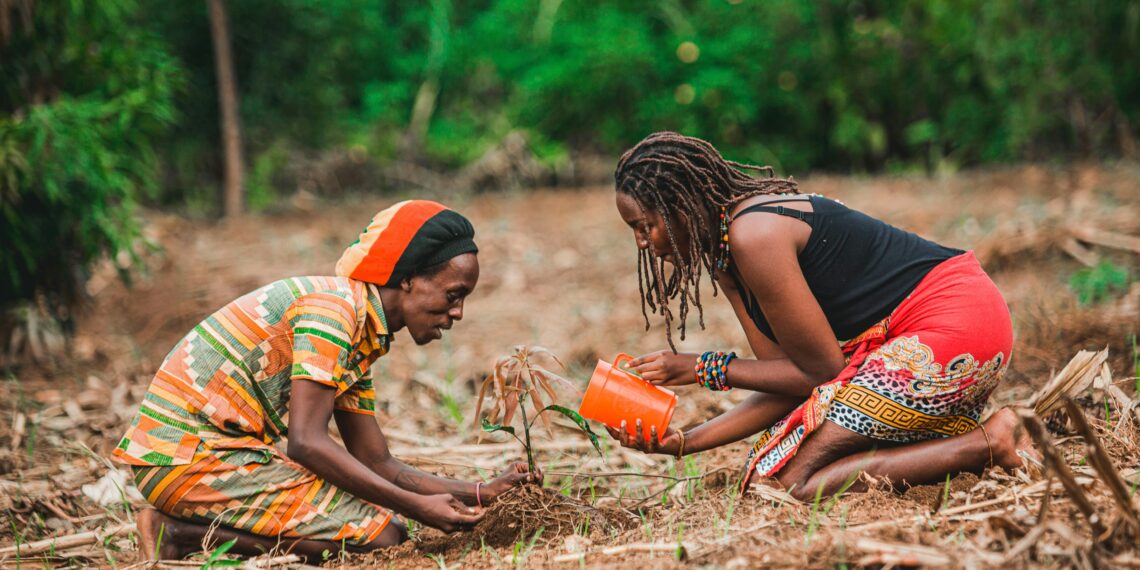
Certain stereotypes about women have become commonplace in climate and development literature. One example is that women are either represented as “saviours” who protect nature or as “victims” more vulnerable to climate impacts than men and less equipped to cope.
Simple either/or ways of seeing women overlook the power dynamics and structural factors that give rise to the stereotypes.
Based on our decades of research into gender issues and the environment, we use evidence from the global south to unpack underlying assumptions. We call for a more complex framing of gender, care and climate change. This will help ensure that building sustainable economies doesn’t reproduce gender injustices.
Women as saviours
The idea of women as “saviours” generally revolves around their role in unpaid care work and their stake in preserving natural resources. Women and girls bear more than their share of responsibility for unpaid work essential to daily survival and intergenerational care in their communities.
This inequality, rooted in long-standing patriarchal norms, in turn, generates inequalities in opportunities to make a living.
It is necessary to assess how these inequalities play out among different social groups. For example, women from more affluent classes generally outsource their unpaid care duties to paid workers, usually women, from poorer, often socially marginalised, households. That allows the more affluent to get better paid and formal employment. They feature far less in the “women as saviour” literature on climate change.
By contrast, women from marginalised and low-income households have no choice but to rely on their own unpaid labour to care for their families. They also do labour-intensive tasks like fetching fuel and water and maintaining buildings without modern conveniences. They take care of family well-being without accessible public services.
They have fewer market opportunities than male family members, so they must undertake unpaid but labour-intensive productive activities such as rearing livestock and growing crops. This work is rarely counted in formal labour metrics. Their greater reliance on natural resources explains why these women have a greater stake in their preservation, lending some credibility to the “saviour” discourse.
However, women’s responsibility for unpaid work and the barriers they face in the market economy also explains why women are left to do much of the work in industrial agriculture. This sector, which has been contracting in much of the world, is dependent on high levels of chemical inputs and is a major source of climate and environmental destruction.
Women are often wage workers in global value chains because they can be paid lower wages. If women’s own farming is less destructive to the environment than men’s, it is because the farms they cultivate are smaller and more labour-intensive, and they are less able to afford chemical inputs.
Stepping back from these examples, it is valid to claim that women and girls in the global south have smaller carbon footprints than the rest of the world because they are more likely to engage in forms of labour that conserve rather than deplete the environment.
Before casting them as “saviours”, though, ask whether these roles result from personal agency. Do women’s environmental and care practices reflect their choice, or are they shaped by patriarchal constraints and limited economic opportunity? Do they have an affinity for nature or simply lack other options? Is this work recognised and rewarded, or does it explain their inferior position in the paid economy?
Such questions are central if the transition to a more sustainable economy is going to address issues of gender inequality.
Related stories
- Women farmers lead with indigenous knowledge against drought
- Climate change: Women farmers cast aside
Women as victims
The other frequently advanced stereotype of women is as “victims”, more vulnerable in the face of climate change, and less capable of adaptive responses.
Once again, it is based on partial insights. It sees women as all the same, ignoring differences shaped by gender, class, identity and location. A more nuanced approach reveals that not all are equally affected by climate change impacts, or equally helpless.
Climate change can have gender-differentiated effects on health due to physiological differences as well as socially constructed ones.
Research shows that rising temperatures and pollution are correlated with complications for childbirth and babies.
Socially constructed gender roles have placed women at a disadvantage in the face of extreme weather events. For example, they are less likely to be able to swim or climb trees than men. During the Asian tsunami of 2004, 70% of those who died were women, many of whom were trapped with children inside their homes.
Gender roles also put women’s health at risk in “normal” times. A third of people on the planet cook with polluting fuels, the majority of them women.
Other aspects of gendered responsibilities also shape climate vulnerabilities. For example, there’s evidence that poor men and women in rural areas are more affected by the climate crisis because it intensifies the work involved in caring for people and because of their dependence on the natural environment.
Women’s care responsibilities amplify their climate vulnerability. They have been found to spend an additional hour per day to care for family members with climate-related illness.
Destruction of health infrastructure and emergency response systems during disasters intensifies these care demands. Resource scarcity lengthens their journeys to collect water and firewood.
Answers
But victimhood is not inevitable. It can be averted if the factors that give rise to it are recognised and acted on.
Despite the barriers they face in earning a decent living and their exposure to climate-related risks, women continue to take primary responsibility for their families. They have also led environmental resistance movements, such as the 1974 Chipko movement in India and the 1977 Green Belt Movement in Kenya.
Today, women’s climate activism is expanding. They remain key advocates for climate and gender justice.
Care work will still be needed in a sustainable economy. The question remains: will it still be the responsibility of women and girls? Or will we organise production, reproduction and care in ways that reconcile climate justice with gender and economic justice?
This article was first published on The Conversation.
READ NEXT: Poultry slaughterhouses urged to adopt sustainable water practices
Sign up for Mzansi Today: Your daily take on the news and happenings from the agriculture value chain.