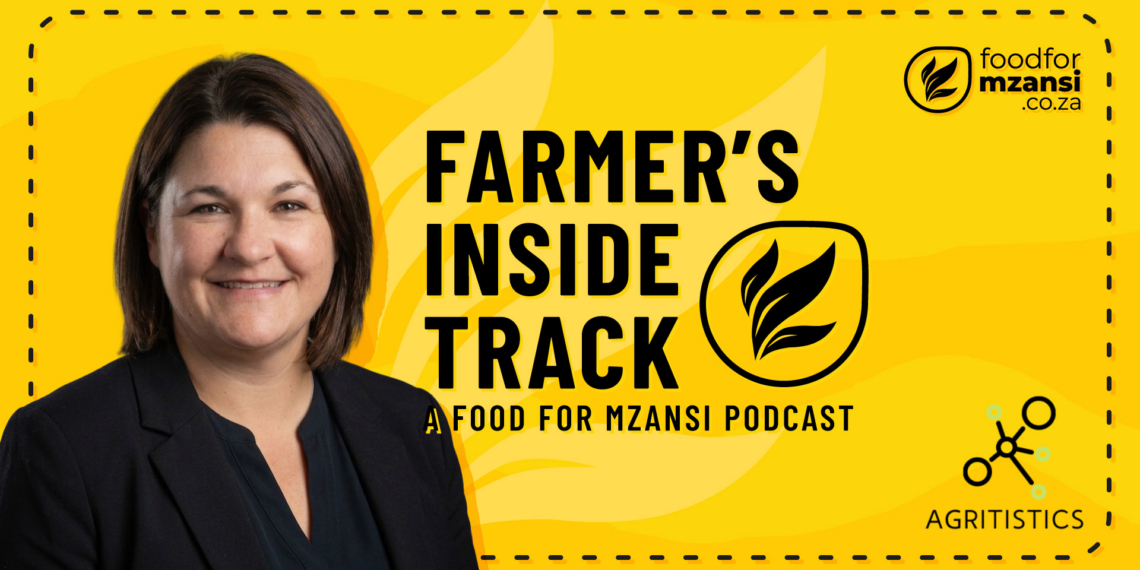
From handwritten notebooks to digital dashboards, farmers are sitting on a wealth of information that could transform their businesses. But as Agritistics managing director Dinah Nel explains, smarter farming isn’t about collecting more data. It is knowing what to do with it.
A farmer might know exactly how many calves died last season, how much diesel was purchased or what each field yielded. But can those records explain why losses occurred, where money is disappearing or which decisions could improve profitability?
That is where the real value of farm data lies.
For Dinah Nel, general manager of Agritistics, digitalisation is not about replacing everything farmers already know with expensive technology. It is about making existing information work harder.
Speaking on Food For Mzansi’s Farmer’s Inside Track podcast, Nel challenged the assumption that modern farming requires sophisticated software from day one.
“Digitalisation doesn’t necessarily mean installing the most expensive software, sensors everywhere or complicated systems,” she explains.
Instead, it begins with finding better ways to capture, store and use information already generated through everyday farming activities.
Start with the problem, not the technology
Before downloading another app or investing in software, Nel believes farmers should ask one fundamental question: “What do you need to know to manage your farm better?”
For livestock producers, that might mean understanding mortality rates, feed consumption, animal performance or production costs. Crop farmers may want to compare yields, rainfall, fertiliser expenditure and profitability across different fields.
Related stories
- From notebook to digital: You don’t have to digitalise your farm overnight
- Why simple farm records beat complex systems
- ‘No books, no loan’: How compliance unlocks farm finance
- The numbers every farmer should know
Once those questions are clear, farmers can identify what information to record. “That is much more useful than collecting large amounts of data just because you can.”
The principle is straightforward. Every record should contribute towards understanding performance, costs, losses or opportunities.
Don’t throw away the notebook
For generations, farmers have relied on handwritten records, diaries and spreadsheets. Nel sees no reason to abandon them simply because newer technology exists.
A notebook or Excel spreadsheet can still be extremely valuable, particularly for emerging and smaller commercial farmers.
The challenge isn’t necessarily the recording method, but whether the information is detailed enough and captured consistently.
Consider a farmer who writes “treated calves” in a notebook. Months later, that entry reveals almost nothing about what happened.
A more useful record would identify the date, animals involved, health problem, treatment administered and number of calves affected.
Excel works on the same principle. Clear columns, standardised terminology and consistent formatting make information easier to retrieve and analyse.
“A simple, consistently used system is often more valuable than a very sophisticated, expensive system that isn’t maintained properly.”
When spreadsheets become a headache
The tipping point arrives when information becomes difficult to manage.
Imagine livestock records stored in one spreadsheet, diesel purchases in another, crop information in a notebook and sales figures on somebody else’s laptop. Meanwhile, important updates are buried in WhatsApp conversations.
The farm has plenty of data, but nobody has the complete picture.
Nel says centralised systems become particularly useful when multiple employees capture information, farms operate several enterprises, or managers struggle to locate the latest records.
A single reliable source lets authorised staff access and update information without constantly searching through disconnected files.
However, technology must fit the operation. “If it takes you five minutes to capture something that previously took 30 seconds, you are unlikely to use it consistently.”
Customised digital forms can simplify repetitive tasks by providing predefined options for animal identification, fields, treatments, and activities.
Crucially, Nel believes employees responsible for capturing information should help design these systems.
Twelve dead calves. But what really happened?
Perhaps the most compelling argument for digitalisation emerges when farmers start to visualise their information.
Hundreds of spreadsheet entries can hide patterns that become clear when converted into graphs and dashboards.
Nel offers a striking example.
A livestock farmer might record 12 calf deaths during a year. That figure alone provides limited insight.
But what happens when a dashboard reveals that nine of those calves died during their first three weeks of life?
Suddenly, the farmer has a much more specific problem to investigate.
Similarly, crop records might reveal a field consistently producing disappointing yields despite higher input expenditure. Diesel records could expose steadily increasing consumption.
“Visualisation doesn’t make the management decision for you, but it makes patterns and problems easier to see.”
That distinction matters. Technology cannot replace farming experience or sound judgement. It can, however, reveal where closer investigation is needed.
From scattered records to smarter decisions
Agritistics supports farmers through the entire journey, starting by identifying which information is worth collecting.
The company can develop structured Excel templates, introduce standardised data-entry methods, centralise records through platforms such as SharePoint, and create customised digital applications, including offline solutions.
From there, information can be transformed into visual dashboards that support management decisions.
Nel emphasises that solutions are tailored to individual farming operations rather than forcing everyone into the same system.
Ultimately, the goal is not digitalisation for its own sake. It is turning everyday farm records into practical business intelligence.
Sometimes, the first step toward a smarter farming operation isn’t buying another piece of technology. It is opening that old notebook and asking whether the information inside can help make tomorrow’s decisions better.
For more information, visit www.agritistics.co.za.
READ NEXT: Bridge the maize yield gap with targeted precision and nutrition