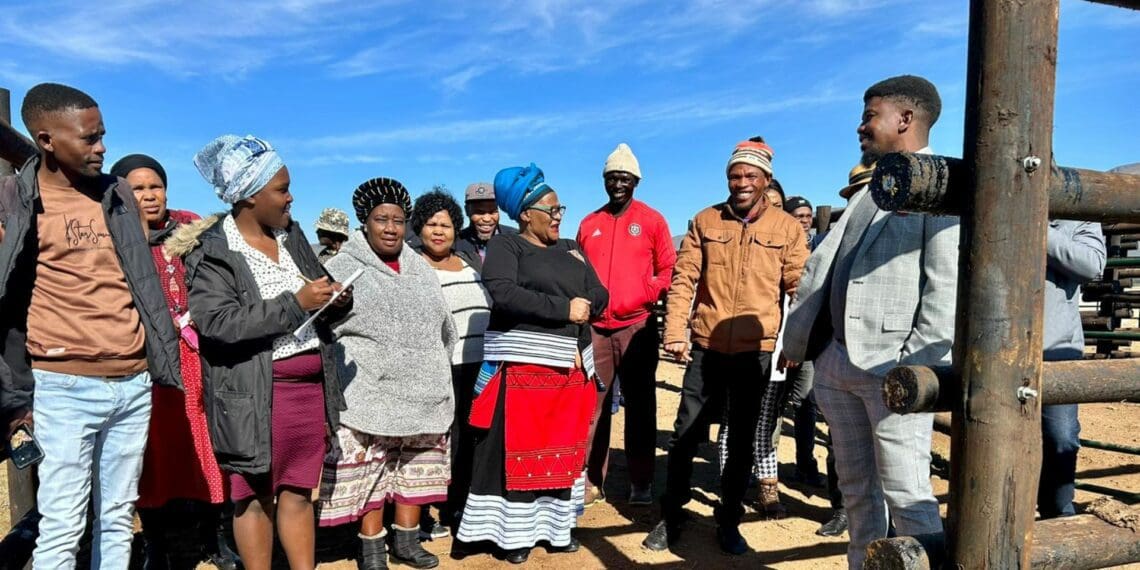
The once-successful farming community of Spring Grove between Komani and Tarkastad is on its way to its former glory. The prolonged drought of 2015 completely disrupted commercial livestock farming in the small village but they are marching forward with their business recovery.
Livestock farmers in the area rear goats, sheep and cattle that they sell to both formal and informal markets. Livestock sales are largely their primary source of income.
Spring Grove Farmer’s Association chairperson, Fundile Plaatjie relayed a gloomy state of how their business went down from being the top producer of wool in the Chris Hani District Municipality.
For the 2020 season, they were crowned overall winners of quality wool clip in the Eastern Cape under the communal woolgrowers’ category 2020.
A grim scenario
“Sasitshotsha entla (we had no competition) before the prolonged drought of 2015 to 2020 hit us. However, 2020 was the worst as we helplessly watched our livestock dying like flies. Cattle, goat and sheep carcasses were scattered across our grazing lands,” said Plaatjie.
This affected them negatively and led to their herd count shrinking and the wool clip quality and quantity affected, Plaatjie explained.
Those who farmed with cattle had to sell them without even looking at the price because feed was scarce and expensive. This only added to the collapse of their makeshift livestock-handling infrastructure, which Plaaitjie described as the last nail in the coffin.
“The dilapidation of our pans and loading zone at our old handling facility meant disaster as we lost the ability to strike deals with buyers, and we struggled to load animals in their trucks.
“ Hot on the heals was a sudden rise in livestock diseases because we did not have a proper structure which we could use for vaccinations and immunisation,” he said.

Government steps up
Things have since improved, and the association credits the department of rural development and agrarian reform (DRDAR) who contributed to their recovery in handing over a livestock handling facility.
The multipurpose large stock handling infrastructure, described by farmers as their springboard to recovery, consists of partitioned pans, a squeeze chute, an adjustable alley, a tub, a scale and a loading zone.
DRDAR also invested in the construction of shearing shed in the area for local farmers, vegetable starter packs that include garden tools and inputs, livestock of superior genes, training, and feed to alleviate the effects of drought.
MEC Nonkqubela Pieters confirmed that more would be done to help the farmers grow their own feed and assist them with the necessary machinery to harvest and bail their feed.
“DRDAR has programmes in place to address the challenges you are faced with. The next step now is to equip you with feed production tools so that you can restore your farming ambitions. By doing so, we want you to play a meaningful role in the agricultural economy and food security of the province,” said Pieters.

Farmers set for revival
Nozolile Magwa is a member of the 74-member association and one of the 28 women in the farming group.
She owns a herd of 27 cattle and 17 sheep, and she is dependent on them to look after her family since the passing of her husband who was the breadwinner in their family.
She said the handling facility would personally help her grow and manage her livestock in a more profitable manner as she expects it to cut down the number of mortalities and theft.
“Sixakwe bubusela ke apha (we are battling stock theft here). Unfortunately, I couldn’t brand my livestock and it get stolen easily without a trace but with the new facility I will be able to brand and grow it to a large herd as it used to be,” she added.
Meanwhile, Plaaitjie said what the DRDAR has done for them will serve as a revival of professional livestock farming. And for now, the drought is a distant memory.
READ NEXT: Grab indaba tickets before they’re gone!
Sign up for Mzansi Today: Your daily take on the news and happenings from the agriculture value chain.