Indigenous crop species, usually regarded as weeds, hold the potential to address issues surrounding food security, says Dr Buhlebelive Mndzebele, a senior research technician from the Agricultural Research Council (ARC).
With the increasing need to preserve the environment and reduce input costs, scientists are identifying cultivation methods such as intercropping with indigenous crops to improve soil quality.
Mndzebele did a study underscoring the potential of intercropping and optimal fertilisation in improving crop yields and soil health, contributing to sustainable agricultural practices.
The study seeks to improve food security by empowering farmers to cultivate food for their communities instead of dependence on the government to change to more inclusive food security policies.
He is passionate about the need to influence the government toward developing inclusive sustainable agricultural policies for rural communities and smallholder farmers.
Related stories
- Sweet sorghum a sustainable solution to climate crisis
- Young farmers voice vision for a sustainable future
- Sustainable grazing key for climate-smart beef farming
The value of indigenous crops
Mndzebele, based in Potchefstroom, North West, shares that the idea for his study stemmed from observing the increasing population in South Africa. Particularly in rural communities, he noted, food insecurity is exacerbated by the challenges of limited land, climate change, and low soil nutrients.
“Now, as people are increasing in number, those people have to eat, and not only eat but also have nutritious food.”
These issues prompted Mndzebele’s exploration of sustainable farming methods using indigenous vegetables like cowpea (Vigna unguiculata), an edible legume in the pea family, and amaranth (Amaranthus) a seed used as grain. He noted that these are highly adaptable and require fewer resources for cultivation.
He says the study is particularly relevant for South Africa, with its generally nutrient-poor soil. “Phosphorus is one [one of the scarce nutrients], as well as nitrogen and potassium.”
Mndzebele explains that cowpea and amaranth are known for their ability to grow in nutrient-poor soils with minimal fertiliser and water.
What is interesting about these indigenous vegetables, he adds, is that they are generally considered to be weeds because of their high adaptability.

Intercropping as a sustainable farming method
Mndzebele’s study encompassed intercropping, a sustainable farming method that can help smallholder farmers maximise limited land space.
“Row intercropping [is] where you would have one crop next to another in rows. In that case, it means that you kind of cover as much ground as possible,” Mndzebele explains.
He adds that below the ground, the roots interact minimising soil erosion. Intercropping legumes such as the indigenous cowpea alongside other crops increases nutrient availability.
Mndzebele shares that legumes can harness atmospheric nitrogen and help in the optimisation of phosphorus in the soil, thus decreasing the use of fertilisers.
“So, what would happen if you plant a legume, you are indirectly reducing the need for the application of fertiliser to the companion crop growing next to it.
“If you’ve got legumes, over time they will biodegrade and then contribute more towards the soil structure and also the addition of nutrients into the soil.”
Mndzebele encourages intercropping for smallholder farmers in South Africa.
“I would promote or recommend intercropping to say if someone has got one hectare or whatever amount of land that they would have in a rural area, intercropping allows the farmer to utilise the space efficiently.”
The issue with fertiliser
Mndzebele acknowledges that though fertiliser has its benefits, it can cause more harm to the soil. He also points to the high cost of fertiliser and the challenges this creates for smallholder farmers.
“When it comes to fertilisers, one major challenge is the issue of costing. They are quite costly. We are aware that when there are instabilities politically, they tend to then affect prices of fertilisers.
“One of those is the major inputs that go into the formation of fertiliser, it increases, then fertiliser [prices] increase,” he explains. Mndzebele adds that this feeds into the value chain resulting in increased food prices for the consumer as well.
Other challenges are the accessibility of fertiliser and the environmental pollution it causes.
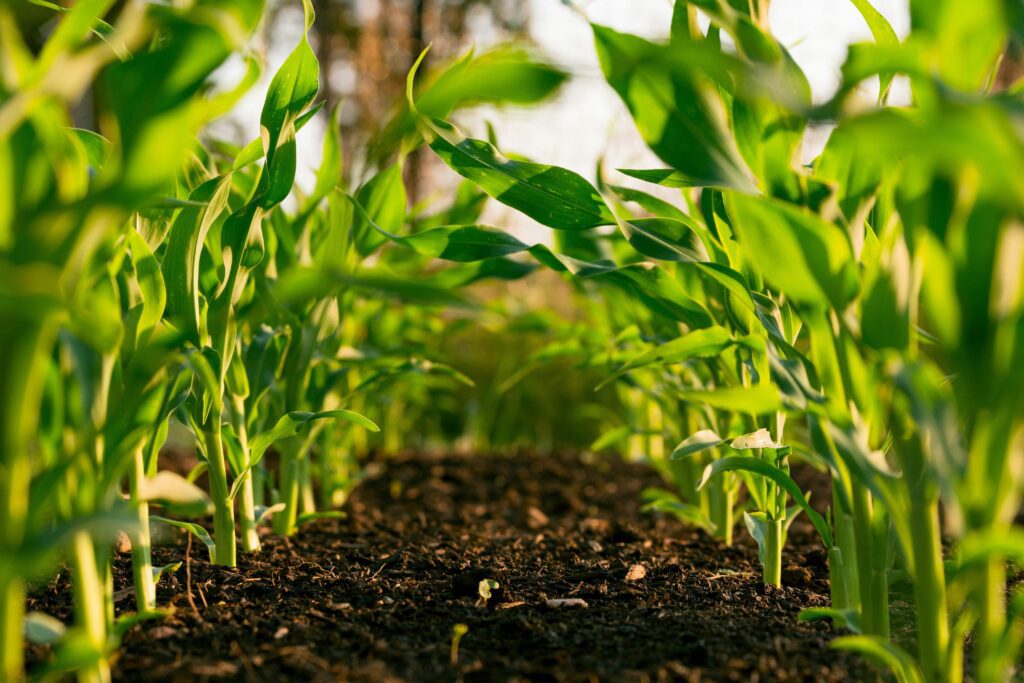
“When it comes to handling it [fertiliser], one must be careful. The other thing is also potential harm to water bodies and the microbiomes.
“We know that in the soil, there would be some animals that live under there. There is life below the soil. The minute you introduce chemicals, you move those [organisms] away and they play an important part in the soil,” he says.
Mndzebele advises farmers to look at the soil as a resource. He explains that sustainable methods such as reducing the use of fertiliser by adopting methods such as intercropping may reduce yield and ensure good soil quality for future generations.
“What we also have in South Africa is that there’s a bit of what is called functional land that is tired that would need to require rest. For one to avoid that, you go for a slower approach where you don’t pump the soil with so much fertiliser and then you take care of it,” he says.
In this way a farmer is able to still have functional land decades from now.
“The issue of food and nutritional security is an important aspect,” he emphasises.
READ NEXT: Experts share essential tips for optimal post-harvest crop handling
Sign up for Farmer’s Inside Track: Join our exclusive platform for new entrants into farming and agri-business, with newsletters and podcasts.