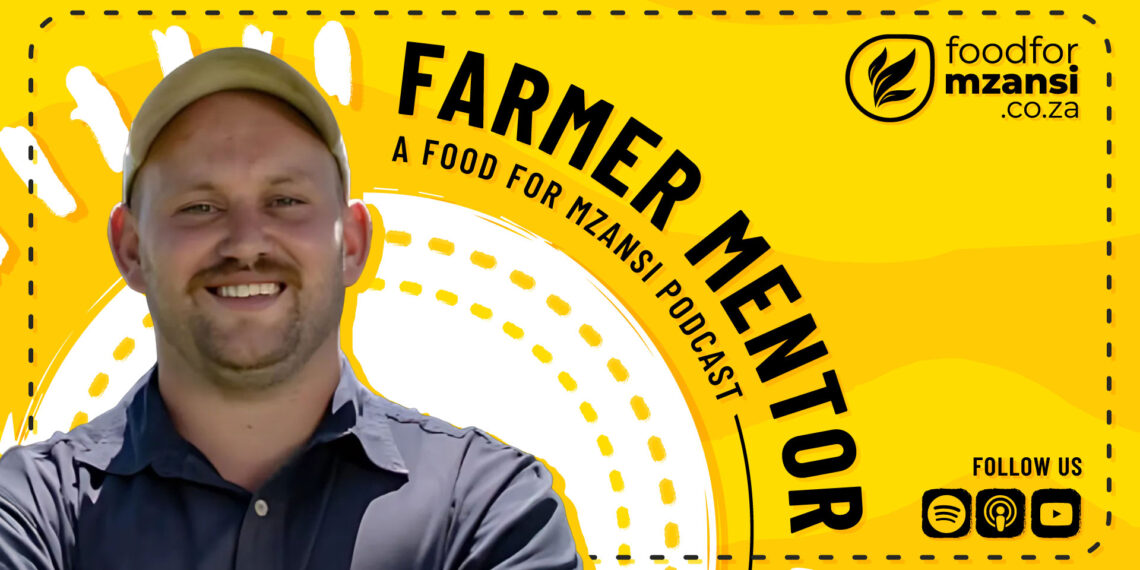
After gaining international farming experience in the US, JW Dercksen returned to the Free State, determined to maximise yields on minimal hectares. Read his story in this episode of the Farmer Mentor series.
In the Hertzogville district of the Free State, Johannes Willem (JW) Dercksen is farming alongside his father, carrying forward a family legacy while shaping his own path. For the past four years, Dercksen has focused on producing maize, soybeans, and sunflowers, following his personal philosophy of “back to basics.”
When it comes to farming, he says firmly, “I’m not doing it because it’s my father or something I inherited. It’s something I love to do, and that’s why I’m doing it. It’s fantastic.”
Unlike many farmers who feel compelled to join the family business, Dercksen had a choice. “My father always said, ‘You don’t have to farm one day. If you want to farm and that’s what you want to do, then you’ll do it and you’ll get up.’ You’ll be on the farm and you will learn,” Dercksen explains.
“I think that’s quite different from most other guys’ approaches, but in the end, it made me realise it’s what I wanted to do.”
That realisation came after years of working away from home in the United States, gaining valuable international experience with one of the biggest cotton operations in the South. “For me, it was a learning experience. I wanted to see how they do stuff, how they organise their farms, and how we could learn from that here.”
On his return, he brought back lessons in efficiency and teamwork. “I think the biggest thing for me was how they divided the work between themselves. The one brother focused on harvest, the other on preparing the land. They had a system. And I think that’s important in family farming – letting everybody do the thing they’re good at.”
Related stories
- Prescribing a farming legacy: EC pharmacist finds his calling
- Debt-free farming: Saunderson’s path to feedlot prosperity
Balancing tradition with innovation
Today, Dercksen and his father manage the core farming operation, while his brother pursues his own projects on the side. Their system is built on crop rotation, alternating maize and soybeans, with sunflowers planted on lower-potential land.
“For the last three years, we’ve just seen better yields and better quality maize if we don’t do maize on maize,” Dercksen explains.
His “back to basics” approach isn’t about resisting change but rather focusing on fundamentals. “The way we farm is the way my father has been farming for 25 years. Not exactly the same, small things have changed, but we do the basic stuff. If we do everything we can, the harvest will be there. That is my advice, just do the little things right and the rest will come.”
That doesn’t mean the road has been without mistakes. He recalls the first year they planted soybeans.
“We kind of went into it with the mentality of, we’ve been planting corn for many years – how much harder can it be? We underestimated the change between the two crops. That was a large learning curve. We adjusted a lot of stuff and made a lot of mistakes in planting and harvesting. From the first year to the second year, there was exponential growth.”
Never a dull moment in farming
Even now, the unpredictability of farming weighs on him. “My wife, she tells everybody she’s married, but for six months of the year she doesn’t have a husband,” JW laughs. “I don’t sleep very well, especially planting season.”
Yet despite the pressures, Dercksen is optimistic. He sees the future of South African agriculture being shaped by both tradition and innovation. “You can’t change every year,” he says. “You need to find what works for you, stick to that, and not worry if it doesn’t work for the guy next to you. It’s about doing the basics right, keeping up with modern practices, and working hard.”
Asked what advice he has for young farmers entering the sector, Dercksen doesn’t hesitate. “Agriculture is competitive. I had a lot of good opportunities that I used, and sometimes a little bit of luck. But the only thing that makes a difference between the guy that makes it and the guy that doesn’t is hard work. Hard work makes up for a lot.”
READ NEXT: Smart crop protection for greenhouse farming