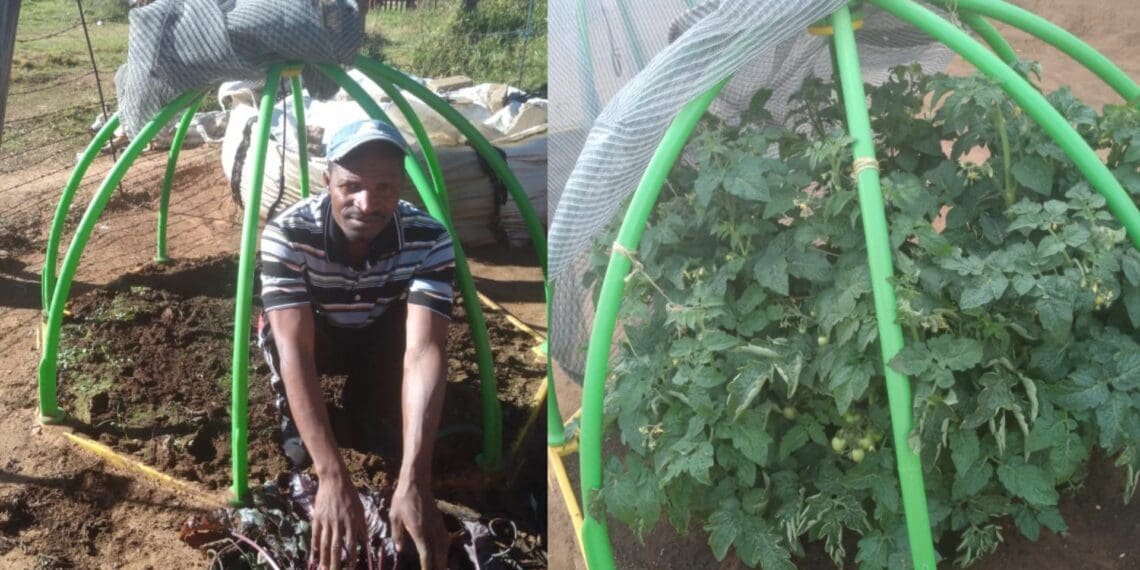
Petrus Maduna, a passionate agriculturalist based in Petrus Steyn, Free State, fondly recalls growing up on a Western Cape potato farm. This was in the early 1970s, a time when life was much simpler. Over the years, his life has taken many twists and turns but today, Maduna provides farming solutions to empower women and youth to produce their own food and stand on their own feet.
Maduna had a rough start to life. He’s the son of two farmworkers whose earnings put Maduna and his three siblings through primary and high school. The two incomes were just enough to cover the basics.
But when his father suddenly fell ill and could no longer muster up the strength to work the potato fields, their household went from having two breadwinners to barely surviving on one income.
“My father got sick while I was still in school, so I had to drop out and find a job,” he explains.
To help support his mother and his siblings, Maduna started working on the farm as well at the tender age of 14. “At least I ended up working in something I was not unfamiliar with,” he jokes.
Lessening the load for female farmworkers
The simple life, as he knew, quickly became a stressful one in which young Maduna had to participate in planting, cultivating, and harvesting potato crops, often under harsh climatic conditions, he recalls.
With each new day, exposed to intense agricultural labour, Maduna grew aware of the hard life of farm work.
“I worked mostly with women on the farm. I noticed how they worked from the early hours of the morning until late into the day.
“It was surprising to see them diligently walk around carrying 5kg bags of potatoes all day long,” he says. “It made me think of my mother. I wanted to find a way to make it easier for them.”
He worked a few more years on the farm, then decided to venture into broiler production on a different farm. This added another layer of experience to the agricultural CV Maduna was building up.
Soon, this was no longer enough because Maduna wanted to indulge his passion for business. This saw him moving across the country to KwaZulu-Natal where he opened an agricultural fencing business. He has fenced many farms in the coastal province.
“I used fence farms, replacing old fencing with new fences and this was my own business idea that I wanted to do,” he explains.
A purple patch of opportunities
In 1998, he moved back to the Western Cape after shutting the doors on his fencing business. His move back to province of scenic beauty saw him learning about sheep farming.
“I was quite experienced and in 2002, I was made a farm manager with a qualification of standard four.
“But because of my experience and knowledge about animal feed and feedlots, I was granted the opportunity,” he says proudly.
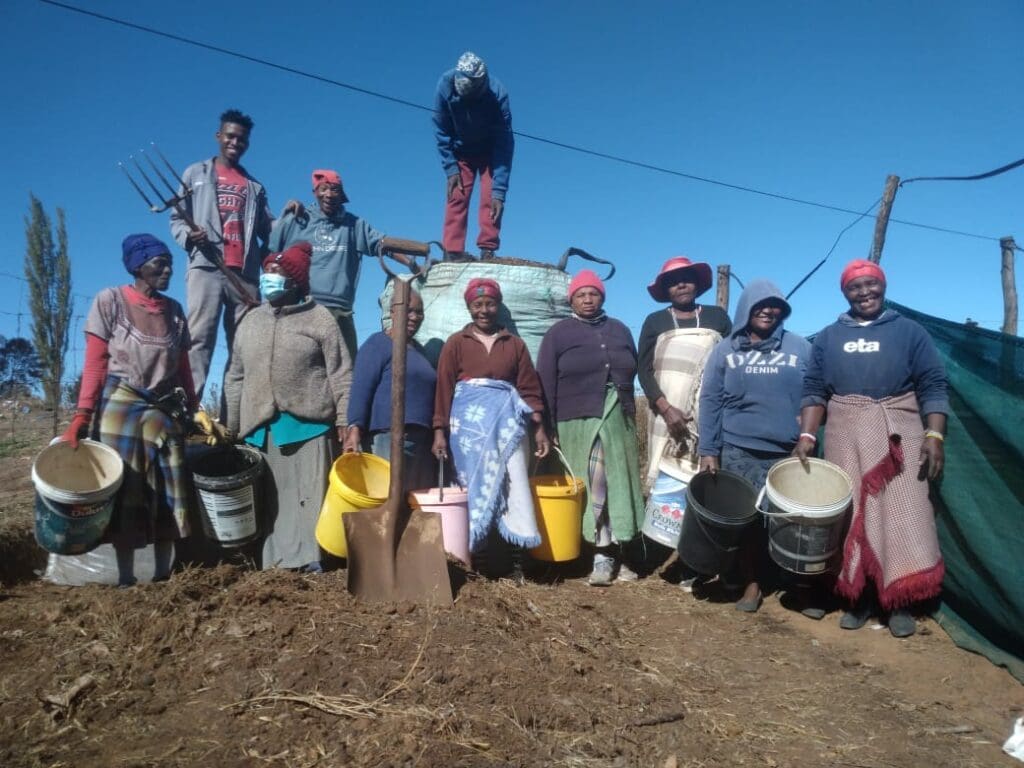
With staggering confidence and valid documentation verifying his expertise, which was certificate from Fair Deal Agricultural Training Center in 2008, he moved to Gauteng to start a farming group of women in Johannesburg. The 12 women-owned over 1 300 broiler chickens.
“Women work so hard, that’s why I’m so passionate about them,” he says.
The dark times
Everything was going well. In Johannesburg, he was mentoring a group of poultry farmers and in the Western Cape, he was appointed full-time farm manager. He even ventured into cattle farming with relatives.
For a while there, life seemed great. But it quickly took a dark turn when Maduna was arrested and sentenced to two years in jail in 2013.
It turned out that the land he and his relatives were housing their cattle on also had stolen cattle. Maduna was seen as an accomplice and sentenced to jail. “I was innocent, but I stayed in prison for two years,” he says.
He lost everything. His cattle and his job as a farm manager. Maduna is grateful that the women farmers in Johannesburg were able to continue building and growing their businesses.
Youth unemployment and crime
But prison wasn’t all that bad. In fact, it offered Maduna growth in a different way. “I saw something even more inspiring,” he says.
In multiple conversations with young men convicted for different crimes, Maduna wondered why the prison became home to so many young people.
“I discussed with them why they got into crime and one of them said to me, ‘Bab’ Maduna, what else are we going to do that won’t keep us from sitting around on the street’.”
The conversation sparked Maduna to find a solution for young people. While in prison, Maduna engaged in agricultural activities, acquired new skills and developed his plan aimed at empowering women and keeping young people out of crime.
His plan led to the establishment of the Nkoetona Multi-dome Project, officially launched in 2015.
A multi-dome for multi-solutions
“The multi-dome is a spherical structure that consists of bendable plastic bars to cover the growing crop and it is covered with transparent netting that absorbs water and light. The dome is a small-scale initiative that allows farms to plant their crop and easily move it around,” he explains.
“It works mostly with vegetables. It contains and protects the crop from pests, rodents and bad weather and is 1×4 square meters big.”
Maduna adds that it is not only used for planting, but for weighing, drying biltong and seeds, and crops. The structure is portable, saves water and uses sprinkler irrigation, underground free-flow irrigation, or drip line irrigation. So, farmers can choose for themselves.


Under the slogan “A multi-dome for multi-solutions”, Maduna and his team want to take the youth and women and teach them farming practices so that they can produce their own food, stand on their own two feet and avoid making bad decisions.
“I wanted to come up with a solution that would make farming easier for them but still enables them to work and provide for their families. Developing these skills in women and the youth is important so that they can have a better future, I think it can work and I know it can.”
ALSO READ: Busy bee Mohotlheng wears many farming hats
Get Stories of Change: Inspirational stories from the people that feed Mzansi.