Sunday, September 6, 2026
SUBSCRIBE
22 GLOBAL MEDIA AWARDS
Food For Mzansi
  • News
  • Changemakers
  • Lifestyle
  • Farmer’s Inside Track
  • Food for Thought
No Result
View All Result
  • News
  • Changemakers
  • Lifestyle
  • Farmer’s Inside Track
  • Food for Thought
No Result
View All Result
Food For Mzansi
No Result
View All Result
in News

Ramaphosa signs controversial Expropriation Bill into law

President Ramaphosa has signed the Expropriation Bill into law, allowing the government to acquire land for public purposes. The bill aims to promote inclusivity and access to resources, but critics argue it threatens property rights and could negatively impact food security and the economy

by Tiisetso Manoko
23rd January 2025
Ramaphosa's two ‘broken’ promises to farmers

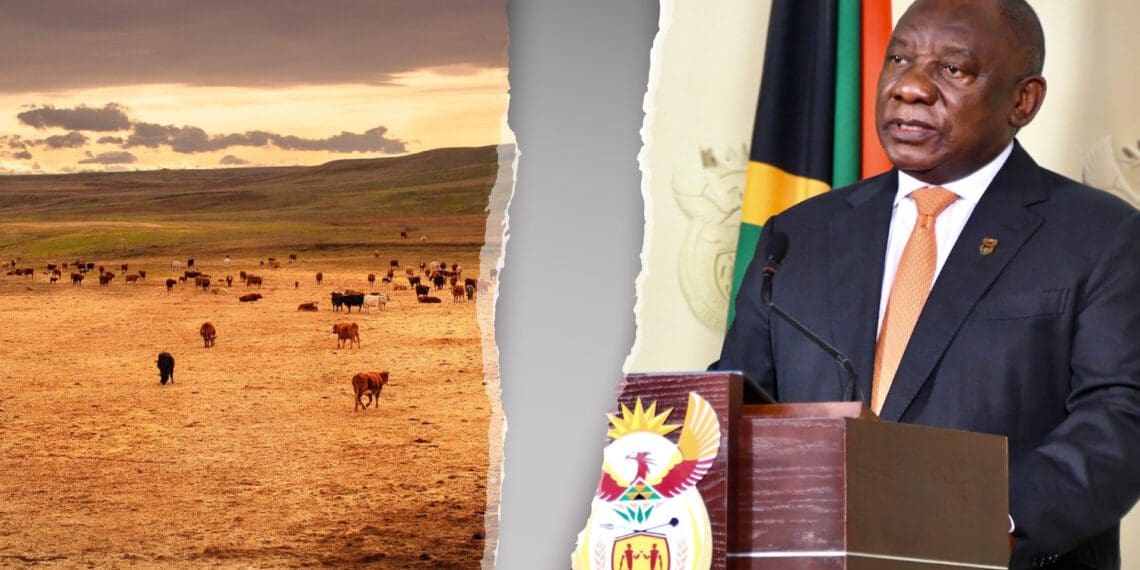
President Cyril Ramaphosa has signed the Expropriation Bill of land into law. Photo: Supplied/Food For Mzansi

Share on FacebookShare on TwitterShare on WhatsApp

President Cyril Ramaphosa has signed the controversial Expropriation Bill into law today. According to his office, the bill, which has undergone a five-year process of public consultation and parliamentary deliberation, aligns legislation on expropriation with the Constitution.

“Section 25 of the Constitution recognises expropriation as an essential mechanism for the state to acquire someone’s property for a public purpose or in the public interest, subject to just and equitable compensation being paid.

“The bill assented to by President Ramaphosa outlines how expropriation can be done and on what basis. This law will assist all organs of State – local, provincial and national authorities – to expropriate land in the public interest for varied reasons,” the presidency said in a statement.

Land bill now a law

The signing of the Expropriation Bill comes hot on the heels of the controversial Bela Act in the education sector, which some in the government of national unity were against.

“Local, provincial and national authorities will use this legislation to expropriate land in the public interest for varied reasons that seek, among others, to promote inclusivity and access to natural resources.

“In terms of this law, an expropriating authority may not expropriate property arbitrarily or for a purpose other than a public purpose or in the public interest,” the statement explained.


Related stories
  • Phosa: ‘There will be no land expropriation without compensation’
  • Land expropriation: ‘ANC ploy for votes?’
  • Parliament votes on land expropriation today

According to the statement, expropriation may not be exercised unless the expropriating authority has without success attempted to reach an agreement with the owner or holder of a right in property for the acquisition thereof on reasonable terms.

“The law provides for disputes to be referred for mediation or to appropriate courts. An expropriating authority must also attempt to reach an agreement on the acquisition of the property before resorting to expropriation – except in circumstances where the right to use property temporarily is taken on an urgent basis in terms of a provision in the legislation,” the statement said.

‘A threat to farmers’

Meanwhile, Transvaal Agricultural Union (TLU) general manager Bennie van Zyl said the bill is unacceptable and that signing the bill is not the right way to build the country.

“This decision signals a serious attack on the foundation of property rights, threatening not only farmers but all South Africans. The government presents this law as an instrument for transformation and public interest, but the reality is that it will have far-reaching negative consequences for food security, investor confidence, and economic stability.

“While most South Africans struggle to revive the country’s economy, the government remains trapped in a victory of ideology over economic realities,” he said.

Van Zyl said it is disheartening that the government thinks it will attract international and local investment after signing the law.

“The South African farming community already faces overwhelming challenges, such as high costs, unstable markets, and increasing rural crime. Now they face additional pressure from the possibility of land expropriation, which threatens not only their financial security but also their ability to ensure food security for the country.

“If the land on which we grow food is expropriated without the necessary capacity to manage it productively, millions of South Africans will bear the consequences through rising food prices and potential food shortages,” he said.

READ NEXT: SA ministers strengthen German-African agribusiness ties

Sign up for Mzansi Today: Your daily take on the news and happenings from the agriculture value chain.

Tiisetso Manoko

Tiisetso Manoko is a seasoned journalist with vast experience in community media. He possesses diploma in media studies majoring in journalism, certificate in civic leadership. He loves news from all angles with particular interest in local government, agriculture and politics. He is a staunch Mamelodi Sundowns Football club supporter.

Tags: Commercialised farmerCommercialising farmerCyril RamaphosaFuture-focused farmerInform meLand expropriationLand reformTransvaal Agricultural Union (TLU)
Dragon fruit thrives in KZN valley despite tough national season
News

Dragon fruit thrives in KZN valley despite tough national season

by Gerda Potgieter
3rd September 2026

South Africa’s dragon fruit industry faces a tough season due to severe weather, but the Maqogo community project in the...

Read moreDetails
The future of Mzansi's sugar industry hangs in the balance

Government hikes sugar import price, but industry warns of gap

3rd September 2026

Chicken is booming, but the real money is in the supply chain

2nd September 2026
How Tebogo beat post-harvest losses with smart agro-processing

How Tebogo beat post-harvest losses with smart agro-processing

2nd September 2026

Aucamp outlines strategy for biosecurity, trade, and infrastructure

2nd September 2026

Early calf care: Key growth targets every cattle farmer must track

Community-led farms boost food security and incomes in Limpopo

Rising costs, climate risk push Swartland wheat farmers to the brink

RSVP now: Emerging farmers’ programme at Nampo Cape

Chicken is booming, but the real money is in the supply chain

Join Food For Mzansi's WhatsApp channel for the latest updates!

JOIN NOW!
Next Post
China eases tariff fees as SA's rooibos flies the flag globally

Rooibos leads global surge in herbal extract market

THE NEW FACE OF SOUTH AFRICAN AGRICULTURE

With 21 global awards in the first six years of its existence, Food For Mzansi is much more than an agriculture publication. It is a movement, unashamedly saluting the unsung heroes of South African agriculture. We believe in the power of agriculture to promote nation building and social cohesion by telling stories that are often overlooked by broader society.

Plant, pick, protect: The rising potential of urban foraging in SA

RSVP now: Emerging farmers’ programme at Nampo Cape

Community-led farms boost food security and incomes in Limpopo

Farmers rethink water use as shortages threaten food production

Honoured roots: A father’s legacy, a daughter’s farming dream

Gauteng farmers urged to harness massive urban market

  • Awards & Global Impact
  • Our Story
  • Contact Us
  • Cookie Policy
  • Privacy Policy
  • Copyright

Contact us
Office: +27 21 879 1824
News: info@foodformzansi.co.za
Advertising: sales@foodformzansi.co.za

Contact us
Office: +27 21 879 1824
News: info@foodformzansi.co.za
Advertising: sales@foodformzansi.co.za

  • Awards & Global Impact
  • Our Story
  • Contact Us
  • Cookie Policy
  • Privacy Policy
  • Copyright

Chat Options

I'm Lerato, your AI assistant!
No Result
View All Result
  • News
  • Changemakers
  • Lifestyle
  • Farmer’s Inside Track
  • Food for Thought

Copyright © 2024 Food for Mzansi

This website uses cookies. By continuing to use this website you are giving consent to cookies being used. Visit our Privacy and Cookie Policy.