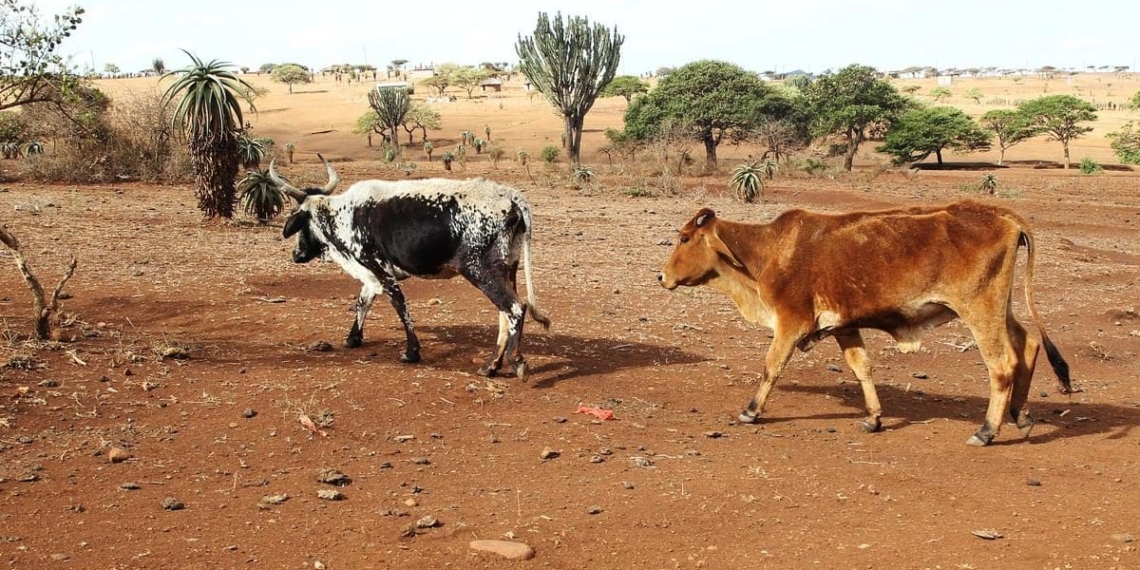
 While South Africa has revoked its classification of drought as a national disaster, Agri SA’s chairman for economics and trade centre of excellence, Nicol Jansen, warns that the Northern Cape remain on its knees.
“The drought disaster… is threatening the agricultural livelihoods of producers in the province who are net producers of red meat, wool and mohair,” he says, warning that while recent good rains have been a blessing the drought has deepened.

Weathers experts concur, and say in the past few weeks Mzansi received an exceptional amount of winter rainfall and snowfall in areas battered by the drought since 2012, particularly in the Western Cape and Northern Cape.
Johan van den Berg, an agricultural meteorologist, believes that the rainfall was above average and will positively impact the grazing conditions of the Northern Cape once temperatures begin to rise.
“There were some really good rain, more than 100 millimetres in some areas, which is a drastic improvement because those areas were experiencing drought for eight years.”
Van den Berg explains to Food For Mzansi that even though the Namaqua district of the Northern Cape received adequate rainfall, the northern parts of the province actually received very little rain this season.

Meanwhile Jansen adds that the northern parts of the Northern Cape only received 10% of the province’s total winter rainfall, while 90% of the western part falls within a summer rainfall season. This part therefore only expects rain between October 2020 and March 2021.
Jansen says since the drought, the production of meat in the Northern Cape decreased by a whopping 50%. To put this into further perspective, he adds that the province only constitutes 2% of the total South African population, but actually delivers 50% of the country’s red meat production.
“This will have a huge, negative cashflow implication for the producers in the Northern Cape,” says Jansen warning that it is just the tip of the iceberg.
Jansen explains that livestock animals need to feed, and because of the drought most farmers are forced to transport fodder to feed their animals which puts profitability in a constrained position.
“Even when the rain patterns go back to normal and the vegetation recovers, building stock will take time. To build your stock, you need to spare your female sheep for reproduction purposes. Therefore, there will be less production for a long time due to the fact that the stock levels must be rebuilt. That also has a negative cash flow implication for the producer,” he explains.
Protect genetic potential of livestock
Jansen calls on government to step in to protect the genetic potential of livestock “and to make sure that we can rebuild stock when the weather patterns restore to normal. If you don’t have any help or support from the government, it is not possible to protect this genetic potential. You can’t transport or import sheep from the Free State and think they will adapt in the Northern Cape environment.”

It simply isn’t possible, he adds. “Sheep will have to be bred and raised in the Northern Cape to adapt in that province. It is better to keep these economies active than to let them fade away and try to restart it in future.”
Van der Berg and Jansen are, however, hopeful that weather conditions will improve in the summer season to potentially benefit agriculture. However, prof. Mulala Simatele, a member of the Global Change Institute (GCI) and environmental scientist at Wits university, warns that the future of the agricultural sector looks rather grim.

“South Africa, as a country, has been identified by the International Panel on Climate Change (IPCC) to be one of the climate change hotspots. Meaning, that out of all the 54 countries that we have in Africa, we are the most vulnerable country to changes in weather conditions and the impacts of climate change.”
Simatele says in the next 50 to 100 years, South Africa is going to become much drier and already the country is rated as the 30th driest in the world. The farming community might very well not have adequate water to engage in future agricultural activities.
“These repeated droughts will impact agricultural productivity, meaning that we can grow whatever we want to grow ,but there will not be rain to feed into the crops,” he tells Food For Mzansi.
“Furthermore, the impact of climate change on agriculture will result in what we call over-obstruction of ground water resources. If we do not have enough precipitation, we will not have enough underground aquafers then our farmers – especially our commercial farmers in the Western Cape that grow vegetables and fruits – will not be able to pump enough water for irrigation purposes.”
This will then reduce agricultural productivity, which leads to reduced food availability and increased food prices. And if food prices increase, it means that only those that can afford it will be able to access the food, which in turn will create a food insecurity crisis, Simatele explains.
KwaZulu-Natal also experiencing dry spell
Already, KwaZulu-Natal is experiencing dry spells and people are not able to grow enough food. Dumisani Hlengetwa, owner of the Thumbela farming enterprise in Nongoma (300km north of Durban), says his beans have not been flowering well since he has not had sufficient soil moisture.

“I’ve planted beans in May and weather has not been good in terms of rainfall. I know I’ve planted it out of the preferred season, but because of the frost-free area of Nongoma I’ve been relying on dew to keep soil moist.”
This year, he only received rain on 28 April and 16 June and he hopes to harvest his crops in August, although he is anticipating rain in September and October.
Simatele says cold winds will also affect the farmers in different ways. “If we have increased cold temperatures as we have been experiencing in the last month, soft crops like lettuce and cabbages won’t survive. Those plants are easily killed by freezing temperatures.”