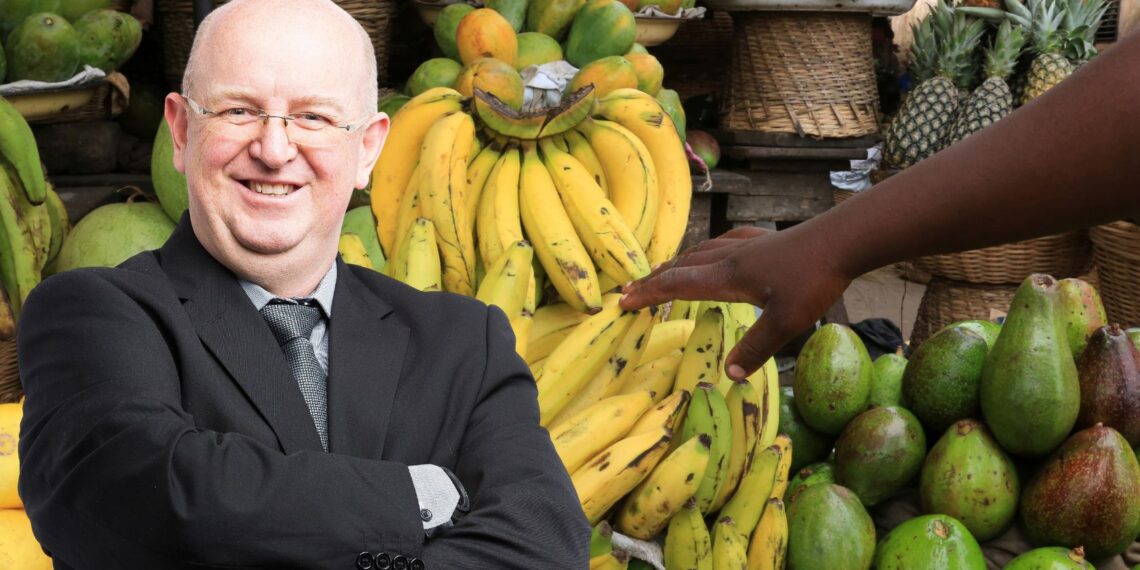
South Africa’s agriculture sector is a paradox. Despite contributing significantly to the economy and employing over 924 000 people, food insecurity at the household level is rising. Dawie Maree, head of information and marketing for agriculture at FNB Business, discusses food security challenges and solutions.
Despite its relatively small share of the total GDP (roughly 2.6%), agriculture is an important sector of the South African economy. The primary agricultural industry employed 924 000 people in 2024, making it the country’s largest employer by industry, with employment weighted towards rural areas.
Agriculture also makes up around 10% of our exports, with a record of $13.7 billion in 2024, and has a prominent indirect role in the economy as a purchaser of goods and supplier of raw materials for beneficiation. If you take these value-chain linkages into account, agriculture’s contribution to GDP is closer to 12-15%. But agriculture is more than a driver of economic growth; it feeds our country and supports our food security.
President Cyril Ramaphosa has made it clear that South Africa will use its presidency of the Group of 20 (G20) and hosting of the G20 and Business 20 (B20) forums in 2025 to articulate a set of aspirations for Africa and to seek collective solutions to the overlapping and mutually reinforcing crises facing the world.
One of these crises, which in many ways encapsulates the complexity and ramifications of a deeply interconnected world economy, which is currently being tested in an unprecedented way, is food security.
Food security cuts to the heart of many of the most pressing and contentious challenges facing the world today: climate change, trade, protectionism, land claims, water scarcity, technology, poverty, inequality, and moral imperatives in international relations.
Related stories
- Agri-transformation: Nurturing new-era farmers for food security
- Banking on seeds: Fowler’s bold plan for food security
Why food is out of reach for many
Food security is defined by the Food and Agriculture Organisation of the United Nations (FAO) as “all people, at all times, [having] physical, social and economic access to sufficient, safe and nutritious food which meets their dietary needs and food preferences for an active and healthy life.”
Food security is dependent on the affordability, availability, and nutrition of food, on the stability of access, and the contribution and sustainability of ecological, economic and social systems.
Food security is measured at both national and household levels. There is a paradox when we look at food security in South Africa. At a national level, we are food secure. We rank only behind Morocco in terms of food security on the continent.
We are Africa’s largest agricultural exporter. But despite this surplus, at a household level, access to food is variable and unequal. Food Security Report for 2019, 2022 and 2023 indicates that ‘the proportion of households in South Africa that experienced moderate to severe food insecurity was estimated at 15.8% in 2019, 16.2% in 2022, and 19.7% in 2023.” We are becoming less and less food secure at the household level.
Our ability to increase food availability and access at a household level is inextricably linked to our level of economic growth. We have made progress in addressing the issue directly through household grants, school feeding schemes and other social-support initiatives, but the simple fact is that South Africa’s population is growing more quickly than its economy, and real incomes are diminishing as a result.
What will it take to fix it?
Addressing food security will depend on a myriad of complex interrelated issues, and the coordinated efforts of public and private organisations and institutions. It will require intelligent, far-sighted policymaking, ecological considerations, and a reckoning with our land-restitution programmes.
South Africa faces critical challenges from a supply side – water quality and availability are decreasing, and residential, industrial and mining sectors are encroaching onto agricultural land – as well as the more intractable demand-side challenges of low employment, poverty and inequality.
South Africa must continue to improve food security by expanding agricultural production and job creation across various economic sectors. Key actions include expanding agricultural activity in former homelands and government land, releasing government-purchased land with title deeds to beneficiaries, implementing effective blended finance schemes, and increasing government investment in critical infrastructure such as water, electricity, roads, ports, and laboratories.
The private sector has a role to play, and we will continue to offer financing and other financial products to commercial farmers, from small-scale to mega farmers, so that they can continue to produce food for the nation and grow their businesses.
As South Africa assumes the G20 presidency in 2025, it has an opportunity to address food security not just as a domestic concern but as a model for sustainable development across the African continent. This requires reimagining agricultural systems to be more resilient, equitable, and adaptive to uncertainty. It means acknowledging that food security is not merely about production volumes but about ensuring that every South African household is able to consistently afford and access nutritious food.
- Dawie Maree is the head of information and marketing for agriculture at FNB Business. The views and opinions expressed in this article are those of the author and do not necessarily reflect the views or positions of Food For Mzansi.
READ NEXT: Cattle and cover crops power vineyard regenerative study
Sign up for Mzansi Today: Your daily take on the news and happenings from the agriculture value chain.