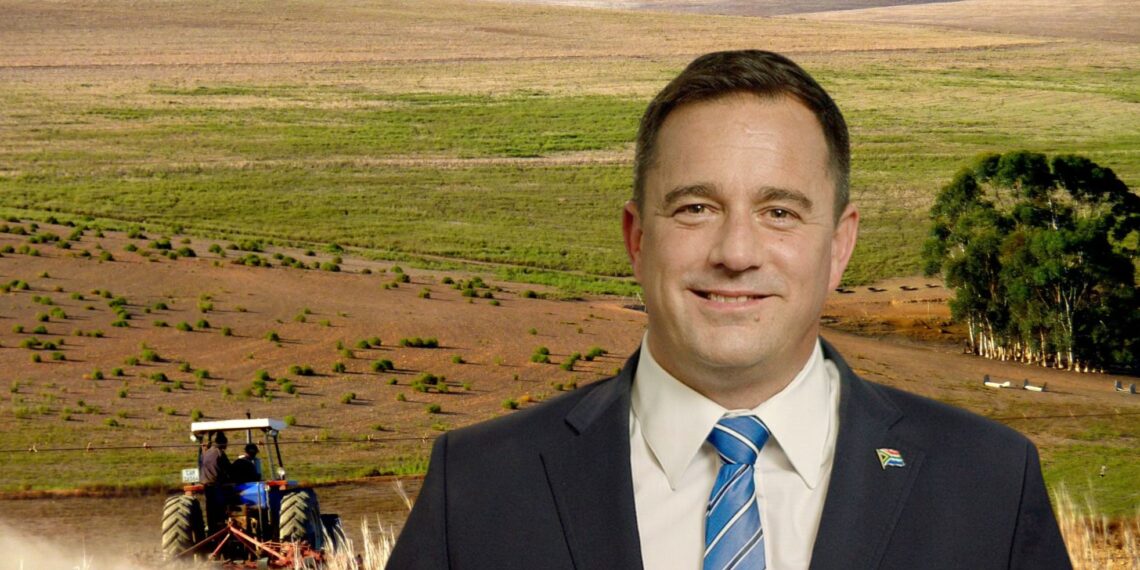
“Women in agriculture deserve more than applause. They deserve land, markets and real support,” says agriculture minister John Steenhuisen, reflecting on women breaking barriers in farming.
August is Women’s Month, a time for South Africa to pause and honour the strength, courage and brilliance of the women who shape our nation. In every sector, women are making history, breaking barriers and building futures. But nowhere is this more vivid, or more vital, than in agriculture.
Too often, when we speak about farmers, the image that comes to mind is not female. Yet every day, from the banks of the Orange River to the farmlands of the Eastern Cape, it is women who are tilling the soil, growing our food, raising livestock, sustaining rural economies and holding entire communities together.
And they are doing so not because the road is easy, but in spite of every obstacle in their path.
Take Kaweng Kedibonye Ellen, a farmer in Barkley West in the Northern Cape. She began her journey in 2013 with just four head of cattle and a handful of goats. Today, through sheer perseverance, she runs Kubu Kwena Farming, a diverse operation with over 400 animals, lucerne fields, pumpkins and watermelons. She employs six workers and sells her produce across Kimberley. Her farm is not just productive, it is alive with hope.
Or consider Siphesihle Kwetana in Mthatha, who established Siphe Development and Capacitation Agency on 25 hectares of land. She produces more than 280 000 seedlings a week and supplies Pick n Pay, Spar, Food Lover’s Market and government departments. She employs over 30 people, mostly women and young people, and still finds time to donate food to funerals, schools and the hungry. Hers is a farm rooted in compassion.
Then there’s Tryphina Mosomane, who turned her garage in Polokwane into a food processing operation, producing SABS-approved beetroot products in flavours ranging from chutney to garlic. Her company, TM Foods, now supplies 18 retailers in Limpopo and gives 25% of profits back to her community. She has also created jobs for 11 people, and dignity for dozens more.
These are not stories of charity. They are stories of power.
They show us what happens when women are given access to land, support and markets. They show us how resilient our people are when they believe the future has space for them. And they show us why agriculture must be central to our national project of social justice and economic growth.
Innovators, educators and trailblazers
Throughout our country, women are quietly leading revolutions in their fields.
In Stellenbosch, Carmen Stevens, who registered as the first 100% black-owned winery in South Africa in 2019, has not only built a successful wine business but has also used her profits to feed 25,000 schoolchildren in Belhar through her foundation. She knows that hungry minds cannot learn, and her legacy is as much in classrooms as it is in vineyards.
In Welkom, Keketso Mokgothu responded to the Covid-19 pandemic by creating Mtswako Immune Booster, processing juices from ginger, lemon and turmeric. From her kitchen, she now supplies Food Lover’s Market, Spar and pharmacies. Her story is one of innovation born in crisis, and proof that youth and women-led enterprises can scale with the right support.
In Masakhane, Zokhanyo Bikani teaches women and young people to grow vegetables in tight spaces using recycled materials. She is the only oyster mushroom supplier in the region and uses her farm as a classroom for the next generation of food growers.
Related stories
- Women who farm, lead, and grow the heart of Mzansi
- Force of nature: Amoré Viljoen revives black-owned fruit farm
- Tshwagong: Raising Brahmans, building dreams, feeding Mzansi
Even in the face of disability, women are not being left behind; they are leading.
Thandi Masilela, born with a disability, founded Vukuzenzele Protective Workshop in Bethal. She farms spinach, carrots, potatoes and pumpkins on a hectare of land and supports 16 beneficiaries, all of whom live with disabilities.
Victoria Matebogo Mouwane, who is hearing-impaired, runs a greenhouse empire in Westonaria, producing over 40 tonnes of tomatoes, peppers and spinach per cycle. Her business employs 41 people, many of them deaf, and her acts of kindness ripple across communities, from school lunches to food parcel donations to bicycles for her workers.
Beyond applause
These are the women who feed South Africa, literally and figuratively. And they deserve more than our applause. They deserve access to land, water rights, working capital, skills development, infrastructure and reliable markets.
As a department, our commitment to empowering women in the agricultural value chain remains unwavering. We recognise that access to land is only the beginning – what truly matters is what happens after. That is why our department prioritises women in every aspect of farmer support: from production inputs and infrastructure to extension services, market access and financing.
Through programmes such as Casp, Ilima/Letsema, the Agro-Fund and the Smallholder Market Access Tracker (SMAT), we ensure that women who acquire land, whether through redistribution, inheritance or purchase, are not left unsupported. They are given the tools, networks and opportunities to thrive. We are expanding agri-hubs and agri-processing nodes. And we are working to build inclusive value chains where the woman planting the seed can also have a stake in the packaging, the logistics, the shelf and the price. This is how we build not only inclusive farms, but an inclusive economy.
To the women of South African agriculture: this month, we celebrate you. But more than that, we commit to standing with you, not just in August, but in every season.
You are not only farmers. You are architects of hope. You are custodians of resilience. You are the ones who turn seeds into sustenance, hardship into harvests and dreams into food security.
May your hands remain strong. May your vision remain clear. And may the rest of us have the wisdom to walk beside you, and not in your way.
- John Steenhuisen is South Africa’s minister of agriculture. The views and opinions expressed in this article are those of the author and do not necessarily reflect the views or positions of Food For Mzansi.
READ NEXT: Nampo Cape: Sign up for sustainable veggie farming event