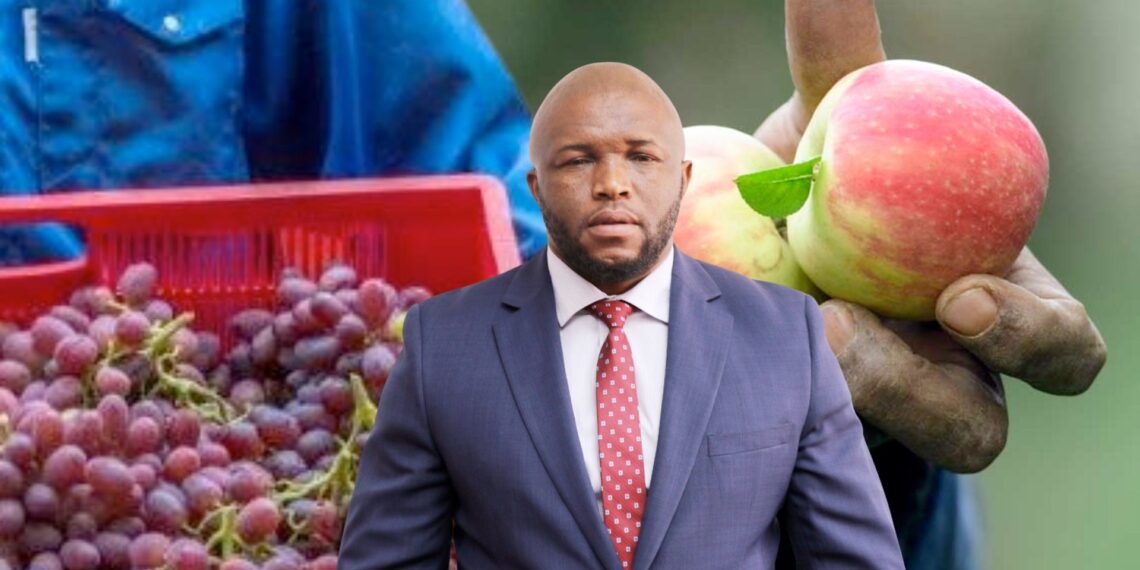
Thabile Nkunjana, senior agricultural economist with the National Agricultural Marketing Council’s (NAMC) trade research unit, says 2025 is off to a ripe start for South Africa’s agriculture sector, with a bounty of positive data and developments. The country is expanding its global reach with newly secured markets for grapes in the Philippines and apples in Thailand.
The agricultural sector in South Africa has started 2025 off well thanks to several encouraging events. Numerous data sets released by different government bodies support this viewpoint.
First, the agriculture sector continued to retain at least 924 thousand jobs by the end of 2024, according to the latest data from Statistics South Africa. This figure exceeds the 2020–2024 five-year average of 872 thousand jobs.
Second, the industry helped the country’s economy from entering a recession by contributing at least 0.4% of GDP in Q4 2024. Third, agricultural exports set yet another record at $13.7 billion (or R251 billion) in 2024.
Fourth, the first Crop Estimates Committee data predicts the harvest at 17.2 million tonnes, a combination of maize, sunflower seeds, soybeans, groundnuts, sorghum, and dry beans, up 11% from the previous season after a severe drought cut South Africa’s maize production by 20% in the 2023–24 production season.
Lastly, establishing new markets for grapes in the Philippines and apples in Thailand. After 16 years of trade talks with Thailand and 10 years with the Philippines, the ministry of agriculture announced an agreement between these countries and South Africa.
Without a doubt, these two markets will be crucial to making the country a more powerful player in African trade. They will also strengthen South Africa’s standing as a major producer and exporter of these products, which will encourage domestic manufacturing. The question is how much do Thailand and the Philippines import these products?
Thailand apple imports
After Taiwan, India, and Indonesia, Thailand was Asia’s fourth-largest importer of apples in 2023. Thailand imported $235.4 million, or R4.3 billion, worth of apples from throughout the world in 2023, a 38% rise from $1704 million in 2014.
As of 2023, China accounted for 69% of Thailand’s apple imports, valued at $162.5 million. New Zealand came in second with 19% ($44.6 million), the USA with 7% ($16.2 million), and France with 2% ($5.1 million). South Africa will face competition mostly from these nations for this market.
Between 2014 and 2023, the value of the leading apple suppliers to Thailand – the USA and France – decreased by 10.5% and 12.2%, respectively, while China, New Zealand, Japan, and Australia witnessed rises of 46.8%, 34.4%, 162.7%, and 298.4%, respectively.
Related stories
- SA’s agriculture: Volatile but full of potential
- Canada, it’s time to raise a glass to South African wine
Philippines grapes imports
The Philippines was listed as the seventh-largest importer of grapes from Asia in 2023. It imported $138.6 million (R2.6 billion) worth of grapes, 400% more than the $27.5 million it imported in 2014.
In 2023, China accounted for 73% ($101.4 million) of the Philippines’ grape supply, followed by Australia (17%) ($23.3 million), the United States (8%), and Chile (1% ($1.5 million). South Africa will face competition from these countries for this market.
Between 2014 and 2023, the United States and Chile, the Philippines’ top grape suppliers, had declines of 38.8% and 63.5%, respectively, while China and Australia saw notable growth throughout the same time frame.
The fact that the Philippines exports very few grapes may be a sign that they depend on imports to maintain their grape consumption and that there is potential for growth in imports over the coming years.
In conclusion, for the past few years, South Africa’s agricultural product, grapes, has continuously ranked among the top two most valued and exportable products, bringing in billions of rands annually. Grape exports hit a high of R14.9 billion, or $818.8 million, in 2024. With exports of R10.7 billion, or $575.1 million, in 2024, Apples, another important product produced by South Africa, came in at number five on the list of the countries’ most exportable products globally.
Additionally, these two markets are essential for locally boosting production, creating new jobs in the industry, and remaining a vital sector for the countries’ economy, as demonstrated most recently by the agriculture sector’s significant contribution to preventing South Africa’s economy from entering a recession in the fourth quarter of 2024.
- Thabile Nkunjana is a senior agricultural economist with the National Agricultural Marketing Council’s trade research unit. He writes in his personal capacity. The views and opinions expressed in this article are those of the author and do not necessarily reflect the views or positions of Food For Mzansi.
READ NEXT: Can organised agriculture unite to empower new-era farmers?
Sign up for Mzansi Today: Your daily take on the news and happenings from the agriculture value chain.