South Africa’s sheep shearing champions were celebrated in the Western Cape this week after the country secured its sixth consecutive world title in hand shearing at the Golden Shears Championships in Masterton, New Zealand.
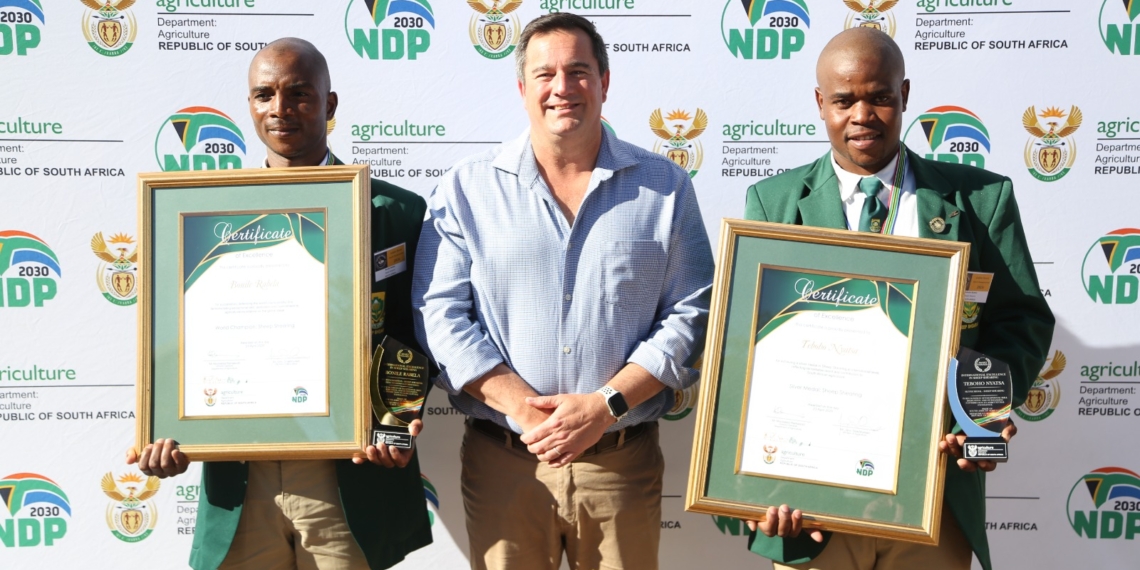
Agriculture minister John Steenhuisen used a ministerial recognition ceremony at Beyerskloof Wine Estate in Stellenbosch to praise the athletes behind the victory and the wider wool industry that helped produce them.
The champions, Bonile Rabela and Teboho Nyatsa, were honoured alongside team leader Izak Klopper and judge Andries Pretorius, who represented South Africa at the prestigious global event.
Steenhuisen said South Africa’s continued dominance in one of agriculture’s most demanding disciplines reflected far more than individual talent.
“We are not simply marking a win. We are marking a sustained standard of excellence that very few countries, in any field, are able to maintain,” he said.
“For the sixth consecutive time, South Africa has been crowned world champion in hand shearing. To reach the top once is an achievement. To stay there, year after year, against the best in the world, requires discipline, consistency and an almost relentless commitment to getting the details right.”
Praise for champions
Rabela, already recognised as one of the finest hand shearers in the world, successfully defended his title.
Steenhuisen described the achievement as the result of years of dedication and technical mastery.
“To defend your title as the world’s best hand shearer is an extraordinary achievement,” he said.
Nyatsa (26) returned home with a silver medal after competing internationally for the first time. Originally from a village outside Burgersdorp in the Eastern Cape, he developed a love for shearing in a region where the craft is deeply rooted.
After completing matric, Nyatsa trained in sheep shearing and rose quickly through local and national competitions. He now works as a blade and machine shearer for Nyatsa Rural Shearing Services in the Free State.
Steenhuisen said Nyatsa’s performance showed that South Africa’s excellence was being renewed by a younger generation.
“What you have shown is that this excellence is not confined to one generation. It is being carried forward, strengthened and redefined.”
Nyatsa has said his long-term ambition is to establish his own shearing team and train young people in blade and machine shearing.
Leadership behind the scenes
The minister also highlighted the role of Klopper, saying world-class performances depend on strong preparation and steady leadership.
“Sustained success of this nature does not happen without strong, consistent leadership,” Steenhuisen said.
As team leader, Klopper was credited with guiding athletes, managing pressure behind the scenes and ensuring South Africa arrived on the world stage ready to compete.
Pretorius was also recognised for serving as a judge at the championships, a role Steenhuisen said reflected the depth of South African expertise.
Related stories
- EC farmers receive 300 sheep to boost wool industry
- Tech and transformation boost SA’s wool and mohair industries
- Wool exports rebound amid industry transformation
- Farm women demand faster land reform, end to unfair evictions
Wool industry in strong position
The ceremony also turned attention to the health of the domestic wool sector, which has seen a sharp market recovery.
South Africa produces around 40 million kilograms of wool annually. Combined with Lesotho, regional production reaches roughly 45 million kilograms, with most of the clip destined for export markets.
According to industry figures, wool prices have surged by 51% since the start of the current season in August 2025, surpassing levels last seen during the 2018 peak.
Steenhuisen said rising demand for high-quality, sustainably produced wool had strengthened South Africa’s global position.
“The fact that South Africa commands a premium in these markets is not accidental. It is built on quality, on consistency, and on the kind of technical excellence demonstrated in New Zealand,” he said.

Traceability and sustainability edge
Industry leaders say one of South Africa’s greatest strengths is its traceability system.
Cape Wools, the representative body for the industry, has digitised the wool supply chain using GS1 standards, allowing products to be tracked from farm of origin to export point.
This is expected to place South African wool in a favourable position as the European Union moves toward Digital Product Passport requirements, which will demand more transparent product information and sustainability data.
South Africa is currently the second-largest producer of apparel wool in the world and the largest supplier of sustainably certified wool.
The Sustainable Cape Wool Standard also includes detailed requirements around animal welfare and shearer welfare, ensuring wool is harvested efficiently and ethically.
Rural livelihoods at stake
The wool industry supports an estimated 8 000 commercial farmers and 43 500 communal farmers across South Africa.
In communal areas alone, more than 960 shearing sheds serve as annual collection and marketing points where wool is harvested and sold through the auction system.
This gives shearing skills a direct link to rural incomes, employment and economic resilience.
Steenhuisen said agriculture should never be viewed only through hectares and export figures.
“At its core, it is a human endeavour. It is about skill, about pride in workmanship, and about people who take what they do seriously enough to keep improving it over time,” he said.
The newly formed Wool Empowerment Trust is expected to focus on the development of communal and emerging farmers in partnership with provincial and national government departments, with the National Wool Growers Association as a strategic partner.
For Steenhuisen, the success of South Africa’s shearers offered a wider lesson.
“You have done more than win a title. You have set a standard. You have demonstrated what South African agriculture is capable of when talent, leadership and discipline come together.”
With six straight world titles secured, South Africa’s shearers have once again shown that excellence in the shearing shed can echo across the global stage.
READ NEXT: Tongaat R200m lifeline brings relief to KZN growers