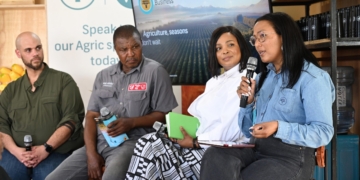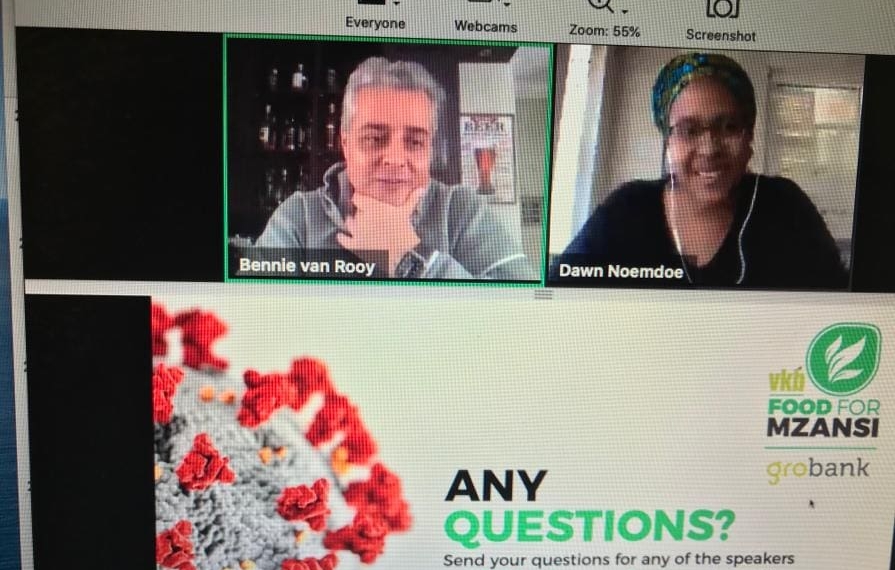
 “There is no returning to normal after covid-19, but there is a path forward – and that path is to transforming the South African food systems,” says Gauteng farmer Mandla Phaahla, one of the 1 355 people who tuned in to Food For Mzansi and Grobank’s historic first farmers’ webinar today.
Top agricultural leaders, including Christo van der Rheede from Agri SA and Dr. Vuyo Mahlati from Afasa, counted among the panellists who spoke about the future of South African agriculture post covid-19 during a webinar of nearly five hours.
Dawn Noemdoe reports that the keynote speaker, Dr. Naudé Malan, a senior lecturer in development studies at the University of Johannesburg, called on farmers to survive the pandemic by building what he described as a “resilient and circular agricultural enterprise”.
“I would like to see some farms that produce one thing, and one thing only: compost. To flourish in the future at least 30% of your farm must consist of compost,” implored Malan, who champions sustainable farming. He is the founder of Izindaba Zokudla, an isiZulu phrase for “conversations about food”. The Soweto-based research project creates opportunities for urban agriculture.
READ: The township food revolution has started

According to Malan it is important that farmers start thinking innovatively. He believes they will have to diversify their operations and warned that a food security crisis could be dramatically more catastrophic than covid-19 – the biggest pandemic since 1918.
Malan emphasized that the pandemic is likely to make more people demand to know where their food comes from. This, he says, presents an opportunity for many farmers to showcase their production processes, guarantee food safety and grow their market identity.
- LISTEN: Agriculture in Mzansi needs to rethink who it serves
- WATCH: ‘Back to basics’ is the way forward for farmers
‘Create local, but think global’
Mahlati, president of the African Farmers’ Association of South Africa (Afasa), echoed Malan’s sentiment, saying, “Coming out of this crisis, customers will be even smarter and more demanding and will want to know what they are eating. It is important that we look at the traceability in the environment.”
Duncan Masiwa reports that Mahlati, who served on pres. Cyril Ramaphosa’s land reform advisory panel last year, reiterated that “the new future” demands of farmers to “act local and impact global”. She says, “It’s the way to go. Worry about what happens in your homes, and in your neighbourhoods. Look at the inefficiencies and inequalities within your localities in order to drive agrarian reform post covid-19.”

She also stresses that farmers and agricultural workers, who count among the list of essential services exempted from the 35-day lockdown, are grateful that they can feed the nation. “We are thankful for being alive and being exempted to keep society alive.”
The global director of the International Women’s Forum believes that the webinar by Food For Mzansi and Grobank ushers in a new future for small-scale farmers whom she described as “the heartbeat of survival and sustenance”. Mahlati asked farmers to take care of themselves and their workers during the pandemic. “This doesn’t mean we should be reckless. We have to be vigilant. We cannot be the ones afforded the opportunity to keeps others alive while our spaces are infested (with covid-19).”
‘Don’t waste billions on SAA, invest in agriculture’
Noluthando Ngcakani reports that Agri SA’s deputy executive director, Christo van der Rheede, sketched the many lockdown struggles farmers are experiencing, including with the police who do not always grasp that they are providing an essential service. He welcomed the many government initiatives to support the agricultural sector during the pandemic, including the R1.2 billion emergency funding for small-scale farmers who are currently in production and preparing for winter crops.

“But we need radical financial interventions to ensure the liquidity of the system at this point in time,” says Van der Rheede. “Instead of spending billions on SAA or billions on state-owned enterprises that are not functioning optimally and that’s just costing the state money, this is one industry (agriculture) where government can channel a lot of funding towards and make sure that funding is well spent.”
Van der Rheede encourages farmers and South Africans to become more sensitive to the plight of those who are struggling financially during the extended lockdown. “We have embarked on a completely unknown path. But at the same time, we can only survive this journey if we start to show respect for each other. If there is respect, we start to take each other’s circumstances into consideration.”
Building ‘an agricultural community bank’
Sinesipho Tom reports that Grobank CEO Bennie van Rooy stressed the importance of collaborative efforts to flourish beyond covid-19. He says, “We recognise the value of partnerships. No one can own the full food value chain and they shouldn’t. Powerful partnerships will transform South Africa’s food value chain.”

Grobank (formerly SA Bank of Athens) aims to be a “agricultural community bank and not just a bank that services large corporations”.
Van Rooy says, “We see our community as the food value chain. We are working on products to support small-scale farmers and subsistence farmers. Solutions for the agricultural space don’t get developed in fancy offices in Sandton, but on the ground with farmers and people who spend time with their hands in the earth.”
Van Rooy spent a large part of his presentation answering questions from farmers and other participants who had tuned in from their lockdown locations across South Africa and even as far as India, Sweden and Switzerland. He says Grobank is focused on exploring new partnerships, including the possibility of a banking product with a mobile operator, and retirement funds for farm workers.
“Our aim is to change the commercial model around access to finance. We are working with partners to develop these models. How do we take micro-farmers and help them to graduate into small, medium and large commercial farmers? What aggregation models can be employed? This is a focus area for us. Our business banking function is very focused on manufacturing and processing functions, as well as sustainability-related businesses.”
Remove barriers for ‘small players’

Furthermore, Duncan Masiwa reports that Dr. Sifiso Ntombela, chief economist of the National Agricultural Marketing Council (NAMC), used his presentation to re-imagine the agricultural and food sectors in South Africa whilst minimising job losses and ensuring that “barriers for small players” were removed.
Ntombela says, “Domestic support to farmers and agribusinesses must be improved. Enhanced investment on research, technology and infrastructure is required. Inclusive food value chains and de-concentrated markets are needed. Also, a stronger focus needs to be put on household food security and upskilling farmers and workers, as well as increased online distribution and modernised trade facilitation.”
‘If you’re not online, you’re invisible’
Closing the webinar, the CEO of YehBaby Digital, Ronelle Louwrens, encouraged all participants to flourish post covid-19 by revolutionising their digital strategies. Amid the disruption caused by the pandemic to established markets and supply chains, there could be opportunities for farmers who think on their feet and can move quickly to fill the gaps.

She adds that “digital life” had been gaining momentum like a wave for some time now, and that the coronavirus has sped up the adoption of online services and ways of doing business.
“Remember, if you’re not online you are invisible to many potential markets, clients and customers. And it is as important to act consistently online as it is to be consistent in the produce that you sell.”
Covid-19 threatens food security in Africa
Ivor Price reports that the farmers’ webinar follows an emergency meeting by Thoko Didiza, the minister of agriculture, land reform and rural development, in which she cautions members of the African Union that food security could be a “major challenge” for Africa in the wake of the covid-19 pandemic.

Didiza was addressing the AU and Food and Agriculture Organisation of the United Nations (FAO) during a virtual meeting co-hosted by the FAO director-general, QU Dongyu. Last year, Didiza was elected chairperson of the African Union’s specialised technical committee on agriculture, rural development, water and environment.
“While covid-19 is primarily a health matter, its profound impact on the economy and social life cannot be underestimated.” – Thoko Didiza
Didiza says, “As decision-makers in various countries, we are fully aware of the need for food security, particularly at this time. And we believe that this is going to be a major challenge for the African continent in the coming months.
“We’re all aware of the negative impact restrictions have had on the trade of agricultural and foodstuffs. This is an area that will need to be addressed, particularly restrictions on exports, to ease concerns of food insecurity. Such export restrictions on agricultural and food trade will negatively affect countries that depend on imports. Also, export restrictions are against the spirit of strengthening Africa’s intra-regional trade.”