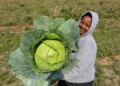
Equipped with a degree in public governance from North-West University, Nhlalwenhle Rapodile combines practical farming with policy insight on his 10-hectare farm. In Meyerton, Gauteng, at Fresh Flow Farms – the business he started with Thomas Nxumalo – his knowledge of rules and planning helps guide how the farm grows, both in the fields and behind the scenes.
Rapodile’s decision to step into farming was shaped by personal experience, watching his parents adjust to life after retirement.
“We moved from the suburbs to the farm, and I saw how my parents were really trying to make it work after retirement. I thought, ‘I’m young, and there are so many opportunities in agriculture, maybe I should take this over,’” Rapodile says.
This personal commitment soon paved the way for a larger vision, one that grew in partnership with a neighbour who shared his passion and drive.
What began as a personal decision to support a family farm soon evolved into a collaborative venture with his like-minded neighbour, Nxumalo Together, they merged their family plots, five hectares each, into a 10-hectare business officially registered in 2023 as Fresh Flow Farms.
Building a business together also meant crafting a brand that reflected who they were and what they stood for.
“We wanted a name and brand that speaks ‘youth and energy’. A lot of farms use traditional names with abbreviations. We wanted something fresh, and that’s how Fresh Flow was born,” Rapodile says.

A fresh start
Before co-founding Fresh Flow, Rapodile’s exposure to farming had been limited, but it was enough to plant the seed of possibility.
Although he didn’t start entirely from scratch, Rapodile’s early experience came from visiting a distant uncle’s farm. Their own journey began with spinach and quickly expanded to coriander, butternut, lettuce, spring onion, and a variety of herbs such as thyme and rocket.
As their crop selection grew, so did their ambitions to explore new avenues in the market. Now, they’re experimenting with new opportunities while staying grounded in what works best.
“We’re not fully focused on herbs yet. Vegetables are still our main commodity, but we’re tapping into herbs as a niche,” Rapodile shares.
Related stories
- Tech-savvy Mdletshe turns tiny plot into harvest haven
- Protect your farm: Legal landmines you can’t afford to ignore
- Graduate to grower: Mashau fertilises farm dream on one hectare
Getting their produce into customers’ hands, however, came with its own learning curve.
Breaking into the market wasn’t easy. At first, Fresh Flow relied on the traditional route of selling at the Johannesburg market. “It was costly, so we decided to try the flea market next to us that happens every Saturday. We just filled up a bakkie and went. It was a good day in business.”
That single day of taking a chance opened the door to a more consistent and rewarding sales stream.
The exposure paid off. A local Spar store manager noticed their quality produce at the flea market, and soon they began delivering regularly to Spar and other clients. Today, their spinach yield supports weekly deliveries of over a ton, with additional sales at the local flea market, though limited to under 100 bunches to preserve stock for other clients.

Farming sustainably
At Fresh Flow Farms, sustainable practices are woven into daily operations, from natural soil enrichment to careful water management, as the team works to produce healthy crops with minimal environmental impact.
“We use organic manure made from goat and cattle dung processed by a friend of ours. It’s chemical-free and works well,” Rapodile explains.
While their approach is rooted in sustainability, achieving official organic certification remains a future goal. Though Fresh Flow describes itself as sustainable, the farm isn’t certified organic yet.
The homemade composted manure is not only cost-effective but also helps improve soil health and water retention, key benefits in the face of climate variability. The team uses it across their 10 hectares – all without synthetic fertilisers or chemical inputs.
Water-wise practices are equally important, especially when farming year-round. Their irrigation relies mainly on a borehole, supplemented by rainwater.
Spinach is planted throughout the year, with higher costs during winter due to increased water usage and the need to cover crops. “We increase our prices slightly in winter to sustain operations. With coriander, summer is actually more expensive because of the insects,” he says.
READ NEXT: Hijacked and left for dead: KZN farmer finds healing in the soil
Powered by family
Behind the rows of vegetables and herbs is a strong support system of family and shared responsibility.
For a long time, the two founders managed everything themselves, from planting to harvesting and delivery. “Now, we hire people, and our families help out when needed. Sometimes, we just get the whole family out and harvest,” Rapodile chuckles. “They have no choice.”
Even as the farm grows, navigating support systems and paperwork has been a learning process.
While they haven’t yet received government support, Rapodile says they’re working on the applications and compliance. “We’ve been doing everything ourselves, and sometimes that’s slowed us down. But we’ve realised we need to focus more on admin, so now we’re aiming to step into our roles as agripreneurs and oversee the farm, rather than do all the work ourselves.”

Challenges, lessons and a vision for the future
Like many young farmers, Rapodile has faced his share of obstacles, but limited resources remain a standout concern.
Among the biggest challenges? Being under-resourced. “Clients want more than what we can supply. We outsource a bit, but we’d love to fully utilise all 10 hectares.”
Still, even in the face of these constraints, he remains hopeful and driven by a bigger purpose.
Rapodile remains optimistic. “What keeps me going is the vision of where this could go. It could be something generational that feeds my family. I want to control the whole value chain, from farming to processing and value-added products.”
When it comes to advice for other young farmers navigating the same uncertain path, his message is rooted in resilience.
Encouragement he would give to young farmers like himself would be simple: “Stay persistent. There are times you want to give up. Farming isn’t instant profit, and at our age, you sometimes feel like you’re working harder than your peers for less. But don’t give up. Visualise the growth and stay focused.”
Beyond the day-to-day challenges, Rapodile’s education is proving to be a strategic advantage.
With a background in public governance, Rapodile is integrating policy knowledge into the business. “There are a lot of legal things you need to look at when farming: resources, soil usage, and compliance. Many farmers get stuck there, but I’m applying my degree to help navigate that.”
And while his roots are firmly planted on the farm, his aspirations reach all the way to the policy-making table.
His long-term vision stretches well beyond the fields of Meyerton. While he’s currently focused on building a successful farming enterprise, Rapodile sees himself one day shaping agricultural policy at the highest level.
“Maybe one day I’ll be the minister of agriculture. That’s the dream,” he says.
READ NEXT: Hydroponics beginner’s guide: Grow more crops in less space