Nestled between towering mountains and rolling vineyards about 75 kilometres east of Cape Town, Franschhoek is internationally celebrated for its award-winning wines, historic Cape Dutch architecture and vibrant culinary culture. Oak-lined streets, boutique guesthouses and art galleries attract visitors from across the world.
But beyond the postcard-perfect landscapes lies another Franschhoek – one shaped by inequality, environmental strain and the daily realities of informal settlements that sit alongside luxury estates and tourist attractions.
It is here, in between the vineyards, that the University of Cape Town’s (UCT) Water Hub is quietly transforming wastewater, waste and discarded landscapes into something far more hopeful: a living laboratory for sustainability, innovation and social change.
At a former wastewater treatment plant once left vandalised and abandoned, researchers, students and community members are working together to rethink the relationship between water, food, energy and human dignity.
It was on a chilly autumn day that UCT News sat down with Emeritus Professor Kevin Winter, director of the hub. The interview was conducted amid a busy schedule, as Winter was preparing to lead a large group of scholars from across the continent on a tour of the facility.
For Professor Winter, who is affiliated with UCT’s Future Water Institute, the site represents both environmental repair and a new way of producing knowledge – living to the town’s mantra of the valley of dreams.
“This is a research site that started out trying to clean water from an informal settlement,” he explained. “If we are going to save the planet, we must learn how to clean water without adding more chemicals – and make that water productive.”
The facility, stripped and vandalised between 2013 and 2016, forced researchers to reconsider conventional approaches to water treatment. Instead of relying on expensive infrastructure and chemicals, the team began exploring how nature itself could become part of the solution.

“We began with nature-based processes and nature-based material,” Winter said. “Learning from nature – seeing how nature cleans water without adding chemicals.”
Today, the site operates almost entirely on solar energy. Wastewater passes through a network of constructed wetlands, biofilters, stone beds, sand filtration systems and biochar before being reused to irrigate vegetable gardens growing spinach, beetroot, onions and sweet potatoes.
Related stories
- SA’s water crisis: A permanent threat to farming and economy
- ‘Our power, our planet’: Farmers innovate to protect soil and water
- Fixing pipes isn’t enough to save communal irrigation schemes
- Pesticide pollution in WC rivers threatens child health
A vision beyond clean water
But the Water Hub’s vision stretches beyond clean water.
“If we are going to save the planet,” Winter said, “we must learn how to clean water without adding more chemicals – and make that water productive.”
The research has become increasingly urgent as pollution levels in the river system continue to worsen.
“I predominantly work on nature-based treatment systems for removing contaminants from highly polluted surface waters,” said Nicklin, a doctoral researcher in UCT’s Department of Environmental and Geographical Sciences.

The Water Hub sits downstream of the Langrug informal settlement, where inadequate sanitation infrastructure, poor drainage systems, and illegal dumping all contribute to severe river contamination.
“This river has been identified as highly polluted, mostly due to runoff from the informal settlement upstream,” she explained. “Grey water, sewage and litter all enter the river system, and what we’re trying to do is treat that water so it can safely be reused, particularly for irrigation.”
“There are thresholds that these systems can cope with. As pollution intensifies, we’ve had to constantly adapt and redesign aspects of the system.”
Unlike conventional wastewater treatment plants, the systems at the Water Hub rely on passive, low-energy ecological processes.
“They don’t require chemical energy, and they’re generally lower cost,” Nicklin said. “They may not replace large wastewater treatment works, but they can complement them in decentralised ways.”
Yet as settlements expand and service delivery struggles to keep pace, the environmental pressures are intensifying.
“There has definitely been a deterioration,” she said. “We’ve seen increasing levels of E. coli in the river, which indicates more sewage entering the water system.”
The worsening pollution has also pushed researchers to adapt their systems constantly.
“There are thresholds that these systems can cope with,” she said. “As pollution intensifies, we’ve had to constantly adapt and redesign aspects of the system.”
Restoring dignity in communities
But the Water Hub is not only about scientific experimentation. It is equally about people, livelihoods and restoring dignity within communities that have long lived alongside environmental neglect.
For community activist Sbongukuhle Siyengo from Clean Health Environment NGO, the polluted river was impossible to ignore.
“I noticed that people were dumping waste into the river, which attracted rats and created unhealthy living conditions. Even when the river was cleaned, it would quickly become dirty again.”
Sbongukuhle Siyengo
Concerned about children playing near the contaminated water, Siyengo began cleaning sections of the river herself. Over time, community volunteers joined her, and a small park began in previously neglected areas.
“Many people suffer from illnesses such as TB because of the environment they live in,” she said. “Children often walk barefoot and are exposed to infectious diseases. That is why I started involving children in the project – so that people who dump waste could see, through the children, that the area deserves to be clean and safe.”
Siyengo said support from the Water Hub has helped create opportunities for volunteers while strengthening environmental awareness within the community.
“Today, people are starting to stop dumping because the community now identifies those responsible,” she said. “They also protect the park because they see how it is changing the environment for themselves and their children.”
The Water Hub has also become a training ground for young people seeking practical skills in agriculture and sustainability.
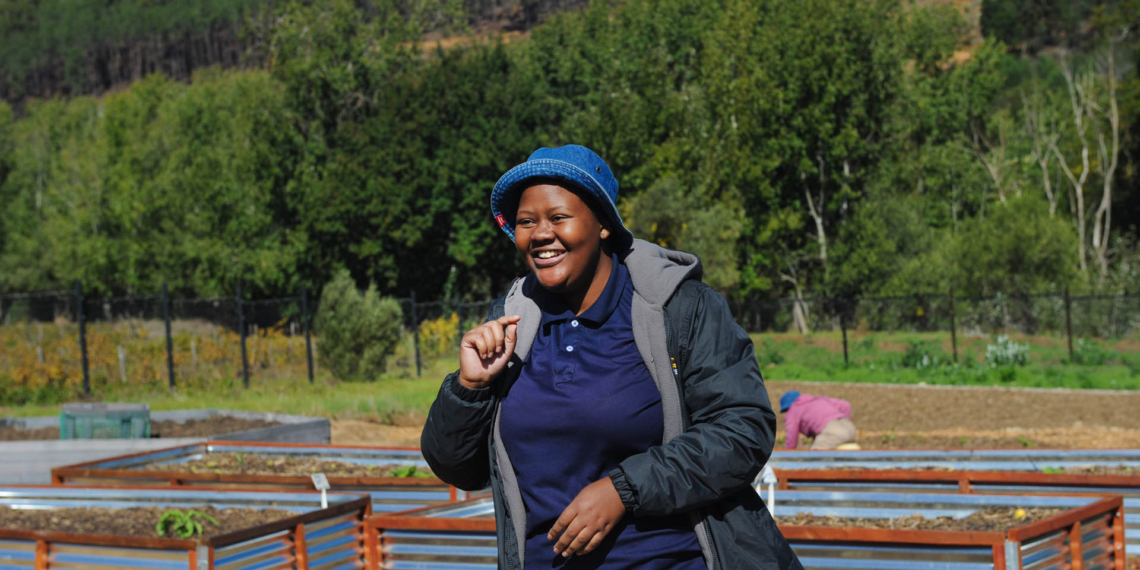
Among them is Sanele Luwata, who joined earlier this year.
“When we started, it was just open land with no garden beds,” she said. “We added compost, sand and biochar to prepare the soil for planting.”

Working alongside researchers and community members, Luwata has developed skills in irrigation, crop cultivation and sustainable agriculture. “I have gained skills, and if I go back home, I can plant vegetables for myself and my family.”
The gardens form part of a broader vision to create a circular local economy where treated water supports food production, food waste is converted into compost or biogas, and local produce supplies markets and soup kitchens.
Every Saturday, the team hopes to eventually sell vegetables and smoothies during market days while donating food to vulnerable households.
“This is a hungry nation in a water-scarce environment,” Winter said. “Food is going to become the most important part of a household budget.”
Adapting to a changing climate
Beyond water treatment and agriculture, the Water Hub also supports climate adaptation research through initiatives such as the “Cool Shack” project, which studies how informal homes can be made more liveable during extreme heat conditions.
Researchers have recorded indoor shack temperatures exceeding 50°C during peak summer heat.
“How do you cool a shack?” Winter asked. “How do you make it liveable under changing climate conditions?”
“I think sometimes there’s a gap in academia between research and reality. Working in a place like this forces you to confront those realities directly.”
For Nicklin, one of the most important lessons from the Water Hub has been learning how research must engage directly with lived realities.

“You can’t always conduct neat, controlled experiments here,” she said. “There are breakdowns, theft, vandalism, changing weather conditions – you constantly have to adapt.”
Yet those challenges have also made the work more meaningful.
“It’s taught me to problem-solve and respond to actual societal needs,” she reflected. “I think sometimes there’s a gap in academia between research and reality. Working in a place like this forces you to confront those realities directly.”
At the centre of the Water Hub’s work is an understanding that sustainability cannot be separated from inequality, public health or community empowerment.
“It’s a tale of two rivers,” Winter said, describing how water systems mirror the social divides of South African society.
But amid polluted waterways and growing climate pressures, the project is also demonstrating what becomes possible when universities, communities and researchers work together.
“We must generate African solutions to African problems,” Winter said. “And that will not happen through one discipline alone.”
- This article was first published by UCT News.
READ NEXT: Hunger crisis: SAHRC demands action on food affordability