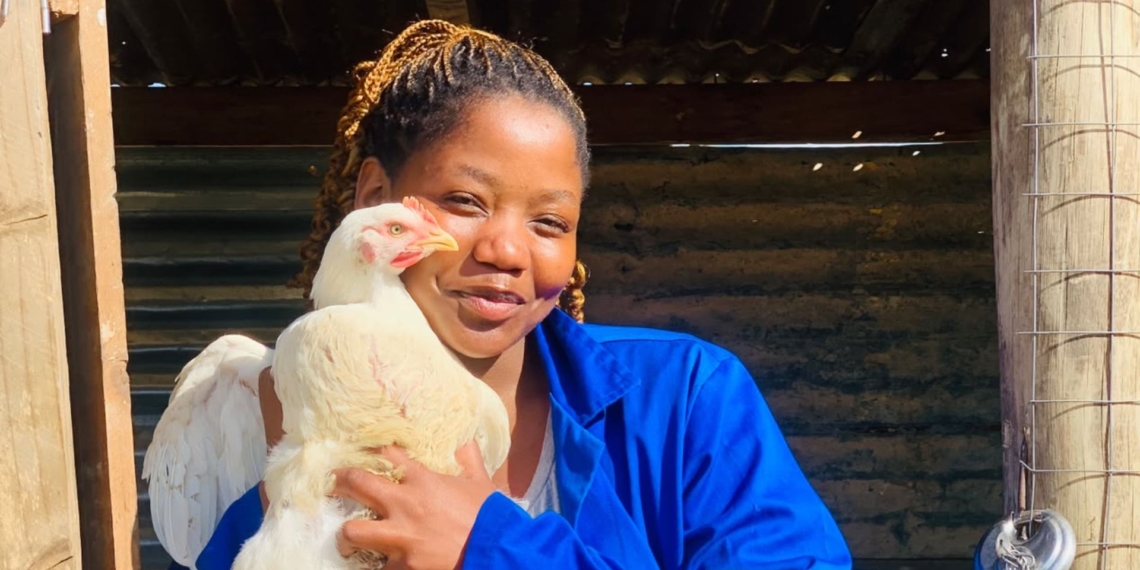
Xolelwa Mthetho once dreamed of a life on the silver screen. However, witnessing food insecurity in her community shifted her path entirely toward agriculture.
Before even attending her graduation ceremony at Nelson Mandela University, she was already setting up her business. Today, the agricultural management graduate runs Kwande Poultry Farm.
The enterprise produces quality broiler chickens directly from her home village of KwaNdungwana in Cofimvaba, Eastern Cape.
Farming dream takes flight
While looking for employment, Mthetho noticed a major gap in her village’s market: residents were entirely dependent on travelling to town just to buy basic goods. Recognising an opportunity, she decided to venture into farming while waiting to graduate.
In February 2026, Mthetho approached her mother with an ambition that had been brewing since 2024, when she first registered her business, Kwande Poultry Farm. Operating on a zero budget, her mother, Bongiwe Fungile, stepped in to provide a vital lifeline.
“I was unemployed. However, I had always shared my vision of starting a poultry business with my mother. She works as a cleaner and cook at a nearby school, earning about R2 000 per month. Yet, she believed in my dream and gave me R1 200 from her salary to help me place my first chick order.”
This passion for agriculture was not accidental. Mthetho explains that her interest began in grade 11, when she developed a strong fascination with genetics. “I became captivated by how genes influence the characteristics and performance of plants and animals.”
By the time she finished matric, her career path was clear. She applied for agricultural programmes and went on to enrol at Nelson Mandela University.
“When I started university, I knew that I loved agriculture, but I was still uncertain about which specific area I wanted to specialise in.”
To test her commitment during her first year, she bought five ewes. That single hands-on decision, she tells Food For Mzansi, ultimately anchored her to a lifelong career in farming.
Related stories
- Cultivating crops is second nature to Morodi
- Mthethwa sets her sights on commercial success in Lusikisiki
- Soil to shelf: Sidzumo turned hardship and hunger into hope
- Soweto seedling farmer turns old school into thriving agri-hub
Outgrowing the village market
Mthetho started with 50 chicks per cycle but now raises 200 birds per batch. This scale works well for her, as it allows for close monitoring and easier management.
“I usually wait at least two weeks between batches before introducing new birds,” Mthetho explains. “This allows me to clean properly, reduce disease risk, and prepare the area for the next cycle.”
While biosecurity is more manageable at this scale, it remains critical, especially when batches overlap in age. She notes that the main risk stems from movement between younger and older birds rather than direct contact.
She prevents cross-contamination and strictly controls her movement and feeding order. At this stage, she emphasises that consistency and discipline matter far more than the size of the flock.
Since launching, the community has shown immense support, with business growing through word of mouth and social media. Although her target market is her village and the surrounding areas, she currently cannot meet the local demand.

However, this does not stop her from dreaming big. In the coming years, Mthetho envisions Kwande Poultry Farm becoming a consistent supplier for both local communities and retail shops.
“I want to expand production, improve biosecurity systems, and stabilise my batches so I can meet larger and more consistent demand,” she shares.
To achieve this, she is focusing on scaling production, upgrading housing systems, securing reliable market agreements, and finding funding to improve her infrastructure.
Building a meaningful agribusiness
Mthetho’s passion for agriculture grew steadily throughout her studies. She notes that a major turning point came when Dr Ernest Dube, a lecturer at Nelson Mandela University, offered her the opportunity to gain practical experience through in-service training on his farm.
“This experience exposed me to real farming operations and allowed me to apply the knowledge I was learning in class to practical situations.”
Although her original interest lay in agricultural genetics, this hands-on exposure to farming and agricultural management opened her eyes to broader opportunities within the industry.
Looking back at her university journey, Mthetho reflects that agriculture is a practical, business-driven field requiring a balance of theory and real-world experience.
“One of my biggest lessons is that agriculture is unpredictable and requires resilience. Challenges such as disease, costs, and market changes are part of the industry, so patience and adaptability are essential.”
Her main takeaway is that the sector is full of opportunities, even for those without a traditional farming background. With dedication, practical experience, and consistency, she believes it is entirely possible to grow and build a meaningful career in the industry.
READ NEXT: Farming teacher Nobuntu turns failures into A+ success