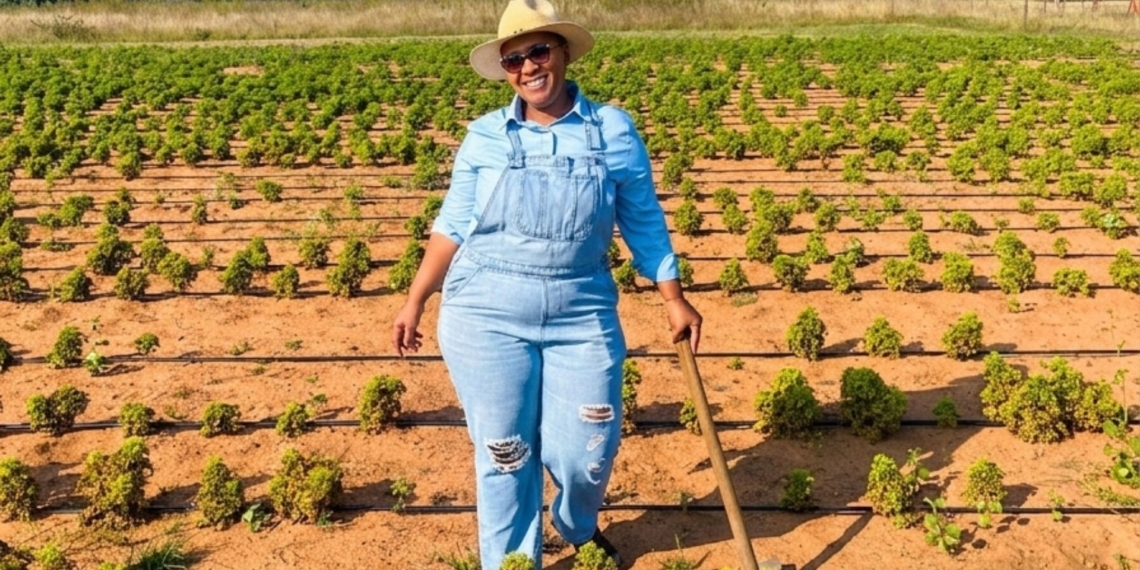
Producing a good crop is only the beginning. For geranium farmer, herbalist, and agroprocessor Kate Sithole, real change came from asking how much more value could be created beyond the farm gate. Her story highlights how small steps into agroprocessing can unlock income streams, reduce risk, and transform farming into a sustainable business.
I planted rose geranium, believing the oil would be the answer. Like many farmers, I followed the logic we are taught: produce well, find a buyer, and the business will work. I focused on getting the crop right. I invested time, energy, and resources into production.
But the reality did not always match the expectation. Prices moved. Buyers were few. And despite doing everything right on the farm, the returns were not always stable.
At some point, I had to ask a difficult question: Was the problem the crop, or was it how I was participating in the system?
The moment everything shifted
The turning point did not come from increasing production. It came from a simple question: What else can this plant become?
Instead of seeing rose geranium only as an essential oil crop, I began to explore its full potential. I started small, experimenting with hydrosols, simple products, and different ways of using what I was already producing.
Some things worked. Some did not. But something important changed.
I stopped seeing myself only as a farmer. I began to see myself as part of a broader value system.
From farming to enterprise
What I discovered is something many farmers quietly experience. We do the hardest part, we grow the crop.
However, most of the value is created after the product leaves the farm. It is in the processing. The packaging. The branding. The market access.
The plant does not change. But its value does. And often, that value grows the further it moves away from us.

Rethinking what diversification really means
We are often told to diversify. But for me, diversification took on a different meaning. Diversification is not about doing more, it is about participating in more of the value.
It is not about adding pressure or complexity.
It is about:
- Reducing dependence on a single buyer
- Creating multiple income streams from the same crop
- Finding ways to stay connected to the value we create
This shift is what begins to bring stability.
Related stories
- Jaftha Flower Farm: From forced removals to flourishing fields
- How to protect sunflower yields from heat stress and drought
- Sunflower farms primed to thrive in summer
Starting small, learning fast
One of the biggest misconceptions is that value addition requires large capital. My experience has been different.
You can start small:
- A simple product
- A local market
- A small experiment
The important thing is to begin. To test. To learn. To improve. Over time, those small steps build confidence and capability.
A bigger opportunity for South Africa
This journey is not just personal. It reflects a broader opportunity within South African agriculture.
When farmers begin to:
- Process locally
- Develop products
- Build small enterprises
We start to see:
- New income opportunities
- Job creation
- Stronger rural economies
One plant can support more than one outcome.
And one farm can become more than a production site.
Beyond the oil
For me, “beyond the oil” is not just about rose geranium. It is about how we think about agriculture.
The crop is not the end. The first product is not the only option.
And the farm is not where value stops. There is more available.
The question is whether we are willing to step into it.
- The views and opinions expressed in this article are those of the author and do not necessarily reflect the views or positions of Food For Mzansi.
READ NEXT: EC agripreneur turns pineapple waste into sanitary products