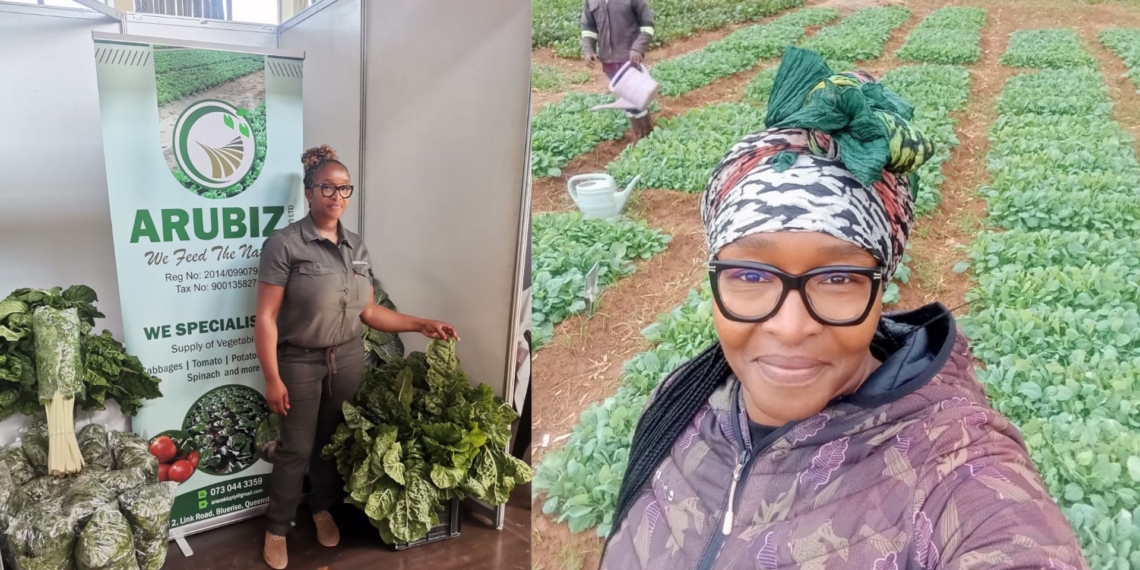
For Zoleka Dikana, farming is more than growing crops for the market. It carries memories of growing up alongside her father, the business lessons she learned at home and a love for working the soil she never thought would become her career.
Today, the farm management graduate from Ikhala TVET College runs Aruzabiz (Pty) Ltd, with farming operations in Cofimvaba and Queenstown in the Eastern Cape.
Growing up in business and farming
Dikana is the daughter of Masiza Dzedze, a businessman who operated in KuBanzi, Cofimvaba, for decades. She says growing up in her family’s supermarket, Khayamnandi, also known as Esibeneni, shaped her business mindset.
From a young age, she learned bookkeeping, tax submissions, stocktaking, costing, customer service and setting targets for employees.
Her family was also involved in community farming. Her father taught her to maintain tractors and implements while they grew potatoes, white and yellow maize. They also packaged dry maize and potatoes to sell at their shop.
“My love for farming grew from there and in a way got me close to my dad,” she reflects.

Dikana says she never thought she would farm professionally, but struggling at school pushed her towards agriculture. She later discovered through research that she has a neurological condition affecting her learning.
Related stories
- Eastern Cape farmer bets on poultry and grows a diverse business
- Taleni Farmers Co-op grows hope in rural Eastern Cape
- Jobless EC graduates strike gold with peanut butter co-op
- Jobless graduate turns EC homestead into opportunity hub
Building skills locally and abroad
The business skills she learned growing up now help her manage her farming operation. Dikana says bookkeeping helps her track seasonal production, planting figures and cut-off percentages to measure each season’s success. She also records weather events such as hail, strong winds and heat damage, alongside supply and demand.
After matric, she enrolled at Ikhala TVET College, graduating with a farm management diploma.

In 2024, the department of agriculture took her to Germany for international training, where she learned about climate change and its impact on agriculture, agroforestry to reduce soil erosion and evaporation, wastewater irrigation, sustainable water management and no-till machinery for soil and water conservation.
On her return, the department, in partnership with the Eastern Cape Development Corporation (ECDC), enrolled her in export training covering export audits, planning, market selection and market entry analysis.
Community connection runs deep
Dikana founded her business in 2019, growing cabbages, spinach, beetroot, bell peppers, potatoes and green maize. She farms at Maya in Qamata, Cofimvaba, under an irrigation scheme, and has recently expanded to Amberdale 2 in Queenstown.
Her connection to farming and community runs deeper. Her mother, who died when Dikana was three, owned a supermarket that her father later took over. She says growing up in the villages shaped her belief that no one should go hungry when the soil can be worked.
“My dad told us about my mom’s great involvement in the community, accommodating her garden for widows and women abandoned by their men who used to work in the mines.”
Dikana believes in empowering women, and seeing women take the stage reminds her of their strength and her mother’s legacy. She employs 22 people: 16 women and six men.

One of her farming challenges is land ownership. On communal land, farmers cannot build permanent structures, limiting her plans for value addition and agroprocessing.
This prompted her expansion to Queenstown, where she leases an eight-hectare farm along the N2 from a private landowner under a five-year agreement.
Her business now supplies Boxer and SuperSpar stores, as well as informal markets. “I supply 31 stores and Buffalo City Market,” she shares.
Looking ahead to bigger markets
Dikana tells Food For Mzansi that growing vegetables and grain has taught her that okra and tomatoes are in demand but do not perform well under her farming conditions.
She attributes this to heavy rainfall in Qamata and the shared irrigation scheme, which limits her control over water. Tomatoes can perform well, she adds, but require cold storage facilities she does not have.

She hopes Aruzabiz (Pty) Ltd will own land where she can build a packhouse, shade nets, water reservoirs, fencing and solar backup, grow high-value crops, increase her workforce by 50% and work with rural schools to support children with learning disabilities.
She also hopes to begin exporting her produce in whatever form the market demands.
Her advice to farmers is to build good working relationships with government departments, which can assist with compliance, production inputs, implements, marketing materials, business plans and financial support.


READ NEXT: Farming teacher Nobuntu turns failures into A+ success