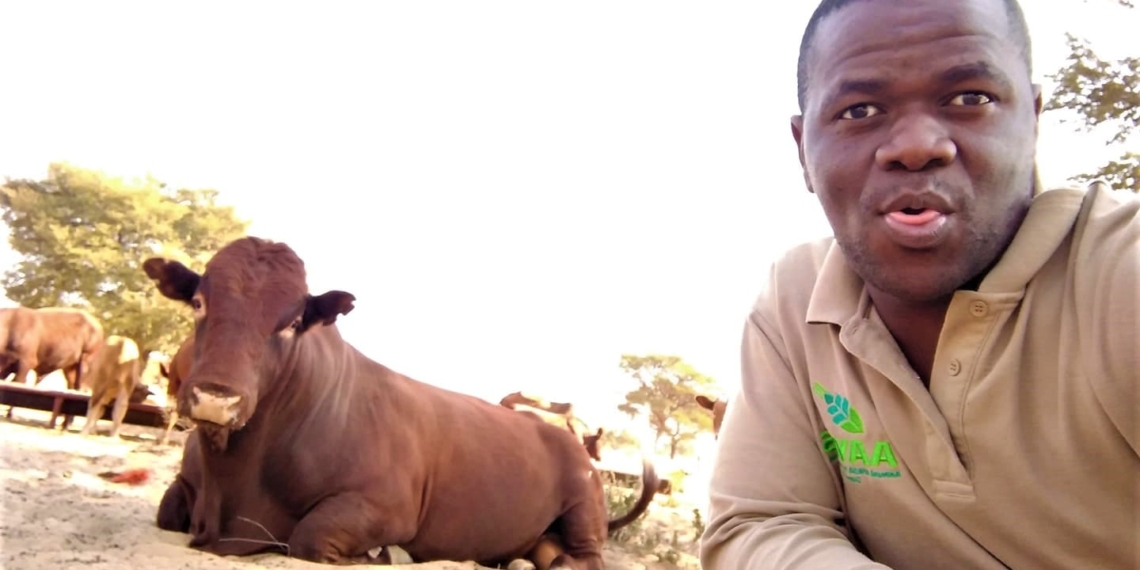
 Thapelo Kgopodithate might be just 33 years old, but he’s already learned one of life’s greatest lessons. He learned that “farming in the Kalahari is like farming on the moon. Sometimes you feel alone – far from everything and everyone. It’s a place where you struggle to find help”.
However, no matter what, you simply have to make it work. As a child of the Northern Cape, this livestock farmer has always known that the conditions are hard and that giving up is simply not an option. In fact, during one of the province’s merciless droughts in 2016 their family farm, Oratile Farming, struggled financially.
The Kgopodithates feared they would not survive.
But they did. And they flourished.
Their saving grace was reaching out to other struggling farmers to form the Makawana Farmers’ Stokvel. Four years later the stokvel consists of 24 young farmers who pool their money for 12 months to invest in either livestock, feed or equipment.
Heeding his father’s call to save the farm
Kgopodithate and his father, Oratile (72), have been farming with sheep, cattle and goats for eight years now in Bosra village in the Kuruman district. They farm on land his father received from the department of rural development and land reform. Before then, his father farmed on communal land for 31 years.
Despite never having had an interest in farming, Kgopodithate now calls himself a “proud desert farmer”. His interest in the agricultural sector was initially sparked after Oratile paid for his studies at Damelin College with profits made on the family farm. For a few moments there he thought that pursuing a farming might be worthwhile after all, but it took him a little while longer to make the big move.
After he completed his human resources qualification in 2009, Kgopodithate struggled to find work and decided to move to Cape Town. There he ended up working as a general worker at one of the largest steel producers in Africa.

Meanwhile the new farm his father moved to in 2012 was in a poor state with little grazing land. With the bit of money he earned in the big city, Kgopodithate would often have to send money home to help cover some of the farming costs. Although it wasn’t much, it helped.
“But then things changed. Ntate called me one day and said, ‘Son, I’m struggling here. Please come and help me’,” Kgopodithate recalls. He immediately heeded his father’s call and returned to Kuruman to assume the position of farm manager although nothing prepared him for the challenges that awaited.
“Firstly, being a farmer in the Kalahari is extremely difficult. It’s dry, water and rain are scarce, and it can reach up to 45 degrees. Also, the poor conditions of the roads that I had to travel to reach our markets didn’t make it easier.”
Potholed roads turned out to be the least of his farming problems, though.
Four years ago, their family farm was now barely breathing financially. The protracted drought made matters worse. They came close to just locking the farm gate for good, but it was his father’s childhood teachings that got them through in the end.
As a boy, Kgopodithate was barely allowed to play with his friends. He was always helping at the communal farm. One day he told his father that it was unfair of him to always work. His father simply said, “If you don’t listen to me, you’ll end up working for your friends. If you listen to me, you’ll employ them one day.”
His father also taught him that under the harsh South African sun a true farmer always finds a way. “’n Boer maak ’n plan,” he used to say in Afrikaans, adding: “Boerdery is nie ’n matras om op te lê nie.” Farming is not a mattress to lay on. So, when the 2016 drought was about to give them a final knockout he simply made a plan.
Stokvel born virtually
Kgopodithate realised that he needed to be better prepared in order to navigate around the challenges that came with the Northern Cape drought. This led him to starting the Makawana Farmers’ Stokvel.
The stokvel that was born on Facebook and WhatsApp, allowing its members to save money with a group of fellow farmers for 12 months. Thereafter they collectively decide how the money will be invested – either on livestock, feed or equipment.
Makawana is a Setswana word for “young people”. The members are all younger than 35. He says, “The aim of the stokvel is also to provide young farmers with a platform where they can learn from one another and strive towards excellence in farming – and eventually grow into commercial farming.”

Chicken farmer and owner of Lelo’s Poultry Farm in Kuruman, Kagalelo Matlala, says the stokvel has helped her enterprise grow.
“The stokvel is such a great platform. We buy farming equipment and inputs in bulk at low prices, which means we save a lot of money. When you’re a farmer, especially a young one, it’s important to be informed with what’s happening in the sector. Being part of the stokvel has made it easier for all of us to access sector-related information.”
Suddenly the future looks much brighter for young farmers in the Northern Cape. Even brighter than the midday sun. They have started dreaming again. And slowly but surely Kgopodithate is making his way towards commercial farming.
He says, “You can’t plant something today and expect it to grow tomorrow. Nothing worthwhile in life comes easy. You must work for it. Yes, the challenges of farming in the Kalahari makes me crazy at times, but passion led me here. That’s why I can’t give up. I’m propelled by the grace of God.”
Read more: African food is unity on a plate, says food pride leader