Mzansi is rich in medicinal plants, rivers that sustain life, and natural resources that support health and well-being. For Letitia Webber, living differently and hoping for a better future is deeply personal. After struggling with her eyesight, she turned to natural resources for help.
Today, she is the founder of Sacred Superfoods, a brand born from her healing journey, and now helping others through natural wellness solutions.
Seeing beyond limits
Growing up in Welkom, Free State and now living in Montagu in the Klein Karoo, Western Cape, Webber lived with an eye condition.
“Much of my life, I had limited vision in one eye, with constant strain,” she says. “I also grew up with very little. There was no clear path for me, and many of the opportunities I dreamed of were simply not there.”
She adds, “My childhood was not easy. My father struggled with alcoholism, and home life was very difficult and unstable.” Still, she says she carried a strong creative fire.
“I loved beauty, design, storytelling, and expression. I knew I wanted to be a graphic designer, but I did not have the support or means to study.” So she taught herself.
Today, she works in graphic and web design, built through persistence, curiosity, and refusing to give up.
For years, she worked in corporate procurement while developing her creative skills on the side. “That season taught me a lot. Procurement sharpened how I understand sourcing, quality, and detail.”

A path rewritten in faith and nature
In 2021, Webber left the corporate world and started her own graphic and web design business, LDJ.
“It was the beginning of building brands, finding my voice, and trusting that I could create something meaningful with my own hands,” she says.
In 2022, another chapter opened. She co-facilitated at a gut health and detox facility, where she was introduced to natural wellness, traditional remedies, and plant and mineral-based support.
“It was there that I first came across pearl powder. I had no idea how deeply it would connect to my story,” she says.
Related stories
- NW agripreneur creates condiments with care and purpose
- Turning goat milk into gold: Farmers tap agro-processing power
- EC agripreneur turns pineapple waste into sanitary products
- How Refilwe brewed her mother’s gemere into a business
She explains that pearl powder is a finely milled powder made from freshwater pearls, valued for its natural minerals, including calcium, magnesium, collagen, amino acids, and over 30 trace minerals.
“I want to be clear, I am not making medical claims. I can only speak from my own experience,” she says.
After using pearl powder for a few months, both internally and topically, she says she began to notice changes in her vision. “My vision felt clearer, and I could start reading more easily with my weaker eye. Now, a few years later, it has improved even more.”

Photo: Supplied/Food For Mzansi
She says the experience was too meaningful to keep to herself.
“I felt it was both an honour and a responsibility to source it carefully and make it available to others in South Africa.” That is how Sacred Superfoods was born.
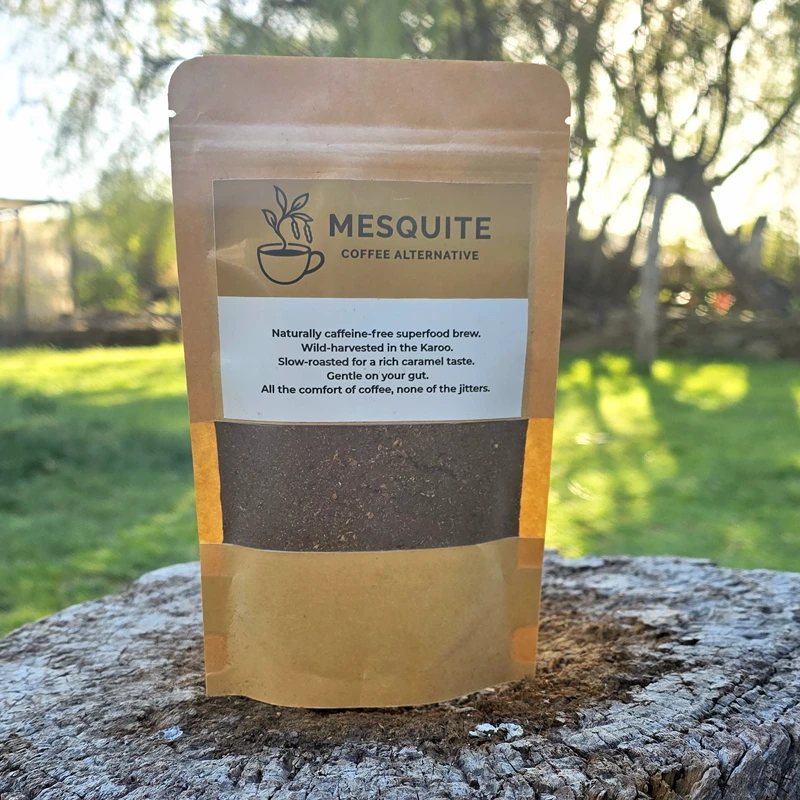
Today, the brand includes pearl powder, dragon’s blood, shilajit, cacao, a mesquite coffee alternative, and more.
Carefully built, step by step
Their work at Sacred Superfoods is very hands-on, she says. One of the ingredients, mesquite, is sourced locally, while pearl powder, dragon’s blood, and shilajit are imported.
“I am very particular about where things come from and how they are chosen,” she says.
“My background in procurement helps a lot. I care about quality, testing, purity, and proper sourcing.”

The work is still small-batch and very personal. They work with raw ingredients, repackage some, encapsulate others, and also make products like serums. They also supply raw ingredients to people making their own skincare and wellness products.
They are still working from home in a way that keeps the heart of the brand intact. She works closely with her husband, Douglas Webber, and another employee, Petronella Malima, who helps with packaging and capsule making.
She says quality and compliance shape everything she does, especially with imported products. “Each batch I import comes with a Certificate of Analysis, and I only source from trusted, regularly audited facilities.”
Testing and traceability are central to her brand. On the processing side, she ensures products are handled and packed in a clean, controlled environment.
“I also make sure labelling and product information are accurate and handled responsibly.” The same care extends to locally added ingredients, such as castor oil.
Marketing natural products
In marketing, support has come in different ways over the years, sometimes through referrals, sometimes through people simply sharing or believing in the brand.
“In terms of market access, I currently supply customers across South Africa,” she says. Her market includes people looking for natural alternatives, nutrient-rich superfoods, and more intentional ways of living.

Photo: Supplied/Food For Mzansi
She also supplies people who make their own products and need high-quality raw ingredients.
Webber shares a few tips for upcoming agripreneurs:
- Let your work be rooted in genuine purpose and heart.
- Surround yourself with people you can learn from and who build you up.
- Protect your mental, emotional, and physical well-being as you build.
- Stay grounded by acknowledging how far you have already come.
- Do not be discouraged by slow growth; keep showing up with integrity.




READ NEXT: Sorghum: Forgotten grain rises as climate-smart crop choice