In many parts of Africa, smallholder farmers face a daunting set of challenges: degraded soils, soaring input prices, and the mounting pressure of climate change. But a quiet microbial breakthrough, born out of decades of soil science and driven by a commitment to farmer resilience, is offering a glimmer of hope.
At the heart of this innovation is Legume Technology, a UK-based company with a bold mission: to improve access to microbial inoculants – tiny, bacteria-filled packets that help crops grow better by naturally fixing nitrogen in the soil.
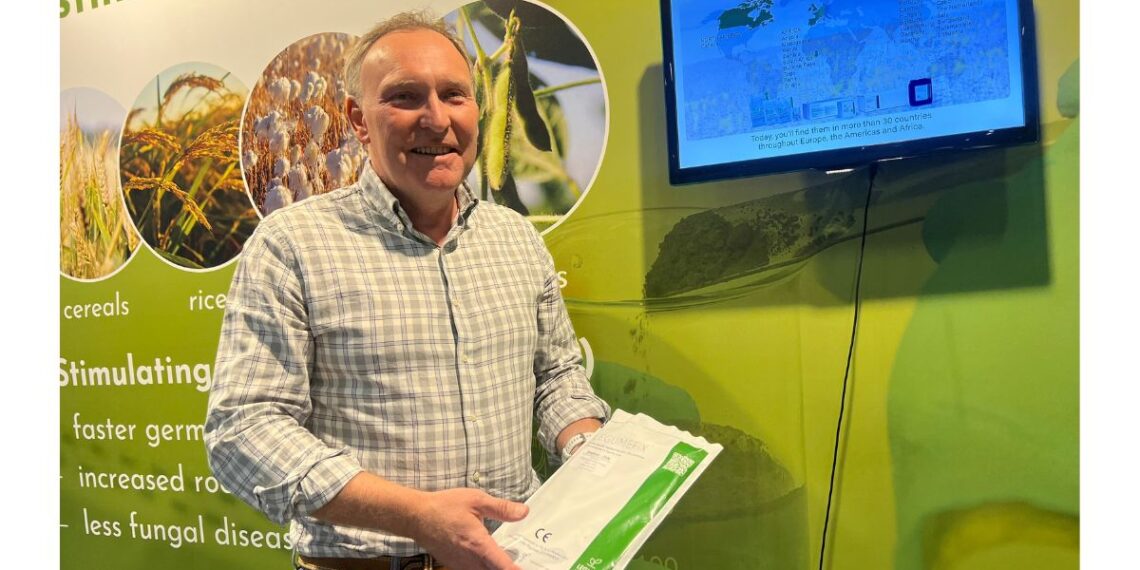
Dr Bruce Knight, a microbiologist and founder of Legume Technology, has spent his career studying how to harness nature’s own processes to boost crop production, especially for legumes like soybeans.
“I did my PhD at Rothamsted [Research], established nearly 200 years ago. I was looking at how modern farming practices would affect the sustainability of farming, looking at the microbial populations in soil,” he explains.
It soon became pretty obvious that the use of chemical fertilisers was actually degrading the population of soil microbes. That realisation led him to build Legume Technology in the early 2000s “in a very small way – in an old barn in the village where I was born,” he says. “We scroll forward to 25 years later, and we sell into 34 countries around the world.”

Nitrogen from thin air
At the core of Legume Technology’s work is rhizobium – a genus of bacteria that lives in harmony with legumes and pulls nitrogen from the atmosphere into the soil. This biological nitrogen fixation is a lifeline for farmers who can’t afford expensive chemical inputs.
Knight explains it simply: “Most smallholders have access to maybe 10 kilograms of nitrogen per acre. With rhizobium, we can give them 10 more.”
That may sound modest, but it can double yields when combined with the right phosphate fertilisers.
Related stories
- Enhance soil health by intercropping indigenous vegetables
- Biotechnology offers hope for Africa, but politics hold it back
- Exploring the ins and outs of plant biotechnology
“We put 20 trials out in Ghana and 18 in Nigeria and we showed yield increases of between 0.8 and 1.5 tonnes per hectare, and this was in farmers’ fields, not in research fields. So this is real world data…”
Such improvements are transformative in regions where farmers often struggle to feed their families and maintain a steady income. With legume crops, they not only harvest more, but they also return nutrients to the soil for future seasons – a virtuous cycle of sustainability.
Reaching Africa’s smallholders
Despite the promise of microbial inoculants, getting them into the hands of smallholder farmers has been a major hurdle. The challenge? Packaging.
“These products are produced for commercial farmers in 200-gram packets, which treat 50 kilograms of seed,” Knight says. “That’s enough for one hectare, but it costs $5 (about R90). It’s not going to work for a smallholder with 100 square metres.”
Recognising this gap, Legume Technology is now working with support from the Bill & Melinda Gates Foundation and the UK’s Foreign, Commonwealth and Development Office to redesign its products for African smallholders.
“We are developing a packaging line that will produce 50- or 100-gram sachets,” Knight explains. “The real challenge is maintaining shelf life – these products contain live bacteria. If they don’t work when the farmer applies them, we lose all credibility.”
With better packaging, the hope is to expand access across Africa where farmers can use these affordable sachets alongside small bags of seed and fertiliser – a toolkit for improved productivity and resilience.

Beyond legumes: A new frontier
While rhizobium bacteria have long been known for their symbiosis with legumes, Legume Technology is pushing into new territory: maize.
“Maize is not a legume. It doesn’t naturally form nodules,” Knight explains. But with the right microbial partners, nitrogen fixation can still be encouraged. “We’ve been looking at associative bacteria that colonise roots or live around the rhizosphere. Some are capable of nitrogen fixation.”
It’s an exciting field of research.
“We’re working with the University of Nottingham and the James Hutton Institute to isolate strains that will work with maize. We believe it’s possible to supply maybe 10 kilograms of nitrogen per hectare.”
While the benefits may not be as dramatic as with legumes, the cumulative impact across millions of hectares of maize fields could be game-changing.
A call to action
Knight believes microbial solutions are a powerful tool to support farmers grappling with degraded soils and climate uncertainty.
“The climate is changing. It’s happening now. But we can make crops more resilient,” he says. “Better root systems, drought tolerance, better access to phosphate – all of these are possible with the right microbes.”
But technology alone isn’t enough. He stresses the importance of policy support and regulatory reform: “Governments can help by streamlining registration processes and putting in place mechanisms for quality control. If farmers buy a product and it doesn’t work, they’ll never try again.”
From a garden shed in the UK to test plots in Ghana and Nigeria, Knight’s work offers a glimpse into a more sustainable future, one where smallholder farmers have the tools they need to grow more food and steward their land for generations to come.
In many ways, it’s about giving power back to nature – and to the farmers who depend on it. “What we’re offering,” says Knight, “is a chance to do things differently, to work with the soil, not against it.”
For African farmers who often contend with the harshest realities of agriculture, that small packet of microbes might just carry the biggest hope.
READ NEXT: Banking on seeds: Fowler’s bold plan for food security
Sign up for Mzansi Today: Your daily take on the news and happenings from the agriculture value chain.