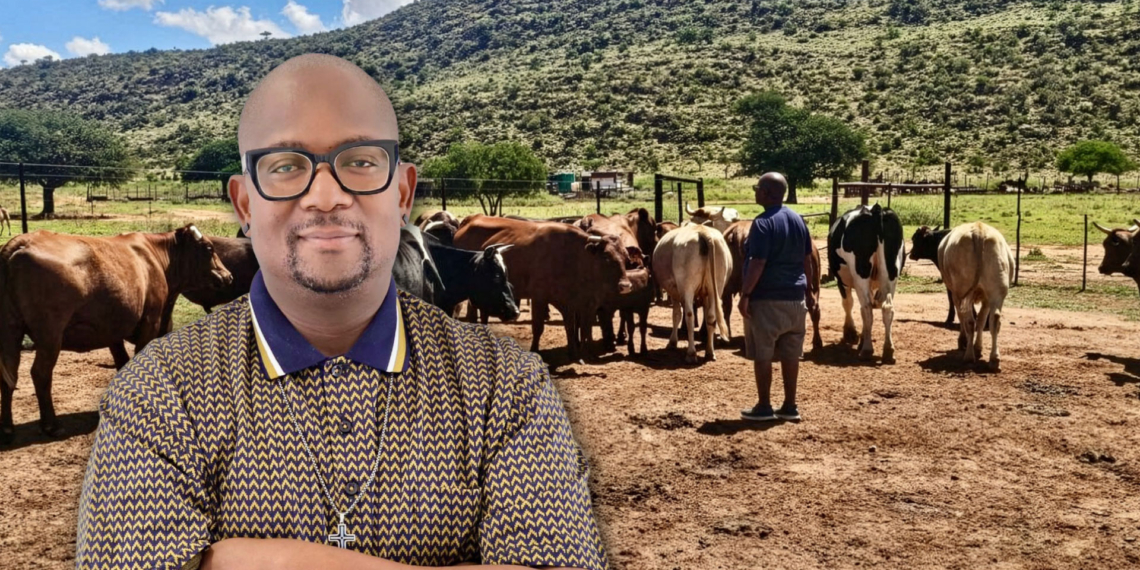
South Africa has fertile land and willing farmers, yet millions go hungry. Reginald Mayekiso, the founder and director of Olifantshoek Trading Enterprise, explains how supporting emerging farmers and reviving idle land can boost food security and create rural jobs.
There is a particular kind of frustration that comes from watching a solvable problem go unsolved.
South Africa is not a country lacking in potential. Across its provinces, we have fertile soil, diverse climates, and vast tracts of land capable of producing food at scale. We have communities with deep agricultural knowledge, passed down through generations. We have people willing to work, to build, and to feed this nation.
And yet, nearly 14 million South Africans go to bed hungry.
The uncomfortable truth
This is not because the land is barren. It is not because the people are incapable. It is because the connection between the two has been neglected. Across rural South Africa, there is land that lies idle, not beyond recovery, but simply unsupported. At the same time, there are communities facing hunger and unemployment.
That contradiction should concern all of us. It should also push us to rethink the way we have approached this challenge.
For too long, food insecurity has been framed primarily as a shortage of resources – not enough funding, not enough infrastructure, not enough intervention. While these constraints are real, they are not the full story.
The truth is more uncomfortable: the foundational resources already exist. What has been missing is coordination, consistency, and long-term commitment. We have not built the systems that turn potential into production.
Finding a sustainable approach
My own journey began in 2013 with just 13 ewe lambs and a belief that rural land, when properly supported, could become an engine of economic activity. There was no large capital injection. No guaranteed outcomes. Just a decision to start where I was, with what I had, and to build deliberately over time.
Today, that effort has grown into Olifantshoek Trading Enterprise, operating in the Gamagara Local Municipality in the Northern Cape. Our work spans agriculture, mining support services, and mechanical repair. This diversification was not accidental. It reflects the realities of rural economies, where resilience depends on multiple streams of activity, not a single focus.
But at its core, our work is grounded in a simple principle: idle land and hungry people should not coexist.
Related stories
- From farms to clinics: Protecting SA’s children from hunger crisis
- Soweto couple conquers hunger with community farm
- Foundation turns small-scale farmers into food security champions
We do not approach agriculture as a once-off intervention. We prepare land, we introduce mechanisation where it has long been absent, and we support livestock and poultry operations that generate both food and income.
More importantly, we remain present.
One of the greatest failures in rural development has been the tendency to intervene and then withdraw. Training is delivered, resources are allocated, and then communities are left to navigate complex agricultural systems alone.
That approach does not build sustainability. It builds dependency.
What we have learned is that emerging farmers do not need temporary support. They need a consistent partnership. They need access to equipment, to markets, and to technical knowledge that allows them to operate independently and competitively.
Through the revival of the Olifantshoek Small-Scale Farmers Association, we have seen what becomes possible when farmers are organised, supported, and connected. Productivity improves. Confidence grows. Communities begin to shift.
Bridging the gap
We must also confront how we speak about emerging farmers in this country. Too often, they are framed as beneficiaries rather than as economic participants. But the reality is different.
These are individuals with a deep understanding of their land and a vested interest in its productivity. What many lack is not capability, but access to the tools and systems that commercial agriculture has long relied on.
Close that gap, and the results are transformative.
This is not just a moral argument. It is an economic one.
When rural communities produce their own food, they become more resilient. When agriculture is activated, it creates jobs not only on farms, but across supply chains, transport, and local markets. Money begins to circulate within communities instead of leaving them.
By integrating agriculture with services like mechanical repair and mining support, we have seen how local economies can become more stable and more inclusive. Growth becomes shared. Opportunity becomes accessible.
This is not a theoretical model. It is already happening.
The answer is in the land and people
The broader lesson is clear: the solution to South Africa’s food insecurity is not something distant or abstract. It is already here. It is in our land. It is in our people. It lies in the commitment to connect the two through sustained, practical support.
We cannot continue to accept a reality where hunger and unused land exist side by side. That is not an inevitability. It is a failure of alignment
The question is no longer whether this approach can work. We have seen that it can.
The real question is why it is not being implemented at scale.
- The views and opinions expressed in this article are those of the author and do not necessarily reflect the views or positions of Food For Mzansi.
READ NEXT: 100 ha of hope: Aphiwe revives family farming legacy in Engcobo