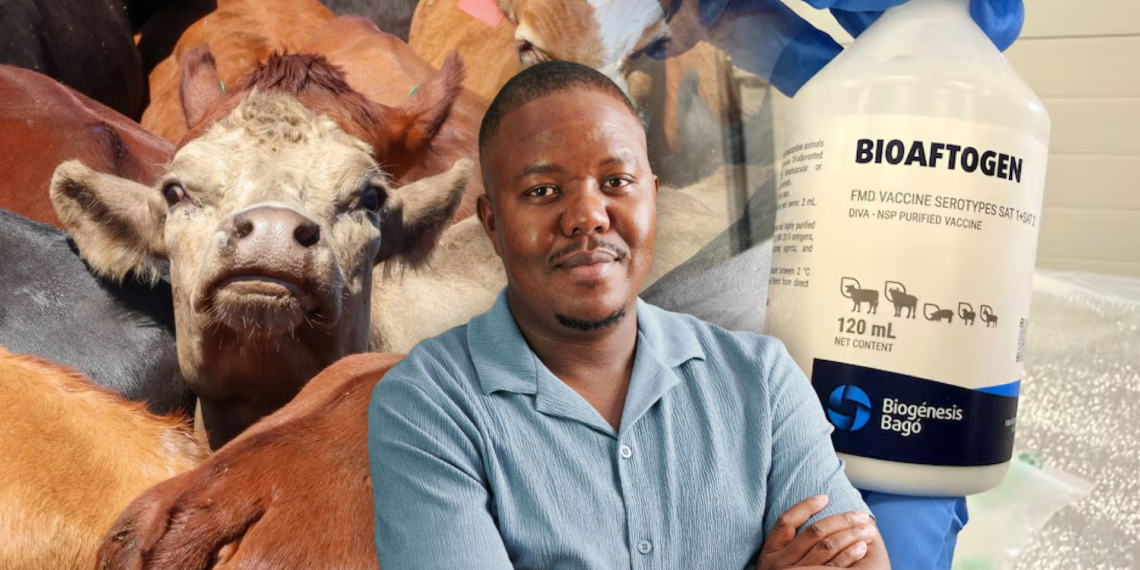
The current FMD outbreak is a national disaster, hitting smallholder farmers the hardest. Sibongiseni Peacock, an innovation manager at the DG Murray Trust, explains that while government vaccines are vital, long-term survival requires shifting from crisis management to resilience.
Livestock farmers are experiencing the worst outbreak of foot-and-mouth disease (FMD) South Africa has ever seen; it’s officially a national disaster. Export bans, trade restrictions and loss of livestock are wreaking havoc on the industry.
It’s fair to say the effects are most severe for smallholder farmers who have limited access to capital and safety nets, and who produce food largely for their own household consumption and local markets.
The latest outbreak is not an isolated event; it unfolds in a context already strained by floods, rising input costs and unstable access to land, water and other essential services. On its own, each shock might be manageable. Together, they show just how vulnerable rural livelihoods are to extreme weather, disease and other setbacks.
Of course, the government must strengthen disease management and roll out vaccines to every corner of the country, as planned. But we must go further building resilience among smallholder farmers so they can withstand repeated shocks over the long term, rather than simply recovering from one crisis at a time.
Various levels of government, civil society, industry players and smallholders themselves have a role in making this happen.
Resilience-building strategies include diversifying production, transitioning to environmentally sustainable farming practices, strengthening local food systems and increasing state investment in smallholder support programmes.
1. Benefits of diversification
According to a study commissioned by the DG Murray Trust (DGMT), smallholder farmers who rely on a single commodity are more vulnerable to shocks. By contrast, other research shows that farmers who diversify growing different crops and pursuing other income streams are more resilient. While diversification does not make farmers immune to disasters, it helps to shield them from the full force of the shock.
Diversification takes different forms: planting a mix of crops instead of relying on just one; raising small animals alongside crop production; processing produce on site to add value; and starting complementary enterprises like beekeeping to generate additional income.
Beekeeping stands out because it coexists with and complements other agricultural pursuits, enhancing both crop production and livestock farming.
Related stories
- North West ramps up FMD vaccination drive in Marikana
- Minister debunks rumours, confirms free FMD vaccines
- Why SA is importing FMD vaccines from Argentina
- Garden Route farmers fight back against soil degradation
2. Environmentally sustainable practices
Farming practices that are good for both people and the environment, such as agroecology, help to build resilience in ecosystems and in the farmers who depend on them.
When supply chains are disrupted or input costs rise, farmers who rely on external inputs like chemical pesticides, synthetic fertilisers and commercial seeds are especially vulnerable. In contrast farmers who focus on improving soil health and biodiversity, for example, by composting and integrating crop rotation can continue producing food for household consumption regardless of external factors or rising costs.
3. Local food systems
Smallholder farmers who are connected to local markets and informal traders are often less exposed to risk than those who rely on centralised value chains. This is not a critique of formal markets; instead, it serves as a reminder that resilience depends on the diversity and strength of one’s connections.
Smallholder farmers who are connected to local systems can adapt more quickly than those who are dependent on narrow economic pathways.
4. Support for smallholder farmers
Outbreaks such as FMD are often described as farm-level failures because of inadequate biosecurity measures, ongoing compliance issues and poor farming practices. While this may be true to an extent, many smallholder farmers are willing to adopt better techniques and change how they work. However, they still lack timely and adequate state support, including access to veterinary and extension services.
When designing emergency disease responses, smallholders are rarely consulted. Consequently, smallholder farmers with limited means are excluded from disease control programmes because they find it difficult to comply with biosecurity standards and disease reporting criteria outlined in official animal health guidelines.
A resilience-focused response
Outbreaks like FMD expose fragilities in our agricultural sector weaknesses that, if addressed, could strengthen the sector as a whole.
Strengthening the sector requires state investment in infrastructure for smallholders, such as quarantine kraals; it involves proactive disease control measures, such as practical and affordable animal identification systems; and it requires inclusive policies that cater to vulnerable farmers.
The state must ensure that veterinary services are accessible to smallholders, information is clear and available in different languages and that coordination among stakeholders is strengthened across national government, provinces, municipalities, traditional authorities and farmer organisations.
Before the next disaster hits, we need to make sure that smallholders have been given enough support to withstand it.
- Sibongiseni Peacock is an innovation manager at the DG Murray Trust (DGMT). The views and opinions expressed in this article are those of the author and do not necessarily reflect the views or positions of Food For Mzansi.
READ NEXT: Rising oil prices squeeze SA grain growers ahead of planting season