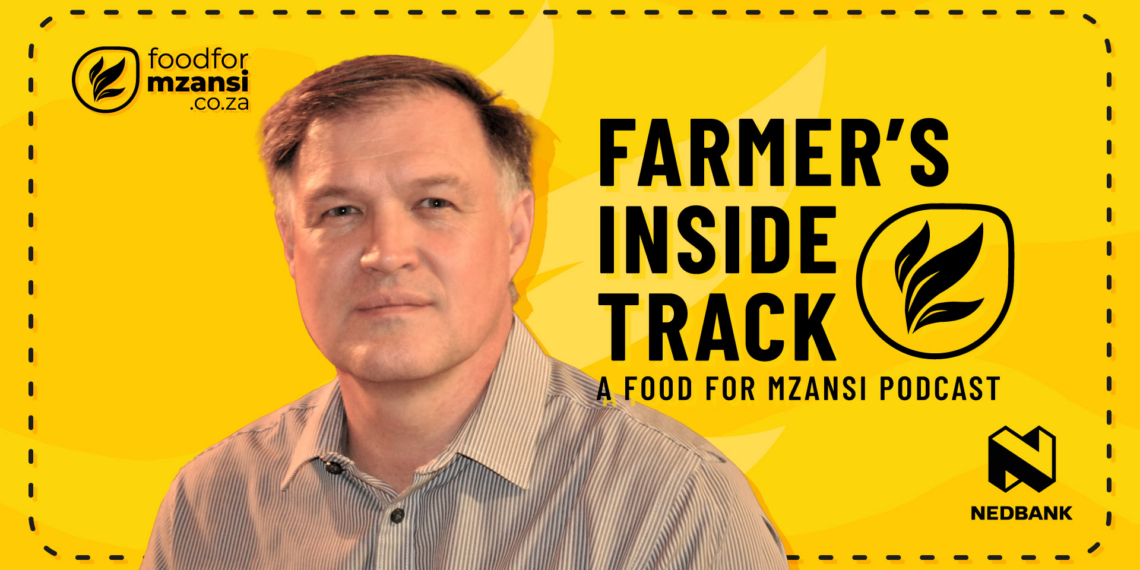
Nedbank’s Cobus de Bruyn argues that meaningful agricultural transformation must go beyond land transfers to building productive, profitable and commercially sustainable farming businesses. He unpacks the barriers facing black farmers, the need for blended finance and why stronger partnerships across the agricultural value chain are essential to lasting change.
South African agriculture needs a more inclusive economy that creates opportunities for new entrants, develops small-scale farmers into sustainable commercial businesses and supports the growth of large black-owned agribusinesses.
That is the view of Cobus de Bruyn, head of agriculture client value propositions at Nedbank, who believes meaningful transformation should be measured by the success of farming businesses rather than land ownership figures alone.
Speaking on Farmer’s Inside Track, Food for Mzansi’s podcast, De Bruyn outlined the progress made since 1994, the barriers that continue to constrain farmers and the importance of collaboration across the agricultural value chain.
“South Africa needs a more inclusive agricultural economy that can attract new entrants and develop small-scale farmers into commercial sustainable businesses but also support large-scale black-owned agribusinesses to grow more,” he said.
De Bruyn identified six reasons for inclusive agriculture: unlocking growth and expanding production, building a broader and more sustainable farming economy, improving access to finance, markets and technology, creating jobs, strengthening sustainability and climate resilience, and enhancing South Africa’s international competitiveness.
He believes transformation must build on established commercial agriculture while opening meaningful opportunities for farmers across the sector.
“Inclusive agriculture should be measured not simply by the land transfers or the number of black farmers that we’ve got, but by the number of farmers who become productive, profitable, bankable and commercially sustainable,” he said.
Land transfers are progressing, but ownership is only part of the picture
De Bruyn acknowledged that South Africa has made progress in transferring land since 1994, pointing to research conducted in 2024 by Wandile Sihlobo and Professor Johan Kirsten.
The research identified approximately 19.3 million hectares transferred through various mechanisms, representing 25% of the country’s freehold farmland. These included restitution, government land redistribution, private transactions, the Proactive Land Acquisition Strategy and government acquisitions for agricultural use.
However, he argued that land ownership alone does not guarantee lasting economic transformation. Secure title deeds are particularly important because land can generate wealth across generations, supporting business growth and creating further income.
Related stories
- Nedbank backs regenerative agriculture in new podcast series
- Nedbank champions a new generation of SA farmers
- Becoming bankable: How to get your farm ready for finance
Reflecting on the challenge, De Bruyn referred to agriculture minister Willie Aucamp’s argument that transformation cannot be achieved by lifting one part of the sector at the expense of another.
“The answer lies in pulling them both up at the same time. The one that requires more attention, more input, you pull that one faster,” he said.
He also welcomed President Cyril Ramaphosa’s announcement concerning the transfer of 2.5 million hectares to farmers, stressing that careful planning would be needed to ensure the land reaches people who can put it to productive use.
Nedbank, he said, is willing to contribute its expertise to this process.
“What you want to achieve is that the land that is transferred is actually transferred to farmers that can farm it, and that those farmers that do receive it put those farms into productive businesses.”
Rethinking the term ‘emerging farmer’
One of the barriers to transformation, according to De Bruyn, is the terminology used to describe farmers who are still building their businesses.
He prefers to move away from the term “emerging farmer”, arguing that it risks defining people by what they have yet to achieve rather than recognising them as farmers.
“I always feel a farmer doesn’t just start to exist. He’s a farmer. He’s born a farmer. It’s often a calling to be a farmer,” he said.
Instead, De Bruyn favours referring to small, medium-sized and large-scale commercial farmers. For him, a farmer who produces a surplus and sells it commercially qualifies as a commercial farmer.
He identified several obstacles confronting farmers, including access to suitable land and secure tenure, delays in transferring title deeds, affordable finance, water infrastructure, technical skills, extension services, machinery, production technology and access to markets.
However, access to finance remains a particularly pressing concern.
De Bruyn said commercial banks participated in developing a concept document for blended finance alongside the department of agriculture but are largely excluded from the scheme. This limits their ability to finance black farmers across various stages of commercial development.
A new farmer, he explained, often lacks the financial backing available to an established business. Without grants or concessionary lending to complement commercial finance, growth can be slow.
“We need that access to blended finance as well to support the government in our efforts to put transformation where it should be,” he said.
Partnerships are key to unlocking transformation
For De Bruyn, meaningful transformation requires coordinated efforts between government, organised agriculture, commercial farmers, financiers and other participants in the value chain.
“I love this topic. Partnerships for me are crucial,” he said. “If we want to build a sustainable, inclusive agriculture, then we must coordinate our efforts.”
He believes commercial banks working alongside the government could make a significant difference, particularly if they were included in blended finance arrangements.
Such collaboration could help establish new farming businesses while enabling existing black-owned enterprises to expand. Partnerships throughout the value chain could also help farmers overcome barriers to markets, production and commercial growth.
Nedbank is pursuing this approach through a differentiated strategy for inclusive agriculture, investing in resources and processes to support transformation.
De Bruyn highlighted the bank’s collaboration with PALS (Partners in Agricultural Land Solutions), through which farmers receive support with training and mentorship, company structures, legal agreements and shareholding arrangements. The partnership also helps farmers with access to markets, applying for water rights and referring credit applications to financiers.
He said the collaboration had already delivered significant value through transformation projects, allowing the bank to see the results on the ground rather than simply discuss transformation in principle.
However, he believes the impact could be greater if commercial banks were included in the blended finance scheme.
A future where transformation speaks for itself
Looking a decade ahead, De Bruyn hopes South African agriculture will reach a point where transformation no longer needs to dominate the conversation because its results will be visible in thriving farming businesses.
“We should talk about what has been done. We should celebrate what has been done,” he said.
His vision is of an agricultural sector with active small, medium-sized and large black-owned farming operations that can access funding, reach markets and overcome the barriers that currently constrain their growth.
For him, the objective is not simply to transfer land or increase participation on paper. It is to build businesses capable of producing, generating income, creating opportunities and growing sustainably.
The path forward, he said, depends on stakeholders working together to make agriculture bigger.
That means combining the strengths of established commercial agriculture with targeted support for farmers who need it most, ensuring that access to land is matched by the finance, infrastructure, skills and market opportunities required to make a farming business succeed.
READ NEXT: Protect your soil and crops while saving water this season