The East Griqualand Highlands in the southernmost of the Drakensberg is considered KwaZulu Natal’s best kept secret. Among these mountains – whose altitude range between 2km to 3.4km – lies Swartberg, a local farming community under the administrative town of Kokstad.
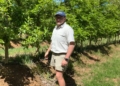
Here lives a hospitable 28-year-old called Lungelo Mathenjwa, who is the youngest black farm manager that runs the biggest livestock operation in the entire area. “I get a lot of respect from the farmers around,” he tells me. “I am managing 12 farms around which go all the way to the Eastern Cape.”
Currently, he manages 5 000 cattle and 4 300 sheep. “I am a beef and lamb producer, like the top of the range,” he laughs. As a young black man, his rise in making a mark for himself into large-scale commercial agricultural terrain has been amazing.
Mathenjwa grew up in Hluhluwe, the oldest proclaimed nature reserve in Africa, nestled in the hilly topography 280 kilometres north of Durban in central KZN.
It starts with failure
He studied at Vryheid Agricultural High School, an agricultural high school located in Vryheid, a coal mining and cattle farming town in northern KZN. After completing his high school, Mathenjwa wanted to study agricultural economics, but his plans came to a halt as he did not pass some of his subjects well enough.
He decided to go back to school. He called his principal to get permission to rewrite some subjects in an attempt to improve his marks. However, as a first born in his family, his father, who has three more children after him, would not dare exhaust all of his savings on one child.
“This is a lifetime goal… I want other emerging farmers to reach the commercial level.”
“I lied to my dad that my principal wants to see me, yet I am the one who called her asking to rewrite some of my subjects. Otherwise it was not going to happen,” he explains. “I improved my marks, but it was still not enough, so I decided to stay and continue working in the school farm. I was a farm worker for two years in the school.”
Challenged to find something more thrilling and challenging after he had worked in the school, Mathenjwa quit his job to work on another, bigger farm for a year.

Working in Australia
Through the help of the Future Farmers Foundation, a foundation which provides apprenticeship for young men and women who are passionate about farming, he flew to Australia to harness and polish his agribusiness skills.
“I was supposed to be an intern in Australia and I had put my résumé online. But when I got there I did not have a job. I was panicking and stressing now, because in South Africa I had left a job,” he tells me while leaning on his kitchen table in Swartberg.
Surprisingly, his farming journey across the ocean was more than he ever imagined.
One gets goose bumps when he speaks of how it turned out. “The next day when I woke up I had 17 jobs offers from different agribusinesses.”
“I was now the one interviewing my potential employers, asking them ‘what do you do in your business, how much will you pay me, what are your expectations…’.” Instead of becoming an intern, now he was to become a farm manager.
“There’s a company that begged my agency and said, ‘please, for our sake, can you give us this guy? If someone offers you a better salary than us we will pay the difference’. Then I took the job they offered me. I was on a 700 000 hectare farm.” That is an area about a quarter of the entire Gauteng province.
Mathenjwa’s livestock farming operation
In mid-2017 he decided to come back to South Africa to work for Glen Read Farms, managing the farms between KZN and the Eastern Cape. It is not by chance or luck that he now successfully manages more than 9 300 livestock. “I am at the top of my game,” he says proudly.

As we are about to leave his house to go around the farms, I can’t help but notice his relationship with his dog, Chief. Unlike many household dogs, Chief is a spear and a working dog. “The only thing that Chief needs now is a salary,” he tells me. The two are soulmates.
On our sightseeing tour around the farms we are surrounded by the rapturous scenic beauty of the mountains and green pastures. He has also planted 1 400 hectares of yellow maize in different sectors of the farms.
Of the 4300 sheep that he oversees, 1600 of them are expected to lamb within a month of our visit. As we arrive to the main farm, 245 of the 1600 pregnant sheep are grouped in the shed which he considers as a “private hospital”.
“What I’ve done with the sheep, I’ve synchronised them. They will be giving birth within 7 days,” he tells me. “This is my first year doing synchronising with the sheep.”
The sheep and cattle are sorted into different sectors of the farms by their breed. He has Dohne Merino sheep and the cattle breeds he has on the farms are Hereford, Beefmaster and Braford. There is an exclusive sector of bulls.
Why are they kept separately? I asked.
He laughs, “Bulls are the most valuable animals on the farm. Each guy here gets 25 cows in three months.” As he explains, one bull bawls three times as if it hears our interview. “If they are lacking and no longer active, we humbly say, ‘Baba, the collective is not pleased with how you do your job and we’ve got to release you’.”
The crowning goal of influence
While it seems he has had an enormous impact on the farms under his care, Mathenjwa’s crowning goal is to have substantial influence in agribusiness and to become a policy-maker.
“I don’t just want to be a farm manager, I want to influence the agribusiness industry by making critical decisions… I want to be able to assist in commercialising rural agriculture. If I could get into the political space of agriculture, I want to make policies that will enable fellow farmers to have better opportunities,” he tells me.
“This is a lifetime goal… I want other emerging farmers to reach the commercial level.”