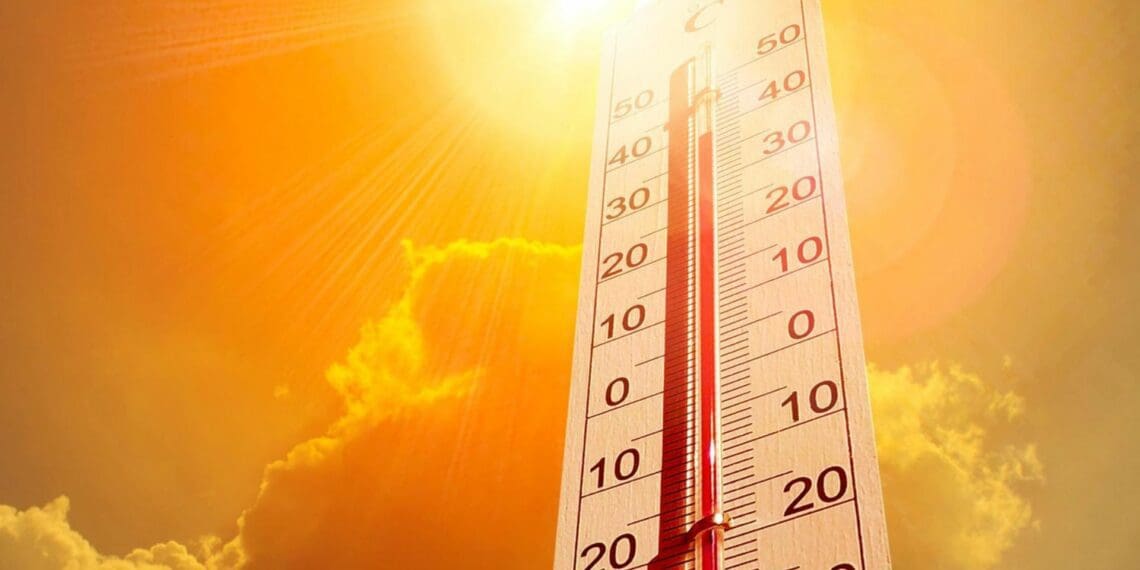
The SA Weather Service issued an advisory on Monday, 3 October 2022, warning residents in Gauteng, the highveld of Mpumalanga, southwestern Bushveld, central and eastern North West and northern Free State to expect a heat wave to continue until Tuesday, 4 October.
Wayne Venter, a forecaster from the SA Weather Service, explains to Our Burning Planet that we have a significant high-pressure system in the northern parts of the country.
“Usually with this high-pressure system, we have the sinking of air which warms as it goes towards the surface of the Earth,” says Venter. “That’s causing the warm temperatures that we are seeing.”
Willem Landman, a professor of meteorology at the University of Pretoria, and a specialist in seasonal to decadal forecasts, explains that once we have high-pressure systems dominating the circulation, the chance of convective storms developing is significantly reduced.
Coming just after winter, and on the back of the heat waves experienced throughout the Northern Hemisphere in July, people may be wondering why this heat wave is occurring.
⚠️Advisory: A heat wave is expected to continue in Gauteng, highveld of Mpumalanga, south-western Bushveld, central and eastern North West and northern Free State until and including tomorrow (Tuesday 04 October 2022). Extremely hot conditions are expected over Northern KZN today pic.twitter.com/e5Cy0iECGk
— SA Weather Service (@SAWeatherServic) October 3, 2022
Francois Engelbrecht, from the Global Change Institute at Wits University and a contributing author to several international climate change reports, explains that this heat wave was predicted and a not uncommon occurrence during the transition period between spring and early summer.
“We saw this heat wave coming from a mile away. It’s a big high-pressure system that started to form over Botswana a week ago,” he says.
During this transition period, in October, when summer rainfall hasn’t started yet – which cools down the temperatures – it’s common to have dry, hot days, despite it still being spring.
“I would be very hesitant to attribute this one [heat wave] to climate change. But in general, yes absolutely, heat waves are occurring more frequently… they are also becoming more intense.”
Landman agrees, saying, “It doesn’t refute the problems that we may face with climate change. But this is not necessarily linked to climate change.”
Heat waves around the world
The heat waves that occurred in the Northern Hemisphere summer in Europe, China and the US aren’t necessarily attributable to climate change, but we can expect heat waves like those to increase in frequency and intensity in the coming decades because of the climate crisis.
“At the moment, they can’t attribute [heat waves in the Northern Hemisphere to climate change] because it’s a single event,” says Venter.
“However, there have been indications that it could be due to the fact that the Earth is warming, because some of those stations have never reached those temperatures.”
“I think a lot of these things have a climate change signature in there,” adds Landman. “My problem is to assign every little deviation from the average — we can’t attribute each one of those to climate change.
“But we can only say that when we have global warming happening, similar events to what we are experiencing are on the increase — that’s the best scientific-based statement to make.”
Landman explains that global warming will make extreme weather events like heat waves increase in frequency and severity.
Why we should care about heat waves
Our Burning Planet previously reports that Dr Pedro Monteiro, the chief oceanographer at the CSIR, says: “The rise in the incidence, magnitude and persistence of extreme events (heat, water cycle, storms) [is] a result of the continued emissions of greenhouse gases.”
Additionally, The Intergovernmental Panel on Climate Change’s (IPCC’s) Sixth Assessment, published in August 2021, states: “It is indisputable that human activities are causing climate change. Human influence is making extreme climate events, including heat waves, heavy rainfall, and droughts, more frequent and severe.”
However, Landman, whose research interests include climate variability, is quick to point out that “we should not confuse climate change with climate variability”.
Climate variability is when aspects of the climate (such as heat or rain) differ from the average – for example, one year having a hot summer and the next a cooler summer. This occurs because of natural causes. Climate change is an adjustment in the climate anthropogenically – change caused by humans.
Rainfall, heat and droughts are naturally occurring phenomena, and Earth has variations when there are years with more or fewer of these events.
Climate change doesn’t cause this; however, what the scientific community is telling us is that there is a very strong likelihood that climate change will increase the frequency and intensity of these events.
Wits professor and climatologist Coleen Vogel explains, “According to the science, southern African areas have been warming at twice the global average, with parts of the interior warming at even greater rates.
“Further drastic warming is projected in southern Africa for as long as global warming continues. This regional warming will be accompanied by more frequent and intense heat waves, increasingly impacting on human comfort, health and mortality.
“Over the next 20 years, it is likely that heat waves of unprecedented intensity and duration will occur in southern Africa.”
Heat events have become more frequent
Christopher Trisos, a senior researcher at the African Climate and Development Initiative at UCT and the coordinating lead author on the Sixth Assessment’s Africa chapter, explains that the reason we know climate change is caused by humans is because of the computer simulations scientists run.
“Imagine we just never put all the greenhouse gases into the atmosphere since 1900,” says Trisos.
“They’ll do a simulation… how many extreme heat events would you have had, how many droughts, etc? And then they compare that to the climate we actually have now.”
With regard to heat waves, Trisos says, “In the climate that didn’t have any greenhouse gases since 1900 – we’re seeing that, yeah, there would have been some heat waves that killed some people.
“But what we’re seeing with the human greenhouse gases is there’s an additional 44% of deaths happening,” says Trisos, explaining that this is because heat events have become “more frequent, more extreme and intense and longer in duration”.
This article was originally published on Daily Maverick.
ALSO READ: How climate change causes rising food prices
Sign up for Mzansi Today: Your daily take on the news and happenings from the agriculture value chain.