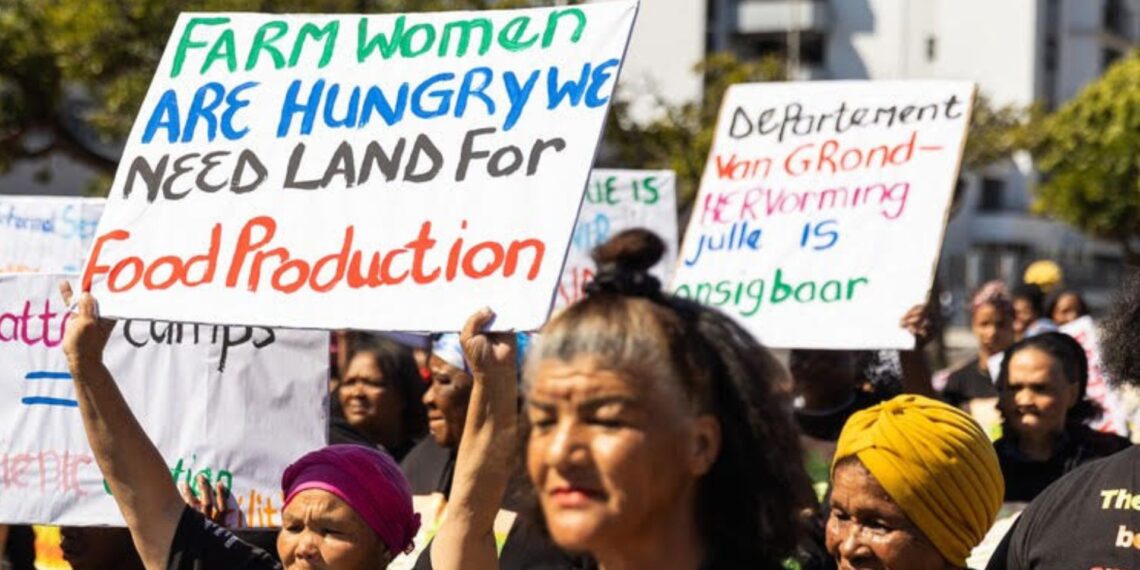
About 150 farmworkers, mostly women, marched through Cape Town to parliament on Thursday, calling for a meeting with the minister of land reform and rural development, Mzwanele Nyhontso, on land redistribution.
The march was organised by the Women on Farms Project (WFP). Farm women are calling on land to be made available to farmworkers and farm dwellers, small-scale producers, and poor working-class women.
In a memorandum, they also called on the minister to develop land redistribution legislation that prioritises farm women, to acquire and expropriate land for redistribution, and to impose a moratorium on all farm evictions until farm workers are beneficiaries of land redistribution, among other demands.
Land reform at ‘snail’s pace’
The march followed the annual National Farm Worker Platform, which was convened by WFP from 26 to 28 August. Discussions at the meeting included labour rights violations on farms, pesticide use on farms, and payment problems with the Unemployment Insurance Fund (UIF).
In their memo, WFP said land reform is moving at a “snail’s pace” and “the lack of land redistribution legislation perpetuates historic power, gender and economic imbalances”.
“The eviction of farmworkers and dwellers from commercial farms reinforces these inequalities, with evicted communities being dumped in already densely-populated informal settlements with very limited basic services,” they said in the memo.
“Despite being a major exporter of agricultural products… about 20 million people lack enough food daily… the majority of farmworkers who produce the country’s food often go hungry,” they said.
Related stories
- Minister vows to fast-track land reform, axe bad CPAs
- Schoeman: ‘If the people lead, the government will follow’
- Minister Nyhontsho: ‘Govt need to cut red tape on land reform’
- Food justice: Rural women launch campaign to end hunger

The marchers said a plot of land would give women a chance to be independent. Photo: Ashraf Hendricks
Magrieta Prins, who used to be a farmworker, now lives in De Doorns, a farmworker community, and plants vegetables and gardens on her plot of land. “Because we have the garden, at least we can live from it,” said Prins.
WFP also calls on the minister to give effect to the “One Woman, One Hectare” campaign, first launched by the Rural Women’s Assembly. The campaign would ensure that farm women have access to at least one hectare of land.
Carmen Louw, co-director at WFP, said: “Historically, farm women only lived on the farm as an addition to the male.” She said this made women “subordinate occupiers”.
Louw said that a hectare of land would give farm women protection, allow them to plant vegetables, and be “economically independent”. “If they have a piece of land, they can sustain their families and also generate an income. They don’t ask much,” said Louw.
Evicted workers struggle to make ends meet
Louw said that illegal evictions are still taking place.
Mateko Mohobo, a WFP activist from Spoekiesdorp, Rawsonville, said she frequently sees evictions in Rawsonville where farmworkers are “dumped” in Wendy houses in Spoekiesdorp. “Where must our people go?” she asked.
Mohobo said farm workers “walk in with empty hands and leave with empty hands” when they go to work on farms.
Siyabulela Ndamane, parliamentary liaison officer for the department of land reform and rural development, came out to accept the memo. He told the women the minister was “concerned about land given to women”. He said the memo would be given to the minister, and WFP would get a response.
- This story was first published on GroundUp.
READ NEXT: Foot-and-mouth outbreak spreads across Free State farms