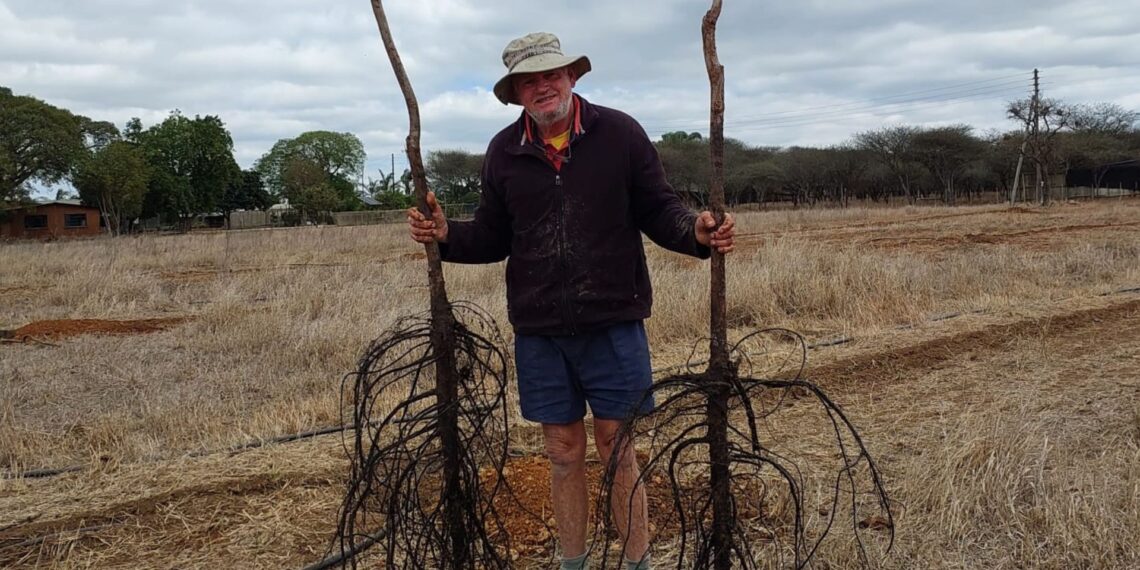
Richard Ball’s path to pecan farming wasn’t linear. It was a journey shaped by a life spent close to nature, a life of listening, learning, and eventually choosing to work with the land rather than against it. Today, he grows over 300 pecan trees with a vision to grow beyond 1 000.
“I grew up in the bush,” says Ball. “I was always exposed to farming. My friends were farmers, and when I was at school in a hostel, a lot of the kids were farmers’ sons. I listened to everything they said.”
This early connection to the land planted a seed that would grow over time. After leaving South Africa in the late 1980s, Ball travelled to the United States, where he worked as a labourer across the country, from construction sites to dairy farms.
While in the US, he also started a small business doing house maintenance and yard cleaning. As life often does, it took an unexpected turn. He became a Christian, discovered a calling to preach, and returned to southern Africa, where he shared his message across South Africa and neighbouring countries like Zambia and Mozambique.
Answering the farming call
Though meaningful, preaching didn’t offer financial stability. Eventually, the pull toward farming became too strong to ignore.
“My wife was a Zambian citizen, so we got property in Zambia and started ploughing,” he recalls. He learned to adapt quickly. “ We planted 15 hectares of maize and three hectares of groundnuts.”
Despite their efforts, the scale of the farm proved overwhelming. Eventually, he scaled down. “I only maintained one or two hectares of maize,” he says.
Those early farming attempts, though unsustainable, were rich with lessons. Ball believes that he learned by doing lots of hands-on work, experimenting with traditional tools, adapting machinery, and navigating both failure and success in Zambia’s soil.
Related stories
- Macadamia mission: Vumisa swaps engineering for farming roots
- Sustainable champion: MJ dreams of taking aquaponics to townships
- Farming is not for chancers, says Limpopo Bonsmara farmer
Why pecans?
A turning point came when a lifelong friend introduced him to macadamia farming. The resilience of the crop and its growing market potential reignited his interest in agriculture. “I wanted to plant nuts, pecan nuts, macadamia nuts, many years ago but the property that I got, gets very cold. We get a lot of frost.”
After returning from Zambia in 1993, Ball settled in Louis Trichardt, Limpopo. It wasn’t long before he decided to try pecan nuts, a crop that aligned with his values of patience, minimal interference, and harmony with nature.
For Ball, pecans offered the ideal balance between long-term sustainability and low input costs. Ball has invested significant time in studying and researching nut trees, particularly focusing on the different varieties suited to his environment.
Currently, he is cultivating three varieties: Choctaw, Wichita, and Ukalinga.
“My Wichita are doing fantastic, and my Choctaws are really big. I’ve had to prune them at three metres. They are very, very fast-growing trees.”
Although he initially planted a fourth variety, it has not thrived in his specific conditions and has since been phased out. Ball notes the importance of understanding which varieties perform best in particular soils and climates, a lesson he has learned through experience.
“In terms of input, it’s a lot less than crops like potatoes or sweet potatoes,” he says. While the initial cost of trees between R250 and R300 each is significant, he believes the long-term benefits make it worthwhile.
He also maximises the space between the trees by planting grass or small-scale crops. “I plant my trees eight to ten metres apart. In between those trees, I’m growing grass for my sheep. Some people even plant maize. It’s all usable space while the trees are still young.”
Integrating livestock
Ball has chosen to also keep Pedi sheep and Dexter cattle, both selected for their hardiness and ability to thrive in his low-input, nature-aligned approach to farming.
“I went for the Pedi sheep because they’re traditional, fat-tailed sheep and incredibly hardy. They’re only grazers, so they just need grass. I put them between my nut trees, they don’t eat or damage the trees at all.”
Their presence in the orchard helps manage the grass naturally while also contributing to the farm’s productivity. Ball’s flock has grown steadily and now stands at around 55 to 60 sheep. “I’ve already slaughtered quite a few,” he adds. “They’re fast-growing and easy to manage, a great fit for my system.”
As for Dexters, these are small cows and very tiny, he says. However, they give good milk and produce quality beef. “They’ll eventually take care of most of the grass, especially the bulkier patches.”
While the sheep have offered quicker returns, Ball is patient with the slower pace of raising Dexters. “The Dexter project will take longer before I start utilising them properly, but it’s worth the wait.”
For Ball, it all comes back to a simple principle: grow what you can manage.

A self-sustaining system
These days, Ball’s orchard is much more than a place where pecans grow; it’s a self-sustaining ecosystem influenced by permaculture practices. His sheep roam freely among the trees, helping to control weeds and naturally care for the land. His style of farming is rooted in simplicity, a far cry from the polished, textbook approaches often promoted to beginners.
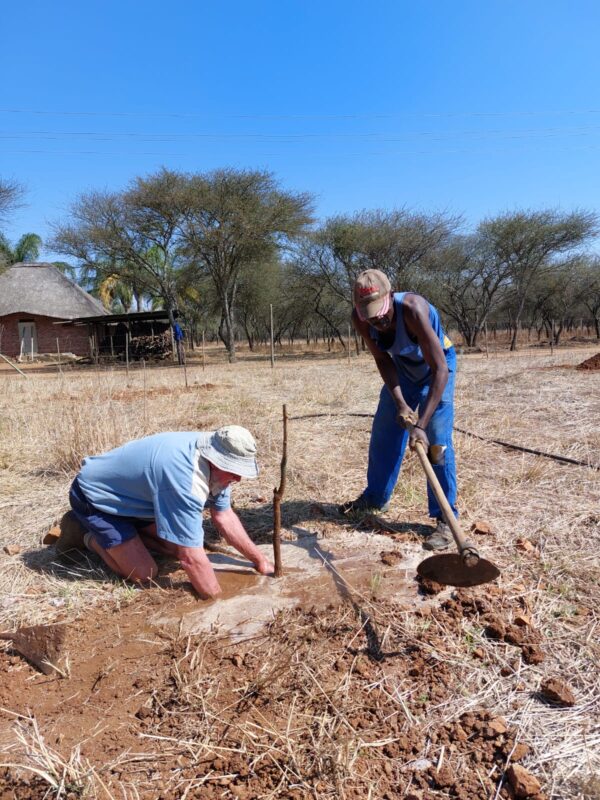
“I began with just 60 trees,” he recalls. “Then I added 40 more once I saw I could manage them. After that, I expanded with another 100, and eventually another 120. Now I’ve got about 350 trees, and this year, I’m planning to add 100 more.”
His approach to irrigation has followed the same step-by-step mindset: keep it manageable, build gradually, and avoid unnecessary complexity. “In the beginning, I was hauling borehole water around with a trailer,” he says.
“Eventually, I moved to a very basic irrigation system. People often tell me I need micro-jets, filters, and all sorts of fancy things, but honestly, that’s all nonsense. I just use a plain pipe with a smaller pipe attached.”
Ball has experimented with high-tech systems but found that simpler is often better. “I’ve used micros and all of that before. They get blocked, and then the trees start dying.
“I don’t spray herbicides or anything. When I give water to the trees, the grass around them goes green, and the sheep go eat it. Now they’re going tree to tree, cleaning up around them. That’s the way you want it.”
It’s a method that saves both time and money while prioritising environmental health. “You have to work with nature. As soon as you work against it, it begins costing you.”
Today, Ball is proud of the progress he’s made with his trees. While pecan farming requires patience, it can take years before the trees reach full maturity and production. He’s already reaping the benefits of a system that balances productivity with environmental responsibility. “I would rather have half a bucket of nuts than one bucket if it means the system works,” he laughs.
Ball’s core advice to aspiring farmers? Start small, scale gradually, and don’t overcomplicate things.


READ NEXT: Former Soweto DJ finds rhythm in sustainable farming
Sign up for Mzansi Today: Your daily take on the news and happenings from the agriculture value chain.