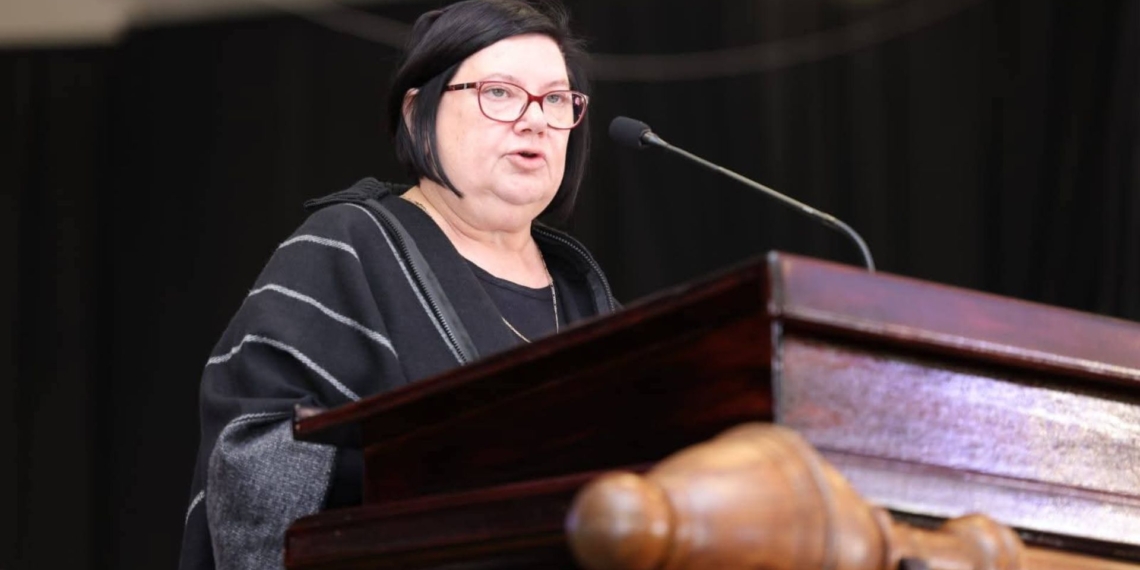
Presenting a budget of R1 089.079, Free State MEC for agriculture, rural development and environmental affairs, Elsabe Rockman, said the scale of South Africa’s foot-and-mouth disease fight is evident in projections that her department will need to vaccinate about 3 million cattle – roughly 18% of the national herd.
Rockman said as of 17 April 2026, there were 443 confirmed cases and 346 suspect cases. A total number of 294 new cases were identified from January 2026 to 17 April, and the Fezile Dabi and Thabo Mofutsanyana districts remain the epicentre of the province’s disease outbreak.
“The increase in reported cases is largely attributable to improved awareness and reporting by farmers following the rollout of the mass vaccination campaign. Most cases present as historical infections.
“The disease has affected both cattle and pigs, with approximately 188 634 animals impacted. Despite the scale of the outbreak, the morbidity rate has remained relatively low at 6%, with mortality negligible at 0.0012%,” she said.
Unlawful animal movement endangers herd
Rockman said in addition, 2 786 farms were inspected and 80 594 samples collected as part of surveillance efforts.
“Our progress is made possible by our small team of veterinarians and animal health technicians, assisted by veterinarians from the private sector. We must appreciate the extraordinary dedication and commitment of these officials and individuals who carry the frontline burden of the fight against the disease.
Related stories
- Free State, Gauteng unveil strategies to combat FMD crisis
- Free State farmers pay the price for broken roads, broken promises
- Communal grazing worsens FMD outbreak in Free State
- Free State farmers hit by rising seed theft
“Unfortunately, there are those who continue to move animals unlawfully, even with forged documentation, who refuse vaccinators access to herds, who fail to adhere to biosecurity measures at auctions and others who treat this national disaster as another business opportunity. Our control measures are not negotiable,” she said.
Rockman said in 2025/26, they developed and implemented a comprehensive Provincial Farmer Register on which 8 094 farmers are now registered.
“The Casp supported 63 projects and Ilima/Letsema supported 19 projects, with combined funding supporting 25 women-led projects and 24 youth-led projects across grains, fodder, horticulture, sunflower, soya beans, red meat, and agro-processing.
“We also invested in the disaster management capacity of farmers, fire protection associations, and provincial reserves with the distribution of fire-fighting equipment and facilitating fire-fighting training,” she said.
Investing in agricultural education
On the educational and training front, Rockman said their work in strengthening Glen College of Agriculture is continuing and supported by a focused programme guided by the Council of Higher Education (CHE).
“It focuses on curriculum review and transformation as well as policy review and development. Our partnership with the Da Vinci Institute also
supports our work and focuses on, inter alia, governance, compliance and quality management as well as digital student lifecycle systems.
“In addition, we have systematically started a programme to resuscitate farming,” she added.
Looking ahead, Rockman said one of their priorities this financial year will be the resolution of the disjuncture in the period of lease agreements offered to farmers by the municipalities, and the lease agreement requirements of CASP funding.
“Our focus will be on agricultural land rehabilitation, the promotion of conservation agricultural practices, climate-resilient agricultural production and green jobs. We will rehabilitate 7 500 ha and employ 700 people under green jobs activities on Glen Farm.
“We will contribute to the reduction in soil erosion and improve soil health by ensuring that 202 hectares of cultivated land are under conservation agriculture practices,” she said.
READ NEXT: AgriTrends: SA farmers adapt as global shocks reshape agriculture