Sunday, November 29, 2026
SUBSCRIBE
22 GLOBAL MEDIA AWARDS
Food For Mzansi
  • News
  • Changemakers
  • Lifestyle
  • Farmer’s Inside Track
  • Food for Thought
No Result
View All Result
  • News
  • Changemakers
  • Lifestyle
  • Farmer’s Inside Track
  • Food for Thought
No Result
View All Result
Food For Mzansi
No Result
View All Result
in News

 Small-scale sugarcane growers: ‘We are hungry, and we are ready’

Growers, millers and funders at the Sugarcane Development Transformation Dialogue say fast funding, shared risk and real farmer ownership will decide whether the industry meets its 51% transformation target

by Ivor Price
29th November 2026
Add FFM on Google
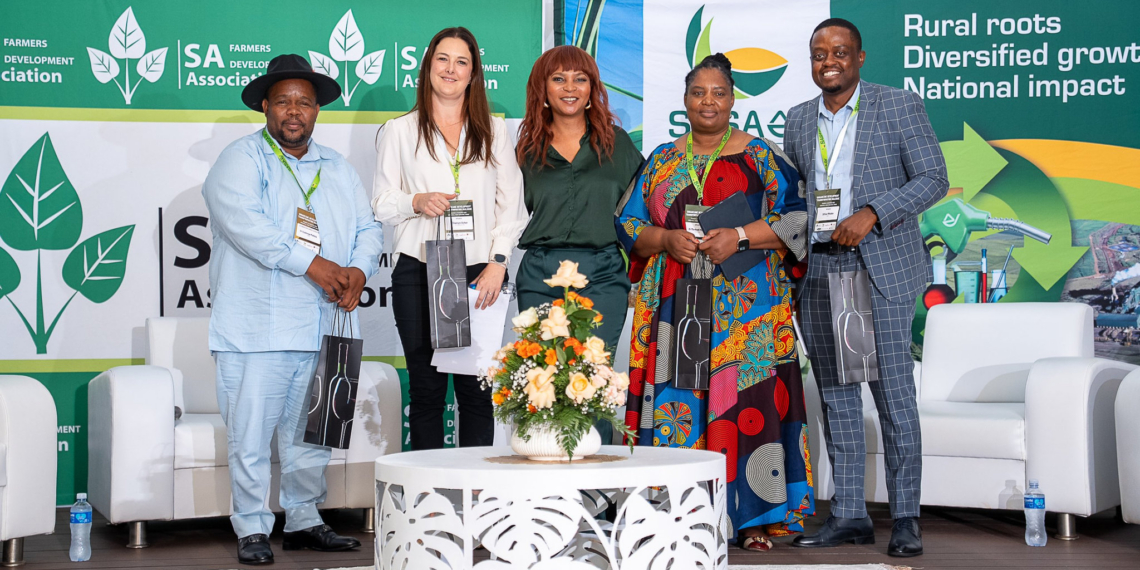
Panellists who discussed building an integrated and inclusive sugarcane development ecosystem at the Sugarcane Development Transformation Dialogue in Mount Edgecombe. From left: Dr Siyabonga Madlala (executive chairman, Safda); Sharryn Usher (finance and administration executive, SA Canegrowers); media personality Asanda Beda, Dr Mankodi Moitse (CEO, Kagiso Trust), and Sifiso Mhlaba (executive director, Sasa). Photo: Supplied/Food For Mzansi

Panellists who discussed building an integrated and inclusive sugarcane development ecosystem at the Sugarcane Development Transformation Dialogue in Mount Edgecombe. From left: Dr Siyabonga Madlala (executive chairman, Safda); Sharryn Usher (finance and administration executive, SA Canegrowers); media personality Asanda Beda, Dr Mankodi Moitse (CEO, Kagiso Trust), and Sifiso Mhlaba (executive director, Sasa). Photo: Supplied/Food For Mzansi

Share on FacebookShare on TwitterShare on WhatsApp

Small-scale sugarcane growers in KwaZulu-Natal have a simple message for the industry: give us the opportunity, and we will deliver.

That was the mood at the Sugarcane Development Transformation Dialogue, held at KwaShukela in Mount Edgecombe, Durban, on Thursday. With broad consensus that the 2028 deadline would be missed, growers, millers, funders and industry bodies explored how to accelerate progress towards the industry’s 51% transformation target.

In a panel led by Makho Gxumisa of Safda Financial Services, four growers supported by the South African Farmers Development Association (Safda) and Kagiso Trust shared how the funding has changed.

Thandiswa Ndlovu, a 23-year-old farmer and director of Bongza Farming & Engineering, is the youngest grower in the programme. Before the support, her 85-hectare farm had low yields.

Since then, she has replanted and restructured the farm, and expects yields to rise this season. Just as important, she said, is the community around it. Many neighbours knew nothing about farming before. “Employment was created, jobs were created, and they had to learn the skill of everything involved,” she said.


Related stories
  • Sugar industry seeks new path to 51% transformation target
  • Godlimpi calls for innovative sugarcane grower financing
  • Scrap sugar tax to save farmers and jobs, SA Canegrowers plead
  • Choosing local sugar is critical to keeping SA’s heritage alive

Funding that arrives in a week

For Bongani Sambo of Ikhwezi Agro Holdings, the biggest change has been speed. He joined his family’s business in 2018, moving from vegetables into sugarcane.

In his experience, funders give either a quick answer, usually a no, or a slow one, with months of questions. Safda’s support came just after harvest, when a partner’s problems had left the business unable to reach its funds. “I was very impressed that it only took a week,” he said.

He also used Safda’s mechanisation services to establish cane on newly acquired land, and even to repair the farm’s roads. “The experience for me has been such a success.”

‘Their humanity is now recognised’

Nolwazi Zaca, project manager of Isivuno Somzali Primary Co-operative, called herself “a product of sugarcane”. Her village’s cane project had collapsed years ago. When her father set out to revive it, neighbours asked to be part of it.

Safda and Kagiso Trust came in near the end of the planting season.

“We were racing against time, but because we were given this great opportunity, we wanted to run with it,” she said. The project has grown beyond its first 50 hectares. Diesel costs were hard, but jobs have been created.

“People that never had an opportunity to work before can walk in the streets of their own village. Their humanity is now recognised,” she said.

After finishing her degree, Zaca was unemployed herself. Her challenge to the room was direct: “This 51% is going to be made possible if you allow us to work with you. As small-scale growers, we are hungry.”

‘Do not expand faster than your cash flow’

Zethembiso Maphumulo of Mganu Afrika said a strike in August hit production. “We must be rooted in the soil,” he said. “We are the children of the soil.”

His main lesson was about money. “Most of our problems are money-related before they become operational.” Without cash flow, growers cannot plant on time, mechanise or test their soils.

“If you don’t get your soils right, how will you know what inputs to put into that soil?” He praised the programme as fast and responsive, and asked that it reach more growers, “regardless of how small or big they are”.

Quinton Naidoo, head of socio-economic development at Kagiso Trust, presented the trust's sugarcane development pipeline at the Sugarcane Development Transformation Dialogue in Mount Edgecombe. Photo: Supplied/Food For Mzansi
Quinton Naidoo, head of socio-economic development at Kagiso Trust, presented the trust’s sugarcane development pipeline at the Sugarcane Development Transformation Dialogue in Mount Edgecombe. Photo: Supplied/Food For Mzansi

From projects to an ecosystem

Quinton Naidoo, head of socio-economic development at Kagiso Trust, said the trust works to connect growers, millers, land reform beneficiaries and funders.

He showed a development pipeline of about 46 000 hectares across several catchments. “This shows the scale of what we are trying to do.”

Andrew Cochrane, agricultural executive at Illovo Sugar South Africa, said earlier models in which millers planted cane for growers had been loss-making. Illovo now supports about 3 000 hectares of small-scale cane. He warned against grant dependency.

Commercial farmers replant 10% to 12% of their cane each year, he said, but small-scale growers often cannot afford the lost income. He proposed replanting grants with a mandate that recipients save 10% of each grant.

Dr Siyabonga Madlala, executive chairman of Safda, called for farmer-driven partnerships with real ownership by growers at the Sugarcane Development Transformation Dialogue in Mount Edgecombe. Photo: Supplied/Food For Mzansi

Orchestration, ownership and trust

The discussion then turned to how an integrated sugarcane development ecosystem could work in practice. “Ecosystem and collaboration are a myth unless it’s orchestrated,” said Dr Mankodi Moitse, CEO of Kagiso Trust. It takes trust and “leadership that listens”, she added.

Dr Siyabonga Madlala, executive chairman of Safda, called for farmer-driven partnerships with real ownership by growers. Sharryn Usher, finance and administration executive at SA Canegrowers, said funded projects will now be tracked from start to finish, so the money truly reaches growers.

Transformation, she argued, should be judged by how many small-scale growers enter and stay in the industry. Another panellist hoped to see financiers “no longer as identifiers only of risk, but of opportunities”.

For the growers in the room, the opportunity is already clear. As Zaca put it: “We are ready.”

READ NEXT: R67m partnership transforms rural livestock health and traceability

Red stylized leaves resembling flames enclosed in a rounded, irregular red border on a white background.

Sign-up for the latest agricultural news delivered straight to your inbox every day with Mzansi Today!

Add FFM on Google Follow FFM on Google News

Ivor Price

Ivor Price is a multi-award-winning journalist and co-founder of Food For Mzansi.

Tags: Inform meKwaZulu-NatalSugar industryTransformation
Family holiday inspires thriving Mzansi moringa business
Agripreneur

Family holiday inspires thriving Mzansi moringa business

by Vateka Halile
26th November 2026

When Richard Gaisie and Freda Linde-Gaisie couldn’t find moringa in South African stores in 2011, they didn’t give up; they...

Read moreDetails

SA beef: Traceability is the ticket to global markets

26th November 2026
R67m partnership transforms rural livestock health and traceability

R67m partnership transforms rural livestock health and traceability

26th November 2026
Calls to bridge the gap between red meat industry and researchers

Calls to bridge the gap between red meat industry and researchers

26th November 2026
Building the future: Seriti Institute brings new hope to Standerton

Building the future: Seriti Institute brings new hope to Standerton

25th November 2026

Calls to bridge the gap between red meat industry and researchers

Boshof Solar Power backs three-year emerging farmer programme

R67m partnership transforms rural livestock health and traceability

Enza Zaden field days prove crop performance from farm to market

Indigenous leafy vegetables: Climate-smart lifeline during droughts

Join Food For Mzansi's WhatsApp channel for the latest updates!

JOIN NOW!

THE NEW FACE OF SOUTH AFRICAN AGRICULTURE

With 21 global awards in the first six years of its existence, Food For Mzansi is much more than an agriculture publication. It is a movement, unashamedly saluting the unsung heroes of South African agriculture. We believe in the power of agriculture to promote nation building and social cohesion by telling stories that are often overlooked by broader society.

 Small-scale sugarcane growers: ‘We are hungry, and we are ready’

Indigenous leafy vegetables: Climate-smart lifeline during droughts

Sugar industry eyes R1bn funding boost for transformation

Why African farmers need finance, not just rules, to go green

Sugar industry seeks new path to 51% transformation target

EC farmer Zoleka Dikana scales from village roots to 31 retailers

  • Awards & Global Impact
  • Our Story
  • Contact Us
  • Cookie Policy
  • Privacy Policy
  • Copyright

Contact us
Office: +27 21 879 1824
News: info@foodformzansi.co.za
Advertising: sales@foodformzansi.co.za

Contact us
Office: +27 21 879 1824
News: info@foodformzansi.co.za
Advertising: sales@foodformzansi.co.za

  • Awards & Global Impact
  • Our Story
  • Contact Us
  • Cookie Policy
  • Privacy Policy
  • Copyright

Chat Options

About this assistant

This feature generates automated answers summarised from Food For Mzansi articles. By using it, you are interacting with an AI system (provided by Google), not a human. AI can make mistakes. Please refer to the source articles for verification and citation purposes.

Our staff do not check or moderate Lerato’s answers in advance, but may review some later. Our journalists continue to write and edit all the articles Lerato uses as sources.

To estimate unique and returning web users, we store a random browser ID in this browser. WhatsApp users are counted by phone number. The same person using both channels may be counted twice.

I'm Lerato, your AI assistant!
No Result
View All Result
  • News
  • Changemakers
  • Lifestyle
  • Farmer’s Inside Track
  • Food for Thought

Copyright © 2026 Food for Mzansi