Friday, November 27, 2026
SUBSCRIBE
22 GLOBAL MEDIA AWARDS
Food For Mzansi
  • News
  • Changemakers
  • Lifestyle
  • Farmer’s Inside Track
  • Food for Thought
No Result
View All Result
  • News
  • Changemakers
  • Lifestyle
  • Farmer’s Inside Track
  • Food for Thought
No Result
View All Result
Food For Mzansi
No Result
View All Result
in News

Why African farmers need finance, not just rules, to go green

Certification alone isn’t enough to shield African farmers from climate change and rising input costs. Experts at the Rainforest Alliance roundtable said that to survive climate shocks and falling commodity prices, farmers need upfront finance, fair buyer pricing, and landscape-level investment

by Vateka Halile
27th November 2026
Add FFM on Google
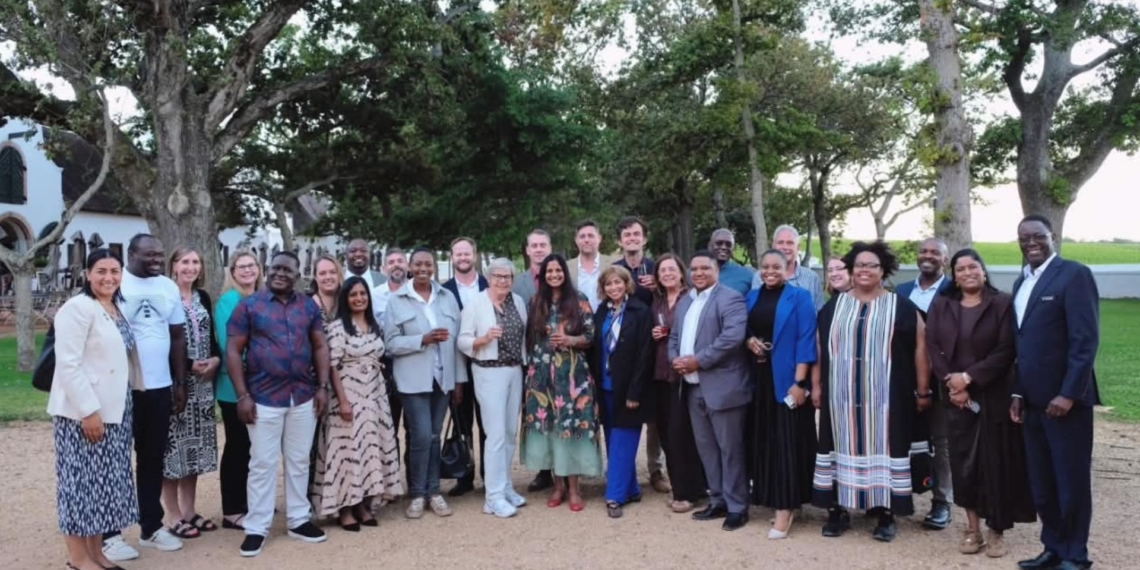
Participants at the Rainforest Alliance Donor Roundtable held at Groot Constantia, where conversations centred on sustainable agriculture, farmer support and the true costs of food production. Photo: Rainforest Alliance

Participants at the Rainforest Alliance Donor Roundtable held at Groot Constantia, where conversations centred on sustainable agriculture, farmer support and the true costs of food production. Photo: Rainforest Alliance

Share on FacebookShare on TwitterShare on WhatsApp

At Groot Constantia in Cape Town, with its rich history, wine and food, the future of African agriculture was at the heart of conversations on Tuesday, 24 November. At the Rainforest Alliance donor roundtable, attendees discussed the pressures farmers face, from climate change and rising production costs to soil degradation and markets that do not always reward sustainable farming.

Beneath the beautiful setting, the conversations carried a sobering reality. Making agriculture sustainable comes at a cost, and the question of who carries that cost remains.

Annemieke Wijn, Rainforest Alliance board member, said companies buying commodities such as coffee and cocoa do not always account for the environmental and social costs of producing them.

“They do not pay for the water, they do not pay for the soil, they do not pay for soil degradation, and they do not pay for the fact that children are working to some extent,” she said.

Wijn noted that this allows products such as chocolate and coffee to be sold too cheaply, while the costs of production remain unaccounted for. 

Annemieke Wijn, Rainforest Alliance board member, said the environmental and social costs of food production are often not reflected in the prices companies pay for agricultural commodities. Photo: Rainforest Alliance

She said regenerative agriculture could help farmers improve production without degrading their land, while giving forests greater economic value when left standing. “As we say, a standing forest is worth more than a forest that has been cut down.”


Related stories
  • Kagiso Trust to convene Regenerative Futures SA this June
  • What we’re missing in regenerative farming: A new way to learn
  • SADC experts urge smarter, more inclusive climate-smart tech
  • Carbon credits 101: A guide to regenerative farming & income

Farmers need more than certification

Marla Naidoo, relationship manager for Africa & Middle East, Corporate Engagement & Partnerships with the Rainforest Alliance, said farmers are facing difficult economic conditions, with falling macadamia prices prompting some to reconsider their farming practices and input costs.

Naidoo said farmers who are already adopting better practices could help others learn and scale up, but certification alone could not address the pressures facing agricultural communities.

“In order for certification to be sustainable, we have to invest in landscape programmes in order to make sure that farmers are supported adequately,” Naidoo explained.

Karin Kleinbooi, executive director of inclusion and development at South Africa Wine (left), and Marla Naidoo, regional director at the Rainforest Alliance. Photo: Rainforest Alliance

She pointed to a family-owned tea farm in Malawi that she visited the previous week, where the effects of El Niño had become so severe that the factory had to close. Despite the difficulties, the farm had tried to retain its workers, spreading the available work among them as it struggled to keep going.

Naidoo said regenerative agriculture could help strengthen farms against climate shocks, while investment in landscape restoration, grants and markets would be needed to support farmers and recognise their efforts towards sustainability.

Farming, forests and water are connected

Julius Nganga, senior director of programmes at the Rainforest Alliance, said protecting agricultural landscapes requires farmers, communities, government and other stakeholders to work together, as activities upstream can affect water, farming and electricity generation further downstream.

He noted that through the Mount Kenya Sustainable Landscape and Livelihoods Programme, which has been running since 2020, the Rainforest Alliance works with stakeholders to manage natural resources across the landscape. Mount Kenya is an important water tower for Kenya, supplying water to agricultural areas, towns and dams that generate electricity.

Nganga said agricultural expansion to increase production can put pressure on forests, making it important to balance productivity with protecting the natural resources farms depend on.

“I can give an example of a river whose source is in the forest. If people upstream do not protect the source, those downstream will be affected,” he said.

Julius Nganga, senior director of programmes at the Rainforest Alliance, speaks about protecting landscapes such as Mount Kenya, where farming activities upstream can affect water supplies, communities and electricity generation downstream. Photo: Rainforest Alliance

He explained that soil erosion from tea and coffee farming can lead to silt accumulating in dams, reducing their capacity to generate electricity. Water users beyond farming communities, including people in Nairobi, also depend on the landscape.

“So, how do we ensure that people work together? Even people in Nairobi benefit from this landscape. They depend on it for electricity and water, so it makes good business sense to invest in protecting it,” Nganga said.

He highlighted that investment in the landscape, sustainable farming practices and access to finance are important in helping farmers withstand climate and economic shocks. Farmers need funding upfront to put sustainable practices in place, and the Rainforest Alliance works with financial institutions to help them access that support.

Building more resilient agricultural systems

Tina Lippstreu, communications leader at the Rainforest Alliance, said sustainability claims also need to be backed by evidence and independent verification to prevent greenwashing.

“We have always advocated for independent third-party verification,” she said.

The Rainforest Alliance donor roundtable brought together stakeholders to discuss the economic, environmental and social pressures involved in making agriculture more sustainable. Photo: Rainforest Alliance

Lippstreu said regenerative agriculture practices such as agroforestry, protecting trees, mulching, maintaining ground cover and choosing climate-resilient crop varieties could help farmers protect their soil and retain moisture.

The discussions pointed to the need for sustainability efforts to extend beyond farm-level practices, with investment, credible verification, responsible purchasing and support for farmers and workers all playing a role in building more resilient agricultural systems.

READ NEXT: Regenerative Futures: How outdated banking stalls SA farmers

Red stylized leaves resembling flames enclosed in a rounded, irregular red border on a white background.

Sign-up for the latest agricultural news delivered straight to your inbox every day with Mzansi Today!

Add FFM on Google Follow FFM on Google News

Vateka Halile

Vateka Halile grew up in rural areas of Cofimvaba in the Eastern Cape. She was raised in a traditional family setting and found writing to be a source of comfort and escape. Vateka participated in an online citizen journalism course through Food For Mzansi, and her passion for health and medicine-related stories was born. Her dedication to community work and love for social justice and solidarity spaces is evident in her quality time with the community when she isn't working.

Tags: Inform meRainforest AllianceRegenerative agricultureWestern Cape
Calls to bridge the gap between red meat industry and researchers
News

Calls to bridge the gap between red meat industry and researchers

by Staff Reporter
26th November 2026

Experts at the Agri X Fusion summit unpacked how SA agribusinesses can leverage academic research, tax incentives, and collaborative partnerships...

Read moreDetails
Building the future: Seriti Institute brings new hope to Standerton

Building the future: Seriti Institute brings new hope to Standerton

25th November 2026
Gauteng farmer builds app to get fair livestock prices

Gauteng farmer builds app to get fair livestock prices

25th November 2026
Transformation Lekgotla: Call to fix ‘stubborn problems’ in farming

Ramasodi: ‘The best is yet to come for South African agriculture’

25th November 2026
Stop losing money on poor livestock marketing – here’s how to fix it

Stop losing money on poor livestock marketing – here’s how to fix it

25th November 2026

Drought fears and high input costs shadow SA maize farmers

SA women honoured for breakthrough farming and water research

Boshof Solar Power backs three-year emerging farmer programme

South Africa’s job crisis: Why the agricultural sector is bleeding

Building the future: Seriti Institute brings new hope to Standerton

Join Food For Mzansi's WhatsApp channel for the latest updates!

JOIN NOW!

THE NEW FACE OF SOUTH AFRICAN AGRICULTURE

With 21 global awards in the first six years of its existence, Food For Mzansi is much more than an agriculture publication. It is a movement, unashamedly saluting the unsung heroes of South African agriculture. We believe in the power of agriculture to promote nation building and social cohesion by telling stories that are often overlooked by broader society.

Why African farmers need finance, not just rules, to go green

Sugar industry seeks new path to 51% transformation target

EC farmer Zoleka Dikana scales from village roots to 31 retailers

Drought fears and high input costs shadow SA maize farmers

SA women honoured for breakthrough farming and water research

Family holiday inspires thriving Mzansi moringa business

  • Awards & Global Impact
  • Our Story
  • Contact Us
  • Cookie Policy
  • Privacy Policy
  • Copyright

Contact us
Office: +27 21 879 1824
News: info@foodformzansi.co.za
Advertising: sales@foodformzansi.co.za

Contact us
Office: +27 21 879 1824
News: info@foodformzansi.co.za
Advertising: sales@foodformzansi.co.za

  • Awards & Global Impact
  • Our Story
  • Contact Us
  • Cookie Policy
  • Privacy Policy
  • Copyright

Chat Options

About this assistant

This feature generates automated answers summarised from Food For Mzansi articles. By using it, you are interacting with an AI system (provided by Google), not a human. AI can make mistakes. Please refer to the source articles for verification and citation purposes.

Our staff do not check or moderate Lerato’s answers in advance, but may review some later. Our journalists continue to write and edit all the articles Lerato uses as sources.

To estimate unique and returning web users, we store a random browser ID in this browser. WhatsApp users are counted by phone number. The same person using both channels may be counted twice.

I'm Lerato, your AI assistant!
No Result
View All Result
  • News
  • Changemakers
  • Lifestyle
  • Farmer’s Inside Track
  • Food for Thought

Copyright © 2026 Food for Mzansi