Saturday, November 28, 2026
SUBSCRIBE
22 GLOBAL MEDIA AWARDS
Food For Mzansi
  • News
  • Changemakers
  • Lifestyle
  • Farmer’s Inside Track
  • Food for Thought
No Result
View All Result
  • News
  • Changemakers
  • Lifestyle
  • Farmer’s Inside Track
  • Food for Thought
No Result
View All Result
Food For Mzansi
No Result
View All Result
in News

Sugar industry eyes R1bn funding boost for transformation

With 751 hectares planted in year one, the sugar sector is targeting 5 000 hectares in three years. Panellists at the Sugarcane Development Transformation Dialogue called for pooled resources to accelerate progress

by Ivor Price
28th November 2026
Add FFM on Google
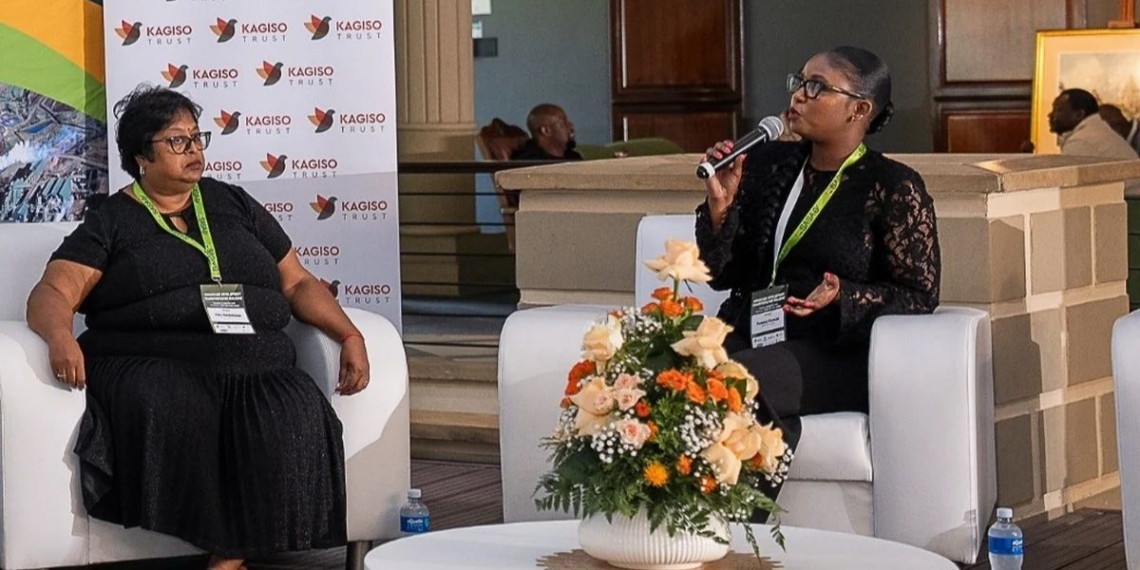
Thobeka Khumalo of Gledhow Sugar Company and Mary Ramkelawon of the South African Sugar Association (SASA) during a panel discussion at the Sugarcane Development Transformation Dialogue at KwaShukela, Mount Edgecombe. The panel discussed how growers, millers and funders can work together to build a more inclusive sugarcane industry. Photo: Supplied/Food For Mzansi

Thobeka Khumalo of Gledhow Sugar Company and Mary Ramkelawon of the South African Sugar Association (SASA) during a panel discussion at the Sugarcane Development Transformation Dialogue at KwaShukela, Mount Edgecombe. The panel discussed how growers, millers and funders can work together to build a more inclusive sugarcane industry. Photo: Supplied/Food For Mzansi

Share on FacebookShare on TwitterShare on WhatsApp

Getting land is only the start of a farming journey. That was the message from moderator Duncan Masiwa, head of brand, marketing and communications at the Agricultural Development Agency (Agda), as he opened a panel of the Sugarcane Development Transformation Dialogue at KwaShukela, Mount Edgecombe.

“What growers then ask themselves is: what do I need, and how do I get the finance to produce, bring my harvest to fruition and make a living off the land?” Masiwa said.

The panel reflected on year 1 of the programme. It brought together Anwhar Madhanpall of the South African Farmers Development Association (Safda), Thobeka Khumalo of Gledhow Sugar Company, and Mary Ramkelawon of the South African Sugar Association (SASA).

From projects to clusters

For Madhanpall, Safda’s head of development finance and project management, year 1 was a project-by-project intervention by Kagiso Trust and some milling companies. The lesson is about scale.

“If you want to achieve that target, you’ve got to scale up. And how do you scale up? You scale up in geographical areas, and the mill catchments are the ideal geographical areas to do it,” he said.

He also called for readiness capital, which gets the next year’s pipeline ready before planting money flows.

Duncan Masiwa of Agda joins panellists Anwhar Madhanpall of Safda, Thobeka Khumalo of Gledhow Sugar Company and Mary Ramkelawon of Sasa for a photograph following their discussion on scaling up sugarcane transformation at the Sugarcane Development Transformation Dialogue in Mount Edgecombe. Photo: Food For Mzansi

Bush, cattle and paperwork

Khumalo, an agronomist at Gledhow, took the audience into the field. The land was heavily encroached by bush, which had to be cleared before preparation could begin. Because it had been used for grazing, it also needed fencing, which meant extensive engagement with landowners, community leaders and livestock owners.

“We couldn’t start planting without these two critical activities, and neither was catered for when the project was budgeted,” Khumalo said. “They need to be viewed as essential components of future projects.”


Related stories
  • Godlimpi calls for innovative sugarcane grower financing
  • Scrap sugar tax to save farmers and jobs, SA Canegrowers plead
  • Choosing local sugar is critical to keeping SA’s heritage alive
  • Value chain collaboration key to building climate-resilient farming

Grower-code applications caused further delays, as many growers struggled to obtain certified documents in time.

Certified seedcane was limited, but Gledhow provided agronomic advice, from soil testing to variety recommendations, with extension services by the South African Sugarcane Research Institute (SASRI).

Fifteen years of Mafisa

Ramkelawon, SASA’s finance director, explained Mafisa, the Micro Agricultural Financial Institutions of South Africa scheme, which SASA has run since 2010. The fund started with R35 million and now stands at about R57 million.

About 2 500 loans worth some R117 million have gone to growers and co-operatives. In the last two to three years alone, roughly 550 loans worth R75 million helped plant about 1 500 hectares.

“As small-scale growers, your biggest challenge is that you cannot get commercial funding, because you don’t have the collateral and you don’t own the land,” Ramkelawon said.

She called for the department to top up the fund and for blended finance, which SASA has piloted with Mafisa as the loan component at 65% grant and 35% loan.

The industry already has the tools, she stressed, including a customised agricultural finance system and direct access to cane payments. “You just need to come in with the bucks, and we’ll do the rest.”

A delegate poses a question to panellists during a discussion on accelerating transformation and unlocking investment at the Sugarcane Development Transformation Dialogue in Mount Edgecombe, Durban. Photo: Supplied/Food For Mzansi

An industry-wide blended finance facility

Masiwa then asked what must change for the industry to reach 50% of cane tonnage from black growers by 2028.

Madhanpall was frank: the 2028 deadline is “somewhat far-fetched”. More important is that the industry and its development partners commit to the target as an industry programme.

“We need a blended finance facility at an industry level to drive this agenda,” he said, with commercial banks, millers and development finance institutions putting skin in the game, and public money lowering the cost of capital.

“It’s not far-fetched to say that within the next year we should have R500 million to a billion rand in facilities. I believe it’s achievable.”

The back-end infrastructure already exists, he said. What is missing is readiness capital, project management support and stronger collaboration.

Masiwa agreed: “If you look around the room, there’s money in the room.”

In practice, Madhanpall said, a special purpose vehicle with proper governance would let funders commit money against a credible pipeline of projects.

What year 2 needs

The panel’s lessons point to four actions:

  • Scale by mill catchment, not project by project.
  • Fund readiness first.
  • Budget for bush clearing, fencing and community engagement from the start.
  • Build an industry-wide blended finance facility that grows the Mafisa pot.

With 751 hectares in the ground and 4 249 still to go, the message from KwaShukela was simple: the systems and the money exist. The partners now need to bring them together.

ALSO READ: Calls to bridge the gap between red meat industry and researchers

Red stylized leaves resembling flames enclosed in a rounded, irregular red border on a white background.

Sign-up for the latest agricultural news delivered straight to your inbox every day with Mzansi Today!

Add FFM on Google Follow FFM on Google News

Ivor Price

Ivor Price is a multi-award-winning journalist and co-founder of Food For Mzansi.

Tags: Inform meSouth African Farmers Development Association (SAFDA)South African Sugar Association (SASA)Sugar industry
R67m partnership transforms rural livestock health and traceability
News

R67m partnership transforms rural livestock health and traceability

by Patricia Tembo
26th November 2026

A landmark collaboration between RMIS, Kagiso Trust and the FirstRand Empowerment Fund is delivering practical support to rural livestock producers....

Read moreDetails
Calls to bridge the gap between red meat industry and researchers
Calls to bridge the gap between red meat industry and researchers
26th November 2026
Building the future: Seriti Institute brings new hope to Standerton

Building the future: Seriti Institute brings new hope to Standerton

25th November 2026
Gauteng farmer builds app to get fair livestock prices

Gauteng farmer builds app to get fair livestock prices

25th November 2026
Transformation Lekgotla: Call to fix ‘stubborn problems’ in farming

Ramasodi: ‘The best is yet to come for South African agriculture’

25th November 2026

Drought fears and high input costs shadow SA maize farmers

Sugar industry eyes R1bn funding boost for transformation

Building the future: Seriti Institute brings new hope to Standerton

Enza Zaden field days prove crop performance from farm to market

Beyond timber: How farmers can profit from multi-purpose trees

Join Food For Mzansi's WhatsApp channel for the latest updates!

JOIN NOW!

THE NEW FACE OF SOUTH AFRICAN AGRICULTURE

With 21 global awards in the first six years of its existence, Food For Mzansi is much more than an agriculture publication. It is a movement, unashamedly saluting the unsung heroes of South African agriculture. We believe in the power of agriculture to promote nation building and social cohesion by telling stories that are often overlooked by broader society.

Sugar industry eyes R1bn funding boost for transformation

Why African farmers need finance, not just rules, to go green

Sugar industry seeks new path to 51% transformation target

EC farmer Zoleka Dikana scales from village roots to 31 retailers

Drought fears and high input costs shadow SA maize farmers

SA women honoured for breakthrough farming and water research

  • Awards & Global Impact
  • Our Story
  • Contact Us
  • Cookie Policy
  • Privacy Policy
  • Copyright

Contact us
Office: +27 21 879 1824
News: info@foodformzansi.co.za
Advertising: sales@foodformzansi.co.za

Contact us
Office: +27 21 879 1824
News: info@foodformzansi.co.za
Advertising: sales@foodformzansi.co.za

  • Awards & Global Impact
  • Our Story
  • Contact Us
  • Cookie Policy
  • Privacy Policy
  • Copyright

Chat Options

About this assistant

This feature generates automated answers summarised from Food For Mzansi articles. By using it, you are interacting with an AI system (provided by Google), not a human. AI can make mistakes. Please refer to the source articles for verification and citation purposes.

Our staff do not check or moderate Lerato’s answers in advance, but may review some later. Our journalists continue to write and edit all the articles Lerato uses as sources.

To estimate unique and returning web users, we store a random browser ID in this browser. WhatsApp users are counted by phone number. The same person using both channels may be counted twice.

I'm Lerato, your AI assistant!
No Result
View All Result
  • News
  • Changemakers
  • Lifestyle
  • Farmer’s Inside Track
  • Food for Thought

Copyright © 2026 Food for Mzansi