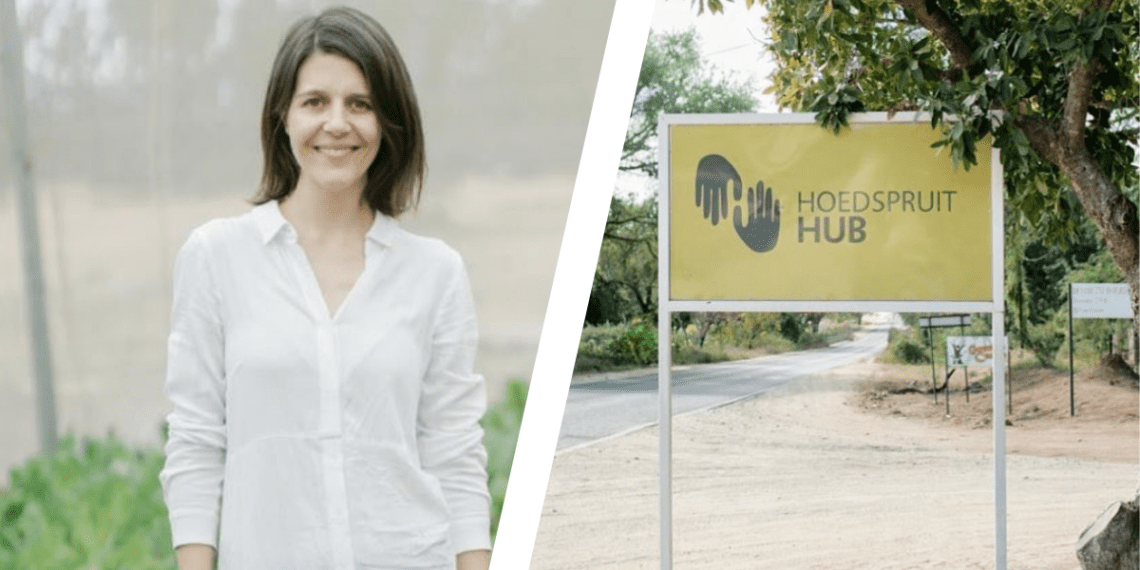
Dr Anri Manderson’s journey into agriculture is an unusual one. The agroecologist spent her childhood on a citrus farm in Letsitele, Limpopo and went on to obtain degrees in both graphic design and psychology. After spending some time in India, she opted for sustainable development.
“My dad has always had this rule as a farmer that we are not allowed to study agriculture,” she tells Food For Mzansi.
“We must go and gain other skills and then if we still wanted to farm, he would help set us up and guide us on that journey. And so, in studying visual communication design, my interest in projects have always just had a more kind of social development angle to them.”
After getting her first degree, Manderson worked in Auroville, a self-sustaining, experimental township in the state of Tamil Nadu. Her stay in India formed her ideas around what agriculture and a food system could look like. This led to a new career path.
“I came back to South Africa and did my honours and Master’s in sustainable development, management and planning at the Sustainability Institute at Stellenbosch University. And then I started my first job in Johannesburg with the Siyakhana initiative.”
Manderson’s time at this nonprofit that transformed city parks into food gardens was brief. After only a year, she got news that her application to further her studies in Belgium was accepted.
“I got accepted to do my PhD at the University of Antwerp, [where I studied] food security policy; focusing specifically on how food security research is used in [the] SADC region to write policy to basically solve hunger.”
With her in-depth knowledge of food security policy, it only seemed logical to Manderson to start working within smallholder farmer development. She then started working for the Southern Africa Food lab where she managed projects and helped structure their support programme.

The Hoedspruit Hub
Manderson’s work as the Hoedspruit Hub’s agroecology programme manager started in 2017. The Hub, which received funding for its start up phase from Flanders State of the Art and the GIZ E4D programme, is a family venture with various members of her family pooling together their research and knowledge to improve their community.
The hub was started when one after the other, she and some of her family members all found themselves returning to Limpopo.
“My husband was offered a job as an exporter here in Hoedspruit. I came with them, and I was still doing some work for the Food Lab, but also wanted to create something new. My mother and stepfather also moved to Hoedspruit at the same time, and they come from an educational and life coaching background.”
Her father and brothers were already farming in the area, and they had identified a breakdown in agricultural training when they hired people to train their staff. Manderson says they would hire big city trainers to do compliance training, but this simply did not work.
“They found that it was expensive; ineffective. There was no real quality control. And many of the talented people on the farm that could really benefit from training that built a bit of a career path for them, were not gaining that.”
With Hoedspruit Hub, the family could internalise their training process, ensuring that they are able to identify talent in their labour pool much more easily. And they could also ensure that their employees received specialised training that will help them to move forward.
“If a farmworker came in, they get a student number similar to a university, and then over time they have a training profile, [one you] could actually draw and see what they have done over the years.
“It’s much easier to identify, for example, an orchard supervisor who has strong leadership skills and is dedicated but who maybe lacks some of the other stuff. [You can] try and fill the gaps with specific training to move them into a junior manager. And ideally one day into a senior manager position.”
Manderson explains that the Hoedspruit Hub is involved in a number of projects, including a bursary programme where rural learners are sent to a local private school. The organisation also contributes to rural schools, where they support food gardens and helps facilitate training in agroecology, women and youth empowerment.

Supporting women growers
From around July 2019, Manderson had been farming herself. Her agripreneurial venture, called Like Mountains, is an essential oil company that she started in order to resolve some of the market issues in her community. Like Hoedspruit Hub, the venture was funded by Flanders State of the Art, and the funding was administered through the Industrial Development Corporation (IDC).
“I realised in my work with the smallholder farmers that it’s very difficult for them to access markets and with their fresh produce, and that they can’t really fetch a premium for their fresh produce. In their rural areas where we are, people don’t really value organic produce to the point where they can ask more for it.”
She thought about the kind of produce that can grow easily, that does not have many pests, that does not have a high transportation cost, and that has a long shelf life. Her answer: essential oils.
“You basically take a tonne of rose geranium and you turn it into 1.5 kg of oil – if you’re lucky. Your transport costs come down significantly and it has a three-year shelf life, so you have some time to actually sell it.”
She has since stopped farming herself but will continue sourcing produce from women growers in her area. She says the company is still in its infancy, but that she intends to add further value to it.
Creating sustainable communities
Furthermore, Manderson lists the Dinkwayane Water Smart Project as one of the most rewarding ones she has worked on with Hoedspruit Hub. She explains that often, doing research and training work has little effect on the communities, despite large amounts of money being spent.
“All that was required from us is to come in as a trainer and do our best to kind of transfer knowledge and skills. But then after that, why would people be motivated to suddenly apply these techniques? Especially when they are getting free inputs from government, and especially if they don’t have a counter support for that.”
Done in partnership with Conservation South Africa and Kruger2Canyons (K2C), Dinkwayane supports the people of Phiring in sustainable livelihood practices and climate resilience.
The project is funded by the Government of Flanders in Belgium, and Manderson says that the programme has a very strong environmental focus.
Manderson acknowledges that Mzansi is filled with great people running great projects. However, it just does not seem to be enough.
“There are amazing projects all around the world, and I would include this one in Phiring. It is just exceptional, and people can really learn from it but there’s just not enough commitment from political leaders and from those with money to really create the massive shift that we need to move towards a more sustainable future.
“So I cannot allow myself to get excited when projects work because it’s not even a drop in the bucket. But I wouldn’t do anything else. I am very content with where I am.”
ALSO READ: EduPlant: ‘A future filled with hand-ups, not handouts’
Sign up for Mzansi Today: Your daily take on the news and happenings from the agriculture value chain.