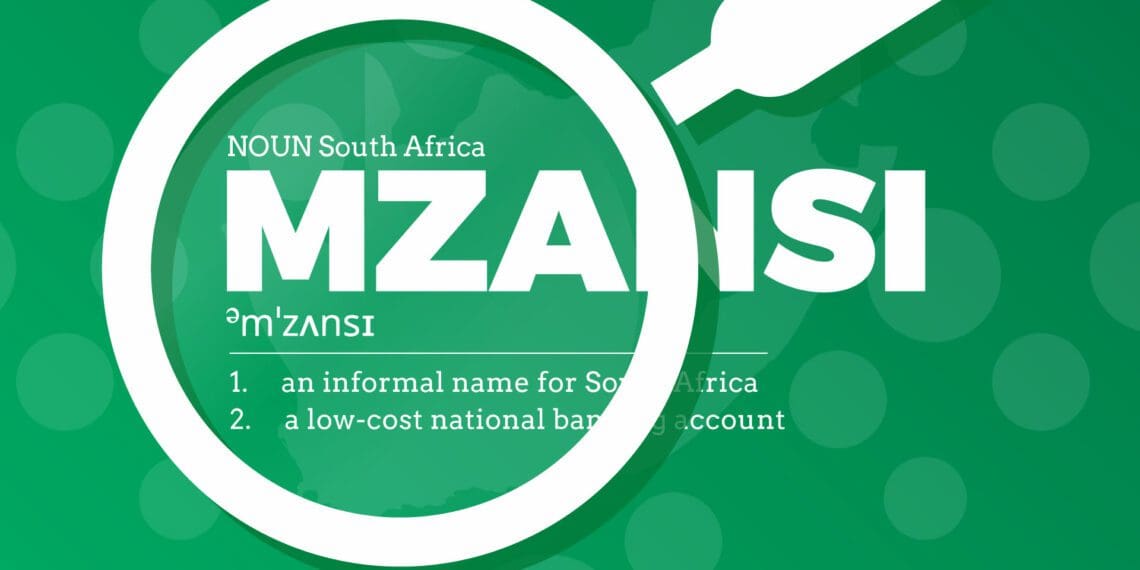
When it comes to origin, the source of the word “Mzansi” is pretty straight forward. It is derived from the word “Mzantsi”, which means “south” in Xhosa. South Africans have been using the word as an informal moniker for our country since the late 90s, more or less, and it is safe to say that the word is now firmly entrenched in our national brand and lexicon.
Still, here at Food For Mzansi we often get the question, “where is this ‘Mzansi’ that you are talking about?”, or “Who is ‘Mzansi?’. To help our readers out, we decided to do a bit of investigating and find out how the word became so popular.
The online Collins dictionary lists two definitions for ‘Mzansi’; the first being “an informal name for South Africa”, and the second a “a low-cost national banking account”. Both of these definitions are in fact correct, though we will get to the second one a bit later.
As an informal name for the country, Mzansi started becoming markedly more popular towards the late 90s. In this very thorough blog post, lexicographer Richard Bowker, who runs the Gqom blog, attempts to unpack where the word first started appearing as a moniker for South Africa.
According to his research, the first mention of the word in written text comes from academic Tlhalo Sam Raditlhalo, in a 1997 paper archived at the National English Literary Museum in Grahamstown (now known as Makhanda).
The word appears as “Mzantsi”, which is the formal word for south in isiXhosa, an Nguni language that is one of the official languages spoken in South Africa (SA). Without the ‘t’, the word is “Zulufied”, which means it looks as if it is from the Zulu language (another Nguni language spoken in SA) when it is actually Xhosa.
Bowker notes that it is very likely that the word was already part of the South African oral lexicon at the time, but that there is probably just no record of it.
A journey to popularity
How “Mzantsi” became “Mzansi” is also an interesting journey. Bowker’s research shows that the official Xhosa name for South Africa (written on our R5 coins!) is uMzantsi Afrika. When compared to the official Zulu name, iNingizimu Afrika, he speculates that the word “umzantsi” became more popular simply because the literal definition of “iningizimu” means “place of many cannibals”.
uMzantsi Afrika then conversationally became “Mzantsi”. And, due to Zulu being the most spoken language in Gauteng, home to the country’s largest urban area, the word became Zulufied, losing the ‘t’ and becoming “Mzansi”.
Another thing he notes is that, at the end of the 90s and in the early 2000s, big corporate brands started adopting the word, which very likely contributed to its popularity.
On that second definition cited in the Collins dictionary – “a low-cost national banking account” – refers to the Mzansi Account, crafted by the country’s biggest banks as an attempt to get low-income citizens into the banking system.
Anyone who was around during that time will also recall SABC 1’s big rebranding, with the tagline “Mzansi fo sho”. And who can forget Mzansi Magic, the MultiChoice channel launched in 2010?
Today, the definition of “Mzansi” has expanded, and is not just an affectionate informal naming of the country. It is also a name for its people. So, when people ask, “Who is ‘Mzansi?’”, we can quite simply say “Mzansi” is all of us.
Sign up for Mzansi Today: Your daily take on the news and happenings from the agriculture value chain.