Saturday, August 8, 2026
SUBSCRIBE
22 GLOBAL MEDIA AWARDS
Food For Mzansi
  • News
  • Changemakers
  • Lifestyle
  • Farmer’s Inside Track
  • Food for Thought
No Result
View All Result
  • News
  • Changemakers
  • Lifestyle
  • Farmer’s Inside Track
  • Food for Thought
No Result
View All Result
Food For Mzansi
No Result
View All Result
in News

WC farm equity schemes under fire after worker exploitation claims

A shocking parliamentary visit to Western Cape farms has revealed the dark side of farm equity schemes. Despite R700 million in state funding, most worker-shareholders have received nothing, and many now face poverty and eviction. Lawmakers are calling for a forensic investigation

by Lisakanya Venna
18th March 2026
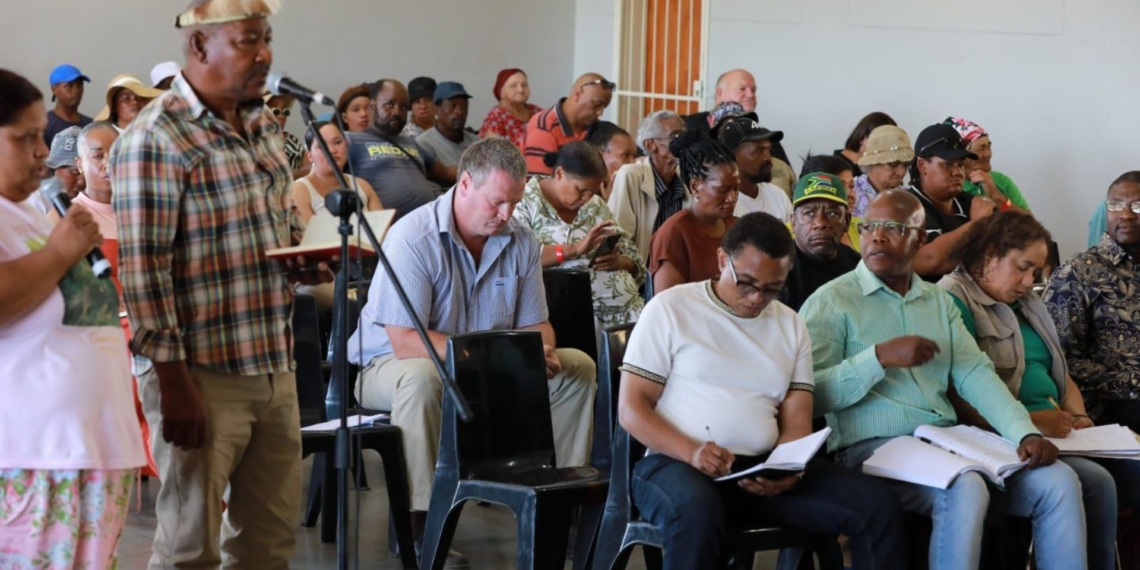
Farmworkers at the parliamentary oversight visit in the Western Cape. Photo: Supplied/Food For Mzansi

Farmworkers at the parliamentary oversight visit in the Western Cape. Photo: Supplied/Food For Mzansi

Share on FacebookShare on TwitterShare on WhatsApp

The portfolio committee on land reform and rural development has called for a forensic investigation into farm equity schemes after a three-day oversight visit in the Western Cape revealed widespread mismanagement and abject poverty among worker-shareholders.

During the mission to farms in Tulbagh, Clanwilliam, Citrusdal, and Ceres, the committee heard harrowing accounts from affected workers. Despite a R700 million state investment in the government’s Farm Worker Equity Scheme (FWES), only nine out of 88 schemes have ever declared dividends. This has left thousands of farmworkers destitute, with many facing eviction upon retirement.

The committee heard harrowing accounts of farmworkers being misled into selling their multimillion-rand shares for minimal amounts, sometimes as little as R20 000, without understanding the long-term consequences. In one case at Verlorenvlei Farm, workers were not even aware that the land had been sold to a Belgian businessman.

These exploitative practices extend beyond share sales. Many farmworkers still live in unbearable conditions, earning below the minimum wage despite their shareholder status. Worse, they lose all benefits and tenure the moment ill health forces them to stop working, often leading straight to homelessness.


Related stories
  • Expropriation Act: Land reform faces its toughest test yet
  • Civil groups slam govt for failed farmworker equity schemes
  • Compensation Fund warns: Compliance key for farmworker safety
  • Portfolio committee probes failures in struggling state projects

The investigation follows a petition submitted to parliament late last year by a coalition of organisations, including the Surplus People Project (SPP), Corruption Watch, the Legal Resources Centre, and the Support Centre for Change. These groups argue that while the schemes were promoted as mechanisms for empowerment, they have instead left a legacy of “enduring exclusion and institutional unaccountability”.

This sense of exploitation was echoed during the committee’s briefing sessions, where the human cost of these failed partnerships was laid bare.

“These farmworkers became symbols of transformation, while others cashed in on their name. It’s a betrayal of farmworkers who feed our nation,” said Brian Adams, CEO of the SPP.

A legacy of failure

The FWES model, initiated in the mid-1990s as joint ventures between agribusinesses and workers, has been plagued by what the department describes as a “structural capability gap”. This gap in governing complex equity partnerships has historically excluded beneficiaries from meaningful decision-making power and access to information.

According to the portfolio committee, this is due to the lack of government support through monitoring and evaluation of the scheme, which contributed to the scheme being discontinued.

The department of land reform and rural development officially placed a moratorium on the model in June 2009 following numerous negative experiences. Although the government introduced the Recapitalisation and Development Programme (Recap) in 2010 and tested a 50/50 model between 2014 and 2018, the original equity schemes remained a site of real and ongoing harm for those involved.

The road to accountability

Committee chairperson Mangaqa Mncwango said they would ask representatives from the department to respond to the petition. Addressing the frustrated farmworkers directly, he said, “I assure you your frustrations are not misplaced.”

The committee is now expected to request a special investigation into the circumstances that led to workers selling their shares and to determine the current ownership of farms.

Following the shocking findings of the oversight visit, the focus now turns to the department to provide a structured set of remedial options and forensic audits to finally deliver justice to the workers.

READ NEXT: Fort Hare proposes SA’s second veterinary academic hospital

Sign-up for the latest agricultural news delivered straight to your inbox every day with Mzansi Today!

Lisakanya Venna

Lisakanya Venna is a junior journalist and content coordinator with varied multimedia experience. As a CPUT journalism alumni, she finds fulfilment in sharing impactful stories and serving as a reliable source of information.

Tags: Agriculture Portfolio CommitteeFarmworkersInform meLand reformWestern Cape
Shongotelo Mashengete: Shielding SA crops from disease
AgriCareers

Shongotelo Mashengete: Shielding SA crops from disease

by Vateka Halile
6th August 2026

Growing up in Malamulele, Limpopo, Shongotelo Mashengete developed a curiosity about the natural world that led her into agricultural science....

Read moreDetails

Why vaccination alone won’t restore SA’s global beef exports

6th August 2026
SA Preserve Championships draws record 700 entries

SA Preserve Championships draws record 700 entries

6th August 2026
How grain farmers can secure cash flow and funding in uncertain seasons 

How grain farmers can secure cash flow and funding in uncertain seasons 

5th August 2026
Professionalism pays: How Jantjies built a thriving lucerne business

Professionalism pays: How Jantjies built a thriving lucerne business

5th August 2026

Professionalism pays: How Jantjies built a thriving lucerne business

SA agri exporters welcome US tariff relief for oranges and nuts 

Table grape industry faces ‘new normal’ in climate crisis

Topsun Fresh drives SA apple brand loyalty in China

Western Cape suffers driest July on record ahead of intense El Niño

Join Food For Mzansi's WhatsApp channel for the latest updates!

JOIN NOW!
Next Post
Fort Hare agricultural students in limbo amid qualification crisis

UFH agriculture students take degree dispute to Public Protector

THE NEW FACE OF SOUTH AFRICAN AGRICULTURE

With 21 global awards in the first six years of its existence, Food For Mzansi is much more than an agriculture publication. It is a movement, unashamedly saluting the unsung heroes of South African agriculture. We believe in the power of agriculture to promote nation building and social cohesion by telling stories that are often overlooked by broader society.

SA agri exporters welcome US tariff relief for oranges and nuts 

SA’s deepening water crisis threatens national food security

Soul To Soil: Win a two-night hotel getaway with ANEW

Pannar Seed: How to build climate resilience through moisture management

EC women-led co-op turns communal land into retail success

Beyond bumper harvests: Why SA must prepare for super El Niño

  • Awards & Global Impact
  • Our Story
  • Contact Us
  • Cookie Policy
  • Privacy Policy
  • Copyright

Contact us
Office: +27 21 879 1824
News: info@foodformzansi.co.za
Advertising: sales@foodformzansi.co.za

Contact us
Office: +27 21 879 1824
News: info@foodformzansi.co.za
Advertising: sales@foodformzansi.co.za

  • Awards & Global Impact
  • Our Story
  • Contact Us
  • Cookie Policy
  • Privacy Policy
  • Copyright
No Result
View All Result
  • News
  • Changemakers
  • Lifestyle
  • Farmer’s Inside Track
  • Food for Thought

Copyright © 2024 Food for Mzansi

This website uses cookies. By continuing to use this website you are giving consent to cookies being used. Visit our Privacy and Cookie Policy.