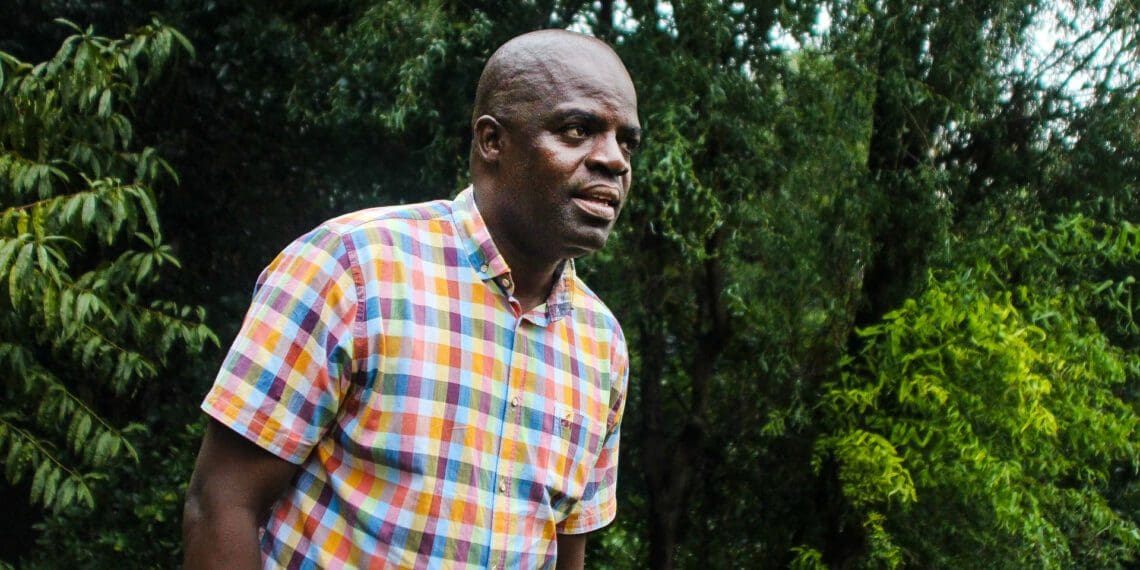
AgriSETA’s top man, Dr Innocent Sirovha, is a leader of impeccable disposition. “I do not feel like a CEO, nor do I behave like one. I behave like an ordinary worker,” he says with an aura of serenity.
He holds a PhD in Public Administration from the University of Pretoria, and has served as municipal managers at the Bojanala Platinum District Municipality in North West and Greater Letaba in Limpopo before joining AgriSETA.
Sirovha is also the author of three books: Forging Ahead, which depicts the adversities and highlights of his career; The Gain of Pain, documenting in gruelling details how pain can be a much-needed recipe for success; and It’s Not Impossible.
In the words of UP’s professor emeritus Christopher Thornhill this last book is a “mature development of thoughts and reflection on life, religion and philosophy”.
But these accolades still fall short in properly describing Sirovha’s character. To do it justice, one needs to go back to before he was born. His father was unpleased that his mother, Munzhedzi, had only conceived daughters and he decided to find a second wife, who managed to conceive a son at first attempt.
According to tales and anecdotes Munzhedzi started fasting and, in conversation with her Creator, said, “Oh Lord, I am the one who believes in you. Let me bear a son who will work for you.” And so it happened.
“I became a beneficiary of a covenant between my mother and God,” Sirovha explains. One of the things he does to honour the covenant is handing out food parcels once a year to at least 450 families. These donations are facilitated through his non-profit entity, the Sirovha Foundation, which “inculcate a culture of giving and sharing”.
He has also started building five-roomed houses for the needy in Venda, and his goal is to build at least 100 houses by 2025.

The gain of pain
Sirovha says that, what further moulded and shaped his character, are the striking failures he had encountered during his humble beginnings at Khakhanwa village in Venda, Limpopo. One of the thorniest of these tribulations was repeating matric thrice at Movhe Secondary School.
He recalls that rising above failing matric wasn’t easy. “There was one English teacher who’d ask a question and if no one raised their hand, he’d say, ‘Innocent, for the past two years we’ve been asking the same question and now you’re doing it for the third time. I am sure now you know the answer. It is the same that we needed last and the previous year. Just give us an answer.’”
Of course there were many challenges he had faced, but “not one comes closer to repeating Grade 12 three times”, he says. “You start to doubt your [capabilities]. No one wants to associate with failures.”
But overcoming this obstacle made him realise that nothing is impossible in life. He learned to push himself beyond his comfort zone, so much so that he is determined to complete the 90 km Comrades ultra marathon – a once-in-a-lifetime goal for before age sets in and lets parts of his body fail him. “Jogging makes me happy.”
It’s not impossible
His journey to becoming an adept jogger was a result of an hilarious experience. It was 2016 when he went to register to run 10 km for the first time. While in the queue, Sirovha vividly remembers, he was struck with great disbelief by “two horizontally gifted women [saying] that they’d register for 50 km”.
As he got to the registration point, the gentleman asked how many kilometres he would be registering for. “I looked at the two ladies… Then I looked at him and I just said 50 km. During the running, when I reached 22 km, I could not even walk. But those ladies came past me and they did 50 km!”
Again, he failed eight times to finish the distance within 5 hours – a requisite for the Comrades. “Then, in March 2020, I ran and qualified… but it was cancelled because of Covid-19.”
He has recently qualified for the torturous run again. “This is a determination,” he says, adding that he always finishes what he has started.
This resilience, utmost devotion and patience are also key elements that have shaped the kind of a leader that Sirovha has turned out to be. Armed with the steroids of tenacity, his career goals are to push AgriSETA to reach a pinnacle. He’s currently driving a campaign for households to have their own gardens.
He says that he is cognisant that owning a garden won’t necessarily end poverty. But it is one step away from chronic hunger. “[And] I want to see more people moving from subsistence farming to commercial. It is not an overnight thing; it is a process,” he says.

Sirovha’s goals for AgriSETA
He adds that AgriSETA has already begun sending subsistence farmers to enrol in programmes for training. “We want to track these farmers to monitor what it is that they need to move from this level to the next. Those are the things that I want to see.”
He wants to see the training entity play an instrumental role in the land reform programmes. He is proud that, for the first time, AgriSETA has allocated R49.6 million to agricultural colleges so that students from impoverished backgrounds would not have to pay a cent when acquiring agricultural skills.
“Those students who passed from TVET colleges, we want to place them on farms and pay them for 12 to 18 months to gain practical experience. We hope that some [of them] will develop an interest and start their own farms so that they’d be eligible to get funding,” he says.
“If the country has to be saved, agriculture is one of the areas that will provide employment. If we do not do anything about unemployment, very soon [the unemployed] will be forcefully eating from the table of the haves.”
Last year, AgriSETA only achieved 73% of its outlined project goals, and this angered him deeply. He wants to see the number at at least 90% and wants to correct this performance. He wants to practise what he preaches in his books: the art of having to take tough decisions for the betterment of the future.
“I didn’t want to recommend the approval of bonuses to the board until I saw that our bonus structure also qualified the cleaners. I ended up recommending them because I am biased towards the low-earning workers.
After all, he knows the pain of not having enough. “It was tough in my life. My wife and I had nothing. We only had each other.”
Sirovha remains confident that AgriSETA will fulfil its duties with distinction. “Anything that you start with love, will succeed.”
ALSO READ: Byron takes agriculture to Atlantis community
Get Stories of Change: Inspirational stories from the people that feed Mzansi.