South African farming faces endless challenges, from degraded soil to poor market access. For Professor Mamokgethi Phakeng, the former UCT vice-chancellor-turned-farmer, South Africa cannot fix its economy or food security without first restoring soil health.
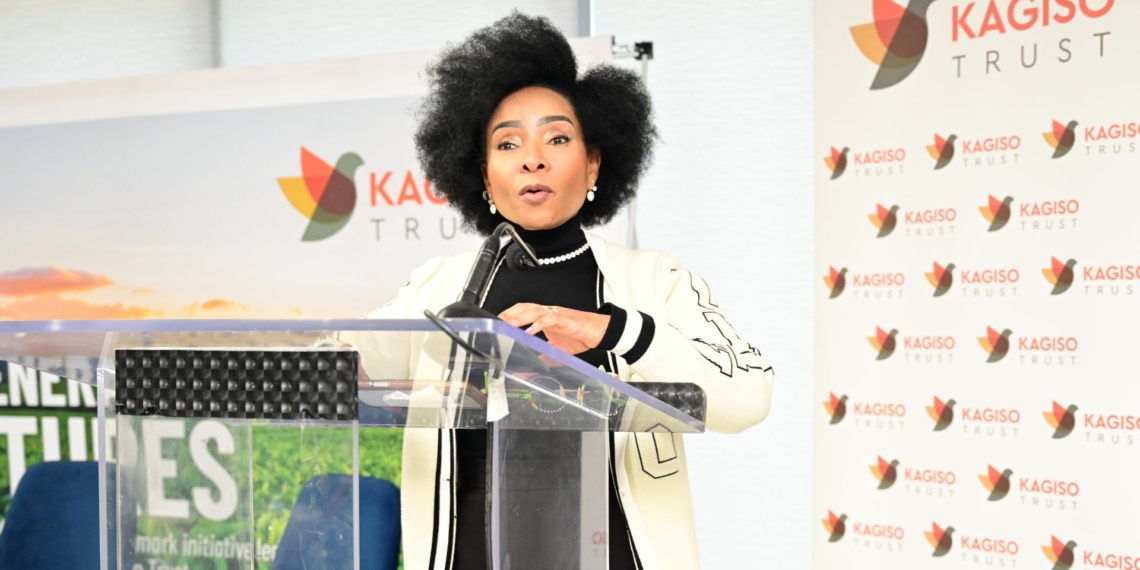
At the Regenerative Futures SA 2026 conference held in Johannesburg, Phakeng wove land health, climate resilience, and economic transformation into one national narrative, laying out a blueprint for a scalable regenerative economy that works for farmers, ecosystems, and markets.
After 30 years in higher education, Phakeng has swapped lecture halls for commercial farming. She admits the leap into Mzansi’s agribusiness sector has been a swift lesson in humility.
“I had no knowledge whatsoever about farming, nothing. And the very first thing I learned is that farming is a very strict teacher. In academia, if you make a mistake, you may get a review or a comment. In farming, if you make a mistake, things die. Money disappears and production drops.”
Operating a commercial poultry enterprise in the Free State focused on layer rearing and egg production, Phakeng has had to learn day-to-day farm management from scratch. Managing biosecurity protocols, fluctuating feed prices, and flock health has redefined her perspective on operations.
Shifting the baseline
At the heart of the regenerative approach is a fundamental change in how producers, investors, and agribusinesses measure commercial success, she explained.
“In this day and age, the more important question is: what happened to the soil while we were producing? It’s not just about how much we produce; it’s what happened to the soil, what happened to water, what happened to biodiversity? What happened to the next generation’s ability to produce from that same land?”

Phakeng noted that regenerative agriculture demands production practices that actively improve soil organic matter, water retention capacity, and on-farm biology. It requires managing the farm as an ecological system in which carbon sequestration and natural resource regeneration safeguard baseline assets.
Championing local, indigenous knowledge
Phakeng spoke out against institutional frameworks that frequently dismiss practical, localised knowledge until it is formatted into an official academic report.
She noted that indigenous farming communities have practised many regenerative principles for generations before being rebranded as modern innovation.
Related stories
- Regenerative Futures: How outdated banking stalls SA farmers
- Beyond land: Leaders call for full package support
“The problem is not that we have no knowledge, but that certain knowledge only becomes respectable when it arrives very sophisticated in time,” she said.
However, she cautioned against unconditionally romanticising historical methods. “Some old practices were wise. Some were limited by time. Regeneration is not always about going backwards. We must bring together the best of ecological wisdom, scientific research, farmer experience, technology, market intelligence, and moral courage.”
Making agriculture intellectually fashionable
According to Phakeng, building a scalable regenerative economy requires a major shift in how young people view agricultural careers. She raised concerns over persistent social biases that treat farming as low-skilled work reserved for those who cannot find corporate employment.
To actively challenge these class-based prejudices, she uses her public profile to document her own practical farm operations, including driving her tractor.
“They assume if you drive a tractor, you are low class. They think a PhD shouldn’t be driving a tractor. We must challenge this dangerous lie that farming is low-skilled work. It must die publicly, loudly, and permanently.”

A coordinated national blueprint
For regenerative practices to scale effectively across Mzansi, the industry needs to move past isolated pilot projects and build an integrated system.
Phakeng concluded with a call for structural alignment, comprehensive training pipelines, and a clear understanding of the economics of food security.
“Whoever controls food systems controls life. Whoever controls land controls possibility.
“The regenerative imperative for South Africa is clear: we must produce food, but we must also restore soil. We must grow markets, but we must also support farmers. The farmer who cannot make money will not stay on the land. That’s a fact. The land that is not cared for will not keep feeding us,” she said.
- Regenerative Futures SA 2026, a landmark convening by Kagiso Trust in partnership with Food For Mzansi, concluded today after two days of robust dialogue and exchange among farmers, researchers, retailers, investors, policymakers and development leaders committed to shaping a more regenerative agricultural future for South Africa.


READ NEXT: Regenerative Futures: How outdated banking stalls SA farmers