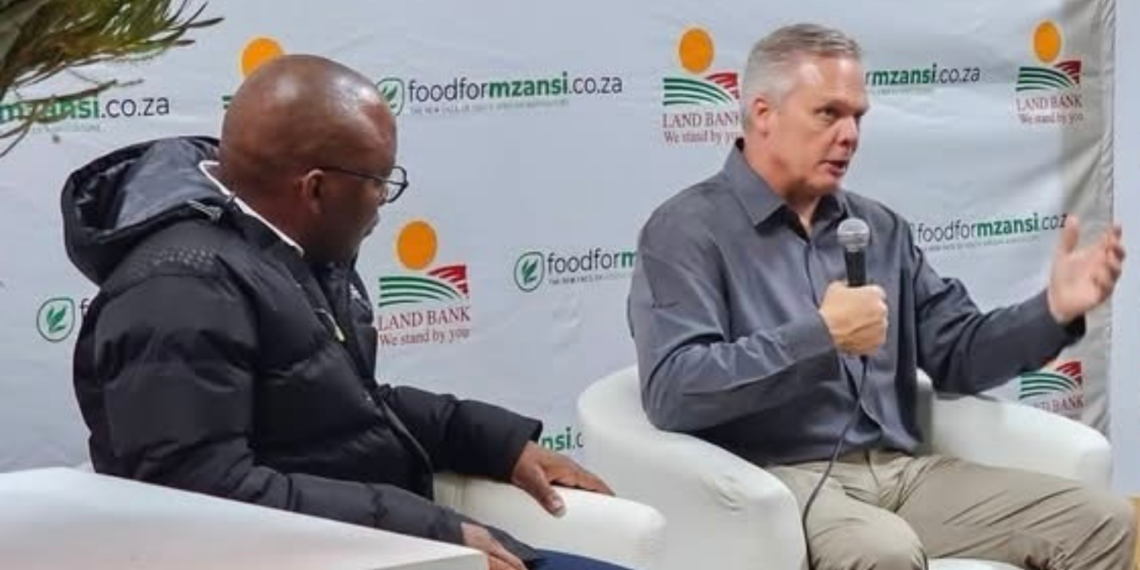
An overfull auditorium marked the final session of Nampo Cape 2026 as agriculture minister Willie Aucamp and Land Bank acting CEO Jabu Mphambo met for a fireside chat hosted by Food For Mzansi and Land Bank in Bredasdorp.
Aucamp and Mphambo engaged in a direct, constructive dialogue on farm debt, structural financial challenges, biosecurity crises, and the urgent need to remodel agricultural financing in South Africa.
Reflecting on his interactions across the country during the transition between the winter crop harvest and summer planting, Aucamp noted that attending regional congresses provided invaluable insights into the specific and shared burdens of South African producers.
“I had the opportunity over the last two months to attend a lot of those agricultural congresses that gave me the opportunity to be with farmers from all over the country and get an idea of the different challenges they face. The individualising of area-specific problems was an eye-opener for me,” Aucamp said.
Related stories
- Protecting what matters: Smart insurance keeps farmers bankable
- Markets, water and finance key to Western Cape farm growth
- Leaders tackle finance and farmer support at Nampo Cape
- New-era farmers get dedicated programme at Nampo Cape
Examining tailored financing solutions
Despite operational hurdles, Aucamp emphasised that he has witnessed notable optimism across farming communities, pointing to recent breakthroughs in managing animal health as evidence of progress.
“When last did you see people complain about foot-and-mouth disease? It’s been quiet for a while because people can get vaccines and solutions. The sentiment is definitely one of collective positivity. Our farmers keep positive.”
Highlighting the need for tailored debt relief, Aucamp made a direct appeal to Land Bank leadership regarding good-standing farmers affected by unexpected biosecurity shocks.
“If there is a border between foot-and-mouth disease and a farmer not being able to service his debt, please help them to restructure and remodel those loans, because they are good payers. They just need a chance, and I would formally like to have a discussion with you on that,” Aucamp said.
This request comes amid a broader evaluation of the lender’s historical performance, where Aucamp did not shy away from criticising previous lending practices that compromised the bank’s standing and eroded market trust.
“I think that at certain times in the past, Land Bank gave out loans without doing proper due diligence, and I think that hit them as it does with any investment that you make. Short-term finance providers took away their funding because of the trust they lost in Land Bank over a period of time.”
However, Aucamp made it clear that he stands firmly behind the institution’s current leadership and turnaround strategy.
“Life is not about the mistakes that you make or the problems that you had; it’s about how you correct it. There’s definitely a change in Land Bank, and I want to commend you for that. We cannot keep on dwelling in the past. You will have my full support in making it happen.”
Building on this spirit of collaboration, Aucamp also highlighted the blended finance scheme as a vital tool for enabling growth, while stressing the importance of transferring government-leased land and issuing title deeds in close partnership with the department of land reform and rural development.
Rebuilding trust and resolving financial constraints
Responding to the minister, Mphambo confirmed that demand for continuous financial support remains high across the country, particularly among producers recovering from livestock losses.
Addressing the bank’s historical defaults, Mphambo highlighted the progress made in stabilising operations and restoring confidence in the market.
“We had a very interesting season in that we’ve seen great progress since the default in terms of getting back into the market to support the sector.
“We were struggling to push forth with blended finance disbursements, but we have since resolved that problem because of the work we’ve been doing on the ground,” he said.
However, Mphambo noted that providing widespread debt relief remains constrained by how the bank itself is funded.
“The old Land Bank used to get consistent government support that enabled the bank to offer cheap funding and do restructures.
“Now, because we borrow money from other financial institutions to lend to farmers, when a farmer requests a payment break, we can’t give that break without getting a break ourselves.”
READ NEXT: Protecting what matters: Smart insurance keeps farmers bankable